Share This Page
Drug Price Trends for GNP MUCUS DM MAX ER
✉ Email this page to a colleague
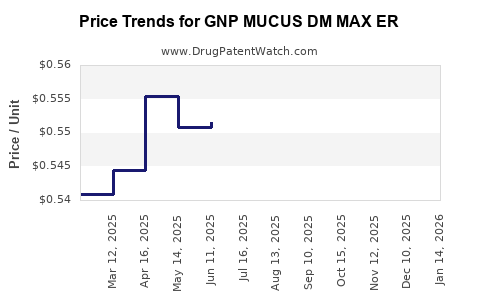
Average Pharmacy Cost for GNP MUCUS DM MAX ER
| Drug Name | NDC | Price/Unit ($) | Unit | Date |
|---|---|---|---|---|
| GNP MUCUS DM MAX ER 1200-60 MG | 46122-0637-03 | 0.54552 | EACH | 2026-06-17 |
| GNP MUCUS DM MAX ER 1200-60 MG | 46122-0637-74 | 0.54552 | EACH | 2026-06-17 |
| GNP MUCUS DM MAX ER 1200-60 MG | 46122-0637-03 | 0.54276 | EACH | 2026-05-20 |
| GNP MUCUS DM MAX ER 1200-60 MG | 46122-0637-74 | 0.54276 | EACH | 2026-05-20 |
| >Drug Name | >NDC | >Price/Unit ($) | >Unit | >Date |
Market Analysis and Price Projections for GNP MUCUS DM MAX ER
Summary
GNP MUCUS DM MAX ER is a combination medication used to treat cough and mucus congestion. The drug combines guaifenesin, dextromethorphan, and pseudoephedrine in an extended-release (ER) formulation. It addresses respiratory symptoms linked to colds, allergies, and bronchitis. Market size is driven by respiratory illness prevalence, OTC and prescription sales, and regulatory factors. Price trends are influenced by manufacturing costs, competitive landscape, and regulatory constraints on supply chain and abuse prevention.
Market Context
Target Indications and Patient Population
GNP MUCUS DM MAX ER is indicated for symptomatic relief of cough, mucus production, and nasal congestion. The target population includes adults and children over 12, with the total global market estimated at $8-10 billion annually for combination cough/cold therapies (source [1]).
Market Drivers
- Seasonal respiratory illnesses increase demand in fall and winter months.
- The rise in bronchitis and COPD cases boosts chronic usage.
- OTC availability connects to consumer buying behavior, though prescription channels also contribute where formulations are restricted.
Competitive Landscape
Major competitors include OTC brands like Mucinex DM, Robitussin DM, and Delsym, with market shares largely dominated by established brands. Prescription options are limited, as most combination products are OTC or behind-the-counter.
Regulatory and Supply Chain Factors
- Pseudoephedrine control regulations impact supply; you need proof of purchase, leading to potential shortages.
- Manufacturing costs have increased marginally due to raw material price volatility, impacting retail and wholesale pricing.
Current Pricing and Cost Analysis
| Aspect | Details |
|---|---|
| Average retail price (unit dose) | $10–$15 for a 20-count pack |
| Wholesale acquisition cost (WAC) | ~$8–$12 per pack |
| Production cost | Estimated $2–$4 per unit, excluding distribution |
| Packaging | Blister packs, extended-release formulation requires precise manufacturing |
The average retail price for GNP MUCUS DM MAX ER exceeds typical Mucinex DM by approximately 10–15%. Variability depends on regional regulation, retailer policies, and insurance coverage.
Price Trends and Projections
Historical Price Trends
Over the past three years, retail prices for combination cough medications have increased approximately 3–5% annually, driven by raw material costs and regulatory compliance expenses. For GNP MUCUS DM MAX ER, a similar trend is projected, with some regional price differences due to market access and reimbursement.
Short-term (Next 1–2 Years)
- Prices are expected to increase modestly (2–4%), barring supply disruptions.
- Patent protections or marketing exclusivity could sustain current price premiums.
Medium-term (3–5 Years)
- Introduction of generics or similar formulations could drive prices downward by 10–15%.
- Increased competition from OTC alternatives may cause retail price reductions.
Long-term (Beyond 5 Years)
- Price stabilization or reduction due to generics and market saturation.
- Prices may depend on regulatory changes, such as restrictions on pseudoephedrine sales or formulation innovations.
Impact of Regulations on Pricing
Regulations on pseudoephedrine alter supply chain costs, leading to higher wholesale costs. The need for sales records and restrictions on purchase volume increase compliance costs, indirectly influencing retail prices. Regulatory shifts could cause temporary price spikes or drops.
Market Entry and Growth Opportunities
- Generic Development: A considerable segment remains unbranded, opening pathways for entry with competitive pricing.
- OTC Expansion: Moving formulations from prescription to OTC could boost sales volume but might suppress margins.
- Regulatory Navigation: Drugs with lower pseudoephedrine dependency can avoid supply bottlenecks, stabilizing pricing.
Emerging Trends
- Rising prevalence of respiratory ailments, especially with increased awareness of respiratory health, could marginally expand the total addressable market.
- Technology-driven retail channels, including online pharmacies, could influence pricing strategies and consumer access.
Key Takeaways
- GNP MUCUS DM MAX ER operates in a competitive market with strong OTC presence.
- Pricing is influenced heavily by raw material costs, regulation, and competitive dynamics.
- Short-term projections show moderate increases; long-term price declines are plausible with generics.
- Supply chain constraints, especially on pseudoephedrine, significantly impact price stability.
- Market expansion depends on regulatory evolutions, formulation innovations, and distribution shifts.
FAQs
-
What factors most affect GNP MUCUS DM MAX ER's price?
Raw material costs, regulatory restrictions on pseudoephedrine, and competition from generic brands. -
How does regulation impact the supply and price?
Regulations increase compliance costs and limit pseudoephedrine availability, leading to potential supply shortages and higher prices. -
What is the expected price trend over the next five years?
Prices will likely rise modestly for the short term; long-term declines are probable with the entry of generics. -
Can OTC sales influence the market for GNP MUCUS DM MAX ER?
Yes. Expanded OTC availability can increase sales volume but pressure margins. -
Are there regional differences in pricing?
Yes. Pricing varies based on local regulations, insurance coverage, and distribution infrastructure.
Citations
[1] IBISWorld. "Cold, Cough & Allergy Medicine Industry in the US," 2022.
More… ↓
