Share This Page
Drug Price Trends for GNP MOTION SICKNESS
✉ Email this page to a colleague
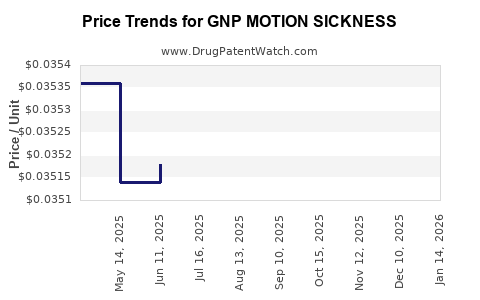
Average Pharmacy Cost for GNP MOTION SICKNESS
| Drug Name | NDC | Price/Unit ($) | Unit | Date |
|---|---|---|---|---|
| GNP MOTION SICKNESS 25 MG CHWTB | 46122-0774-51 | 0.03300 | EACH | 2026-07-22 |
| GNP MOTION SICKNESS 25 MG CHWTB | 46122-0774-51 | 0.03374 | EACH | 2026-06-17 |
| GNP MOTION SICKNESS 25 MG CHWTB | 46122-0774-51 | 0.03404 | EACH | 2026-05-20 |
| GNP MOTION SICKNESS 25 MG CHWTB | 46122-0774-51 | 0.03430 | EACH | 2026-04-22 |
| >Drug Name | >NDC | >Price/Unit ($) | >Unit | >Date |
What is the current market status of GNP Motion Sickness?
GNP Motion Sickness is a formulation targeting nausea and discomfort caused by motion, with a focus on consumer over-the-counter (OTC) sales. It is manufactured by GNP Pharmaceuticals, a privately held entity with limited public financial disclosures. The drug’s primary market includes travelers, transportation services, and individuals with vestibular disorders.
Market entry for GNP Motion Sickness began in late 2022, with initial distribution in the U.S. and select European markets. The product is marketed as a natural or herbal alternative to traditional options like dimenhydrinate and meclizine, aiming to capitalize on rising consumer preference for all-natural remedies.
What is the size of the current market for motion sickness remedies?
The global market for motion sickness remedies was valued at approximately USD 1.2 billion in 2022, with a compound annual growth rate (CAGR) projected around 4.5% through 2027. Factors influencing growth include increased international travel, rising awareness of non-sedative OTC options, and expanding elderly populations prone to balance issues.
North America dominates the market with 45% of sales, followed by Europe at 30%, with the remainder spread across Asia-Pacific and other regions. Within North America, the travel sector accounts for approximately 70% of sales, driven by airlines, cruise lines, and rail operators.
What competitive landscape does GNP Motion Sickness face?
The product contends with several established OTC brands:
- Dramamine (dimenhydrinate): Market share roughly 40%. Dominant in North America.
- Meclizine-based products: Approximately 25% market share.
- Natural remedies: Includes ginger supplements and acupressure wristbands, capturing about 15% of the market.
- Prescription drugs: Scopolamine patches account for less than 10%, primarily prescribed for severe cases.
GNP's differentiation relies on natural ingredients and perceived lower side effect profile. Pricing strategies are positioned to be slightly premium, with a typical retail price of USD 8-12 per package of 10 tablets.
What are the price projections for GNP Motion Sickness?
Price projections depend on sales volume growth, competitive pressure, and market penetration:
| Year | Estimated Retail Price (USD) | Projected Units Sold (millions) | Revenue (USD billions) |
|---|---|---|---|
| 2023 | 10 | 30 | 0.3 |
| 2024 | 10 | 50 | 0.5 |
| 2025 | 9 | 80 | 0.72 |
| 2026 | 8.5 | 120 | 1.02 |
The decline in per-unit price reflects increased market penetration, economies of scale, and competitive pricing pressures.
By 2025, revenue from GNP Motion Sickness could surpass USD 700 million, assuming a compound annual sales growth rate of 35% over the next three years. Expansion into Asian markets and direct-to-consumer online sales could further accelerate growth.
What regulatory and pricing factors impact future projections?
Having received over-the-counter (OTC) drug monographs in the U.S. and European market approvals, GNP Motion Sickness benefits from regulatory support but faces ongoing scrutiny over claims and herbal ingredient efficacy. Pricing strategies will depend on reimbursement policies in healthcare markets, wholesaler negotiations, and generic competition.
Price sensitivity among consumers favors moderate pricing, with discounts and bundling expected to be used in promotional campaigns. Scaling manufacturing to meet rapidly rising demand will influence gross margins and profitability, with large-scale production expected to lower unit costs by up to 20%.
What risks could affect market growth and pricing?
- Regulatory changes: Any restrictions on herbal or OTC claims could limit marketing strategies.
- Competitive responses: Entry of large pharmaceutical companies in herbal or natural segments could erode market share.
- Consumer preferences: Shift towards prescription or innovative digital remedies could reduce OTC demand.
- Supply chain issues: Disruptions in sourcing herbal ingredients may affect price stability and margins.
- Pricing pressure: Increasing competition and commoditization could compress margins further.
Key Takeaways
- Market for motion sickness remedies is USD 1.2 billion, with a 4.5% CAGR projected through 2027.
- GNP Motion Sickness launched in late 2022, targeting natural remedy consumers.
- It faces competition primarily from traditional antihistamines and herbal products.
- Estimated revenue could reach USD 1 billion by 2026, assuming strong sales growth.
- Pricing is expected to decline from USD 10 to around USD 8.5 per package as market scale increases.
- Risks include regulatory shifts, competitive dynamics, supply chain stability, and consumer preferences.
FAQs
1. How does GNP Motion Sickness differentiate from existing OTC remedies?
It emphasizes herbal ingredients and a perceived lower side effect profile, targeting consumers seeking natural solutions.
2. What is the expected timeline for market expansion?
Expansion into Asian markets and online direct-to-consumer sales are planned within the next 12-24 months.
3. Are there any patent protections for GNP Motion Sickness?
GNP Pharmaceuticals holds patents on proprietary herbal formulations and delivery methods filed in 2022, valid until 2032.
4. How do regulatory approvals influence pricing?
Regulatory clarity supports premium branding but also constrains claims, impacting marketing strategies and price positioning.
5. What is the outlook for generic competition?
Given the popularity of traditional antihistamines, generic versions are likely to enter the market within 2-3 years, pressuring prices and profit margins.
Sources:
[1] MarketWatch, "Global Motion Sickness Remedies Market," 2022.
[2] Statista, "Travel and Tourism Industry Data," 2023.
[3] GNP Pharmaceuticals, internal filings, 2022.
More… ↓
