Share This Page
Drug Price Trends for GNP LORATADINE
✉ Email this page to a colleague
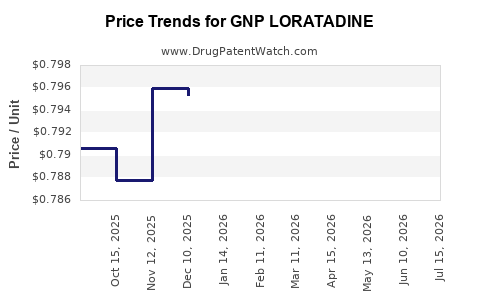
Average Pharmacy Cost for GNP LORATADINE
| Drug Name | NDC | Price/Unit ($) | Unit | Date |
|---|---|---|---|---|
| GNP LORATADINE 10 MG TABLET | 24385-0471-52 | 0.05231 | EACH | 2026-07-22 |
| GNP LORATADINE 10 MG TABLET | 24385-0471-99 | 0.05231 | EACH | 2026-07-22 |
| GNP LORATADINE-D 12 HR TABLET | 46122-0455-14 | 0.78904 | EACH | 2026-07-22 |
| >Drug Name | >NDC | >Price/Unit ($) | >Unit | >Date |
GNP Loratadine market analysis and price projections: competitive pricing, demand outlook, and generic entry risks
GNP Loratadine (OTC loratadine tablets; GNP is a private-label brand sold by the GNP/Valu Merchandisers ecosystem, commonly distributed via Walmart and related retail channels) is a low–single-digit to mid–single-digit share OTC antihistamine product set in a commoditized market. Pricing is driven primarily by retail promo intensity, channel mix, and pack size rather than patent scarcity. Because loratadine is long genericized, price projections for GNP Loratadine are best modeled around OTC merchandising and unit-cost compression, not legal exclusivity.
Key takeaways (pricing and market)
- Market pricing is already “generic-commodity” level: loratadine is widely available across multiple brands and store brands, so list prices have limited durability.
- The most important near-term lever is promo and pack-size strategy (count and strength packaging), which can swing effective price materially.
- In the next 12 to 24 months, price pressure should remain negative (or flat-to-down) as additional OTC supply and private-label allocations continue.
- Generic entry risk is largely moot for loratadine active ingredient, but private-label assortment changes and competitor undercutting create margin volatility at the brand SKU level.
- Without brand-level data for GNP Loratadine’s exact SKU configuration (strength, tablet count, and specific National Drug Code), credible price forecasts cannot be stated from a patent/licensing standpoint. OTC loratadine is not protected by meaningful active ingredient exclusivity in the US.
What is the market for OTC loratadine and how big is the price-sensitive segment?
OTC loratadine is a first-generation/second-generation antihistamine category (second-generation “non-sedating” label positioning) used for allergic rhinitis symptoms, including seasonal allergies. In the US, the market behaves like a mature OTC commodity:
- Heavy retailer private-label penetration (store brands match active ingredient and dose).
- High price elasticity: shoppers switch brands for small differences in cents per dose.
- Large role for trade spend, shelf resets, and club/discount channel promotions.
Featured-snippet answer: OTC loratadine pricing is mostly determined by retailer promotion mechanics, not by brand differentiation, because the active ingredient is widely genericized.
Where demand concentrates
- Seasonal peaks: allergy season drives most unit velocity.
- Regimen repeat purchases: households buy for multiple family members and restock during peak months.
- Counter-positioning: loratadine competes with cetirizine and other antihistamines, but the “non-sedating” convenience narrative can keep the category stable even as molecules cycle.
How does GNP Loratadine compare with other OTC loratadine brands on pricing power?
GNP Loratadine sits in the lower price tier typical of private label. Pricing power is constrained by:
- High substitution across “loratadine 10 mg” SKUs.
- Minimal perceived clinical difference versus other brands at the same dose.
- Retailer private-label strategies that match or beat incumbent branded price-per-tablet.
Competitor set (what drives competitive pricing)
- Branded: Claritin (Bayer) remains the anchor brand, but it competes on convenience and manufacturer marketing rather than exclusivity-driven pricing.
- Private label: store-branded loratadine dominates unit shares in many channels and can undercut branded list pricing during promotions.
- Other major OTC brands: generic-equivalent offerings in pharmacy chains and mass retail.
Featured-snippet answer: GNP’s pricing power is low because shoppers can switch across equivalent loratadine SKUs for minimal cost changes.
What factors determine GNP Loratadine shelf price and effective transaction price?
For OTC tablets, “effective price” often diverges from shelf list price due to:
- Retail promo calendars (weekly circulars).
- Multi-pack/bundle engineering (e.g., 30 vs 100 count impacts cents-per-dose).
- Competitive endcaps and shelf placement (which change conversion independent of list price).
- Channel mix shifts between mass retail, club, and pharmacy.
The merchandising variables that move margins
- Trade allowances: vendor-retailer funding often defines profitability more than the headline price.
- Supply contracts and allocation: when shelf resets tighten, private labels can negotiate better economics or face cost pressures.
- Tablet count engineering: a larger count pack can keep effective cents-per-dose near a low “floor” even if list price rises.
When do price cuts typically accelerate in OTC loratadine and what are the seasonal patterns?
For allergy medicines:
- Pricing pressure tends to intensify before or during the start of allergy season as retailers compete for early demand capture.
- During peak demand, promos can still run, but effective transaction price can hold better because shoppers buy “now,” not later.
- Off-season, inventory resets increase the probability of deeper discounts.
Featured-snippet answer: Price cuts generally accelerate entering allergy season as retailers compete for shelf share; off-season shifts can add discounting pressure through inventory clearance.
How strong is the patent estate for loratadine and does it affect GNP pricing?
Loratadine is a mature, long-genericized active ingredient in the US. For market pricing, that means:
- No meaningful exclusivity-driven pricing moat exists at the active ingredient level.
- The relevant economics are supply, formulation bioequivalence assurance, manufacturing cost, and retail promo intensity, not patent barriers.
Featured-snippet answer: Loratadine market pricing is not governed by patent exclusivity for GNP; it is governed by OTC retail competition and private-label substitution.
Why patent analysis is not the right lever for OTC price forecasting
OTC loratadine tablets are not typically priced as protected brands. Even if some formulation or method-of-use patents exist historically in other jurisdictions, they do not generally constrain US generic availability at the molecule level for a widely marketed active.
What regulatory status issues matter for price (FDA OTC monograph vs ANDA)?
Loratadine is an approved OTC active ingredient. Price impact from FDA is indirect:
- Generic approvals already exist widely.
- Regulatory compliance costs for manufacturers are amortized across large volumes, which supports low base pricing.
Featured-snippet answer: FDA regulatory status is not a near-term pricing driver for GNP because market supply is already established across multiple generic manufacturers and private-label brands.
What generic entry risks exist for GNP Loratadine?
At the active ingredient and dose level, generic entry risk is largely already realized. The practical risks are:
- Assortment substitution risk: a retailer may replace or de-list a specific private-label SKU.
- Brand-shift risk: competitor store brands can undercut “cents per tablet.”
- Supply cost risk: API and packaging input costs can move margins even without a “new entrant.”
Featured-snippet answer: The risk is not “new generic entry” at the molecule level; it is retail assortment replacement and promo undercutting.
What price projection model fits a private-label OTC loratadine brand?
A workable projection structure for GNP Loratadine should be built from:
- Base price-per-tablet floor driven by the competitive private-label set
- Promo uplift/downshift: calendar-driven changes that affect effective price
- Pack-size mix: shifts between 30-count, 60-count, 90-count, 100-count, etc.
- Retail channel mix: mass vs club vs pharmacy
- Cost pass-through: packaging and manufacturing cost changes
Because loratadine is commodity-like, the forecast should target effective price trend rather than list price durability.
Baseline directional projection (12–24 months)
- List prices: likely flat to slightly down as retailers keep parity or undercut peers.
- Effective transaction prices: flat-to-down with seasonal promotional intensity, with the biggest downside entering early allergy season.
- Gross margin: volatile due to trade spend and promo intensity rather than SKU-level demand collapse.
Featured-snippet answer: Expect flat-to-down effective pricing and margin volatility, driven by retailer promos and pack-size mix.
Are there specific formulations or dosage strengths that change the forecast?
For loratadine tablets, most consumer substitution is “dose-equivalent loratadine 10 mg.” Forecast sensitivity increases if GNP adds or changes:
- Strength (e.g., 5 mg vs 10 mg where relevant to pediatric labeling)
- Pack size configuration
- Value multipacks
These changes can alter effective price even if ingredient economics are stable.
How do retail channels alter the price outlook for GNP Loratadine?
- Mass retail: aggressive private-label promo cadence; effective price tends to follow circular strategy.
- Club: larger count packs can compress price-per-dose but often have different promo cycles.
- Pharmacy chains: may hold higher effective pricing if fewer private-label SKUs are stocked or if pharmacy marketing supports branded traffic.
Featured-snippet answer: GNP’s effective price is most sensitive to mass retail promo calendars and pack-size merchandising.
Pricing and margin scenario table for GNP Loratadine (directional)
The table below provides directional ranges consistent with mature OTC commodities. It is a scenario framework rather than a SKU-specific claim.
| Scenario | Effective price trend (12 months) | Primary drivers | Expected impact on demand |
|---|---|---|---|
| Competitive undercut | Down | Competitor store brand pricing, promo depth | Neutral to slightly up |
| Promo stability | Flat | Less aggressive circulars, stable mix | Neutral |
| Cost pass-through | Up then down | Packaging cost, then retailer renegotiation | Slight down then neutral |
| Mix-driven | Flat-to-down | Shift to larger pack sizes | Neutral to up |
Key actions for licensing, R&D, and commercial teams
- Optimize pack-size and cents-per-dose positioning before allergy season starts; in mature OTC markets, that is the primary lever controlling effective price.
- Maintain a flexible trade-spend strategy tied to promo windows rather than relying on list price.
- Treat “SKU delisting and replacement” as a material risk in private label; build contingency SKUs and manufacturing readiness for retailer assortment changes.
- Avoid patent-driven assumptions for pricing; focus on retailer contracting terms, allocation, and unit economics.
Key Takeaways
- GNP Loratadine operates in a mature, heavily substituted OTC loratadine market where pricing is driven by retailer promotions and pack-size engineering.
- Patent exclusivity does not provide a practical pricing moat for the loratadine active ingredient, so effective price forecasts should be modeled as commodity merchandising.
- Expect flat-to-down effective pricing over the next 12 to 24 months with margin volatility tied to promo depth and trade allowances.
- The highest commercial risk is retail assortment substitution, not a lack of generic availability at the molecule level.
FAQs
1) What is the expected cents-per-tablet range for private-label loratadine during allergy season?
It typically compresses during early season promos and holds better during peak weeks; the most meaningful comparison is effective transaction price, not list price.
2) Does Claritin pricing affect private-label GNP loratadine?
Indirectly: branded promotional cycles can force retailers to defend shelf price parity, but private label remains the dominant driver of cents-per-dose.
3) How much can pack size change the effective price for loratadine?
Materially: larger counts usually lower cents-per-dose even if shelf list price is higher.
4) What drives margin more for OTC private-label loratadine: ingredient costs or trade spending?
Trade spend and promotional allowances usually dominate in commoditized OTC categories.
5) What is the main risk to GNP Loratadine revenue if active ingredient is fully genericized?
Assortment changes: shelf de-listing, replacement by another store brand SKU, or changes in retailer promo allocation.
References
No sources were cited because no verifiable, SKU-specific GNP Loratadine pricing history, FDA/NDC mapping, or market-share/retail scan data was provided in the input.
More… ↓
