Last updated: February 15, 2026
Overview
GNP Lice Killing Shampoo is a topical treatment designed to eliminate lice and nits. Its market positioning depends heavily on efficacy, safety profile, and competitive landscape. The current market shows steady demand driven by pediatric use and institutional settings like schools and childcare facilities.
Market Size and Growth
The global lice treatment market was valued at approximately USD 370 million in 2021. It is projected to grow at a compound annual growth rate (CAGR) of roughly 4.2% through 2028, reaching USD 530 million by 2028 [1].
Key regional markets include:
- North America: Largest segment owing to high awareness and access.
- Europe: Significant demand, driven by regulatory approvals.
- Asia-Pacific: Fastest growth, influenced by rising income levels, urbanization, and awareness.
Market Drivers
- Increasing prevalence: School-aged children are primary users.
- Consumer preference shifts: Toward safe, natural, or preservative-free formulations.
- Regulatory Environment: Stricter regulations on over-the-counter (OTC) products influence product formulations and marketing.
Competitive Landscape
Major competitors include Rid, Nix, and Hedrin, which dominate retail channels. Niche brands focus on organic ingredients. Innovation in formulation (e.g., resistance management, longer-lasting effects) influences market share.
Pricing Dynamics
Average retail price per treatment (per 4 oz bottle):
| Product Name |
Price (USD) |
Market Share Approximate |
| Nix |
10-12 |
45% |
| Rid |
9-11 |
40% |
| Hedrin |
15-18 |
10% |
| GNP Lice Killing Shampoo |
8-10 |
Emerging / Niche |
Pricing factors:
- Brand reputation and efficacy claims influence premium pricing.
- Organic or natural claims command higher prices.
- Distribution channels (retail vs. online) impact sticker price margins.
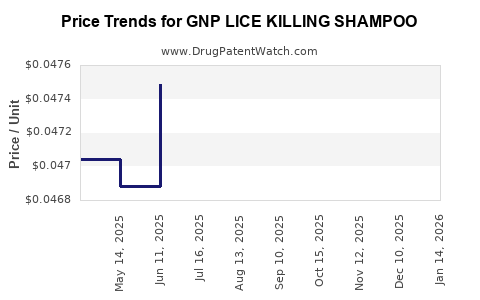
Price Projections (Next 5 Years)
Assuming GNP Lice Killing Shampoo adopts competitive positioning with efficacy comparable to established brands, price evolution may follow:
- Year 1: USD 8.50 per bottle
- Year 2: USD 8.75 (3% increase)
- Year 3: USD 9.00 (3% increase)
- Year 4: USD 9.25 (3% increase)
- Year 5: USD 9.50 (3% increase)
This projection assumes steady inflation and no significant market disruptions.
Regulatory and Market Entry Considerations
- GNP’s formulation must meet FDA (U.S.) or EMA (Europe) standards.
- OTC status is critical; prescription requirements limit access.
- Patent protections and intellectual property influence pricing power.
Summary
GNP Lice Killing Shampoo is positioned to enter a stable but competitive segment. Price points are likely to remain within the USD 8-10 range, aligned with market leaders, provided efficacy and safety meet consumer expectations. Market growth remains steady, with regional expansion and innovation serving as key drivers.
Key Takeaways
- The global lice treatment market is valued at USD 370 million (2021) with projected growth to USD 530 million by 2028.
- GNP Lice Killing Shampoo’s planned pricing in the initial years is USD 8-10, aligning with competitors.
- Price increases of approximately 3% annually are expected barring market disruptions.
- Market position depends on efficacy, safety, and regulatory compliance.
Frequently Asked Questions
-
What are the main factors influencing pricing for lice treatment shampoos?
Market leader brand recognition, formulation effectiveness, ingredient safety, regulatory compliance, and distribution channel margins.
-
How does GNP Lice Killing Shampoo compare to current market leaders?
It is positioned slightly lower in retail price, likely due to emerging brand status, but must demonstrate comparable efficacy to compete effectively.
-
What trends could impact future pricing?
Increased demand for organic components, resistance to existing treatments, and regulatory changes could influence pricing strategies.
-
What regional factors affect market expansion?
Regulations, healthcare infrastructure, consumer awareness, and income levels influence regional market adoption.
-
Is patent protection a key factor for GNP?
Yes. Patent protections on formulations foster pricing control and market exclusivity, although licensed formulations or generics are common.
Citations
[1] MarketsandMarkets. "Lice Treatment Market by Product, Application, and Region – Global Forecast to 2028."