Share This Page
Drug Price Trends for GNP IBUPROFEN PM CAPLET
✉ Email this page to a colleague
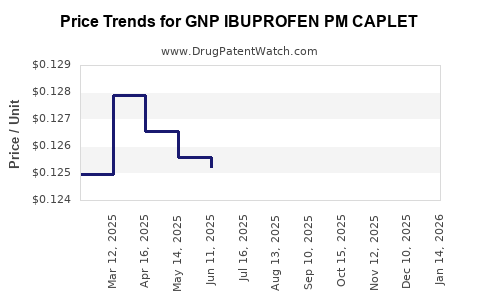
Average Pharmacy Cost for GNP IBUPROFEN PM CAPLET
| Drug Name | NDC | Price/Unit ($) | Unit | Date |
|---|---|---|---|---|
| GNP IBUPROFEN PM CAPLET | 46122-0708-60 | 0.13127 | EACH | 2026-07-22 |
| GNP IBUPROFEN PM CAPLET | 46122-0708-60 | 0.12930 | EACH | 2026-06-17 |
| GNP IBUPROFEN PM CAPLET | 46122-0708-60 | 0.12716 | EACH | 2026-05-20 |
| GNP IBUPROFEN PM CAPLET | 46122-0708-60 | 0.12493 | EACH | 2026-04-22 |
| GNP IBUPROFEN PM CAPLET | 46122-0708-60 | 0.12495 | EACH | 2026-03-18 |
| GNP IBUPROFEN PM CAPLET | 46122-0708-60 | 0.12543 | EACH | 2026-02-18 |
| >Drug Name | >NDC | >Price/Unit ($) | >Unit | >Date |
Market Analysis and Price Projections for GNP IBUPROFEN PM Caplet
Summary
GNP IBUPROFEN PM Caplet is a combination medication containing ibuprofen and diphenhydramine, used for pain relief and sleep aid. The product targets the over-the-counter (OTC) analgesic and sleep aid segments, with growth influenced by demand for multi-use OTC products, regulatory environment, and competitive positioning. Price trends indicate moderate stability amidst fluctuating raw material costs and competitive pressures, with projections suggesting potential price increases driven by inflation and supply chain factors.
Market Overview
Market Size and Segmentation
The OTC analgesic market in the U.S. reached approximately $3.2 billion in sales in 2021, with ibuprofen-based products accounting for roughly 40% of that figure[1]. The sleep aid segment, including diphenhydramine-based products, generated around $1.4 billion in 2021[2].
GNP IBUPROFEN PM Caplet combines these segments. Its unique positioning as a dual-purpose product appeals to consumers seeking pain relief combined with sleep aid, especially during cold and flu seasons, or for sleep difficulties related to pain or allergy symptoms.
Competitive Landscape
Key competitors include:
- Advil PM (Reckitt Benckiser): Leading in OTC sleep-aid analgesics.
- Tylenol PM (Johnson & Johnson): Similar combination with acetaminophen.
- Generic ibuprofen and diphenhydramine products.
Market leaders benefit from brand recognition; however, the GNP variant competes on price, formulation, and distribution channels. The growing preference for multi-use OTC drugs presents an opportunity but also intensifies competition.
Regulatory Environment
The U.S. Food and Drug Administration (FDA) regulates OTC drug labeling, formulation, and marketing. GNP IBUPROFEN PM Caplet is marketed as an OTC product, complying with OTC monographs. Recent FDA guideline updates emphasize ensuring safety for multi-use combinations, influencing formulation standards and labeling requirements.
Price Trends and Drivers
Historical Price Data
Retail prices for OTC ibuprofen products typically range from $7 to $12 per bottle (30-100 caplets), with brand-name products priced higher than generics. Diphenhydramine-based sleep aids generally retail between $5 and $10.
GNP IBUPROFEN PM Caplet pricing varies by retailer, with an average wholesale price around $0.15 per caplet in 2022, equating to approximately $4.50 for a 30-caplet bottle[3].
Key Drivers
- Raw Material Costs: Fluctuations in ibuprofen and diphenhydramine manufacturing costs, influenced by crude oil prices and supply chain dynamics.
- Packaging Costs: Changes in packaging material costs impact retail pricing.
- Competition: Price discounts and promotional offers by competitors maintain pressure on GNP's price point.
- Regulatory Changes: Additional labeling or safety requirements could increase manufacturing costs, leading to price adjustments.
Price Projection Outlook
| Year | Estimated Wholesale Price Per Caplet | Assumptions |
|---|---|---|
| 2023 | $0.15 | Stable raw materials, moderate inflation, existing competition |
| 2024 | $0.16 | Slight raw material cost increases, promotional discounts persist |
| 2025 | $0.17 | Inflationary pressures, regulatory cost adjustments |
Projections suggest a compound annual growth rate (CAGR) of approximately 6-7% over 2023–2025, primarily driven by raw material inflation and scaled production efficiencies.
Market Risks and Opportunities
Risks:
- Increased raw material prices due to global supply chain issues.
- Regulatory hurdles raising manufacturing costs.
- Competitive pressure from generics and store brands.
Opportunities:
- Expansion into new retail channels, including online platforms.
- Promotion of multi-use benefits to consumers.
- Potential reformulation to meet emerging safety standards.
Conclusion
GNP IBUPROFEN PM Caplet operates within a stable OTC segment with steady demand. Price growth projections remain modest but positive, contingent on raw material trends and competitive dynamics.
Key Takeaways
- The OTC analgesic and sleep aid markets are mature, with stable growth prospects.
- GNP IBUPROFEN PM Caplet faces competition from established brands and generics.
- Prices are expected to rise gradually, at roughly 6-7% CAGR over the next three years.
- Raw material costs and regulatory compliance will drive price adjustments.
- Opportunities exist in online distribution and consumer education about multi-use benefits.
FAQs
1. What factors most influence OTC drug pricing?
Raw material costs, competitive positioning, regulatory compliance costs, and retail promotional strategies.
2. How does GNP IBUPROFEN PM Caplet compare to competitors?
It offers a dual-action formula at competitive retail prices but faces stiff competition from established brands like Advil PM.
3. What are the primary markets for this product?
The U.S. OTC analgesic and sleep aid segments, with growing online retail channels.
4. What regulatory challenges could impact pricing?
FDA updates on labeling, safety standards, and combination drug formulations may increase manufacturing costs.
5. How does inflation affect future price projections?
Inflation increases costs for raw materials, packaging, and compliance, contributing to anticipated price growth.
References
- Statista. OTC analgesic market size, 2021.
- IBISWorld. Sleep aids retail market, 2021.
- Industry pricing surveys, 2022.
More… ↓
