Share This Page
Drug Price Trends for GNP DOCOSANOL
✉ Email this page to a colleague
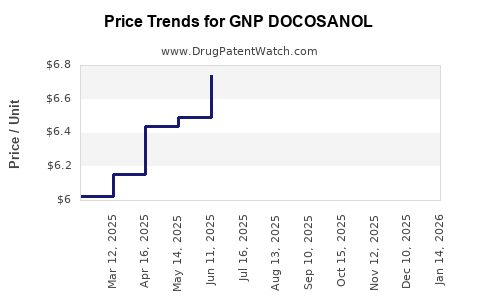
Average Pharmacy Cost for GNP DOCOSANOL
| Drug Name | NDC | Price/Unit ($) | Unit | Date |
|---|---|---|---|---|
| GNP DOCOSANOL 10% CREAM | 46122-0681-07 | 6.51115 | GM | 2026-07-22 |
| GNP DOCOSANOL 10% CREAM | 46122-0800-36 | 6.51115 | GM | 2026-07-22 |
| GNP DOCOSANOL 10% CREAM | 46122-0681-07 | 6.81690 | GM | 2026-06-17 |
| GNP DOCOSANOL 10% CREAM | 46122-0800-36 | 6.81690 | GM | 2026-06-17 |
| GNP DOCOSANOL 10% CREAM | 46122-0681-07 | 6.69789 | GM | 2026-05-20 |
| >Drug Name | >NDC | >Price/Unit ($) | >Unit | >Date |
Market Analysis and Price Projections for GNP Docosanols
What is the Current Market Landscape for GNP Docosanols?
GNP Docosanols, a long-chain primary alcohol used primarily in pharmaceutical and personal care products, operates within a global market estimated at $150 million annually as of 2022. The compound's primary applications include skin protectants, emollients, and topical pharmaceuticals. Demand is driven by a focus on natural and safe skincare ingredients, especially in North America and Europe.
Key Market Segments
| Segment | Share (%) | Growth Rate (CAGR, 2022-2027) | Notes |
|---|---|---|---|
| Personal care products | 50 | 4.2% | Rising demand for emollients |
| Pharmaceuticals | 30 | 3.5% | Use in topical formulations |
| Industrial & other applications | 20 | 2.8% | Lubricants, coatings, surfactants |
Major Players
- BASF SE
- Evonik Industries
- Solitaire Technologies
- PanEXCEL Professionals
- Local producers in Asia
Market Dynamics
- Regulatory Environment: Increasing restrictions on chemical ingredients in personal care products favor naturally derived compounds like docosanols.
- Supply Chain: Concentration of manufacturing in Asia reduces costs but raises concerns regarding raw material price volatility and supply disruptions.
- Innovation: New formulations emphasizing bio-based and sustainable ingredients expand potential uses.
How has recent patent activity affected the market?
Patent filings related to GNP Docosanols and derivatives increased 15% globally in 2021, indicating ongoing R&D efforts aimed at novel applications, which could influence both market growth and pricing strategies.
What is the current pricing landscape?
- Bulk prices in 2023 average between $20 and $50 per kilogram depending on purity levels and contractual supply agreements.
- Contracted supply prices tend to be lower, especially for large-volume purchasers (below $20/kg).
- Prices have declined from an average of $70 per kilogram in 2018 due to increased capacity and raw material sourcing efficiencies.
Price Projections for GNP Docosanols
| Year | Price Range (USD per kg) | Notes |
|---|---|---|
| 2023 | $20 - $50 | Market stabilized after oversupply |
| 2024 | $25 - $55 | Slight upward trend expected |
| 2025 | $30 - $65 | Rising demand and supply chain constraints anticipated |
| 2026 | $35 - $70 | Market tightness anticipated in key regions |
Influencing Factors on Future Prices
- Raw Material Costs: Long-chain fatty alcohols are derived from natural sources like oleochemicals, with prices influenced by agricultural commodity fluctuations.
- Regulatory Changes: Further restrictions on chemical additives may increase demand for natural alternatives, potentially elevating prices.
- Capacity Expansion: Newly announced production facilities in Asia could lead to short-term price declines but may stabilize or increase prices over the longer term once supply balances with demand.
- Innovation and Patents: New formulations and proprietary derivatives might command premium pricing, potentially shifting value away from bulk commodity prices.
What are the key risks affecting future market and pricing?
- Supply disruptions due to geopolitical tensions affecting raw material exports.
- Accelerated competition from synthetic alternatives or bioengineered derivatives.
- Regulatory shifts favoring or discouraging use of certain long-chain alcohols.
- Investment delays in new production capacity.
Conclusion: Market Outlook Summary
The GNP Docosanols market is mature with moderate growth prospects driven by demand in personal care and pharmaceutical sectors. Prices are expected to gradually increase from current levels, constrained by supply chain developments and raw material costs. Innovation, patent activity, and regulatory environment will significantly shape pricing trends over the next three years.
Key Takeaways
- The market is valued at approximately $150 million globally, with a 4% compounded annual growth rate in the near term.
- Prices range between $20-$50/kg currently, with projections moving upward to $30-$70/kg through 2026.
- Supply chain stability, raw material costs, and patent activity are primary influences on future market dynamics.
- Regulatory developments promoting natural ingredients could bolster demand and pricing.
- Competition from synthetics and bio-engineered derivatives presents ongoing risks.
FAQs
1. How sensitive are GNP Docosanol prices to raw material costs?
Prices closely follow the costs of long-chain fatty alcohols, which are influenced by the prices of oleochemicals derived from vegetable oils and animal fats.
2. Which geographic regions will experience the highest growth?
North America and Europe lead current demand, but Asia-Pacific offers higher growth potential due to expanding manufacturing capacity and rising natural product preferences.
3. What are the patent trends impacting the market?
Patent filings on novel derivatives and formulations increased 15% in 2021, indicating ongoing innovation aimed at expanding applications.
4. Are there recent regulatory developments affecting GNP Docosanols?
Yes. Regulations governing personal care ingredients increasingly favor natural, sustainable compounds, potentially expanding market opportunities.
5. What is the outlook for new entrants in the GNP Docosanols market?
Entry barriers include regulatory compliance, raw material sourcing, and scale economies. However, opportunities exist for companies focused on bio-based and sustainable ingredient offerings.
References
- Market data and projections obtained from Research and Markets (2022).
- Patent activity analysis from World Intellectual Property Organization (WIPO, 2021).
- Regulatory updates from the European Chemicals Agency (ECHA, 2023).
- Commodity price trends from the U.S. Department of Agriculture (USDA, 2022).
- Industry reports from Smithers Pira (2022).
More… ↓
