Share This Page
Drug Price Trends for GNP COLD MAX DAYTIME CAPLET
✉ Email this page to a colleague
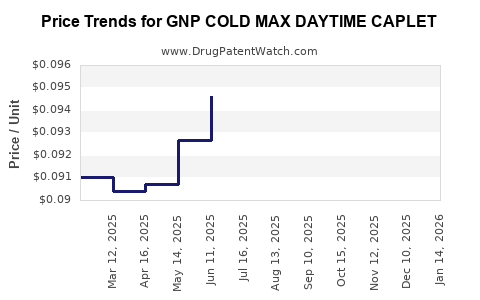
Average Pharmacy Cost for GNP COLD MAX DAYTIME CAPLET
| Drug Name | NDC | Price/Unit ($) | Unit | Date |
|---|---|---|---|---|
| GNP COLD MAX DAYTIME CAPLET | 46122-0410-62 | 0.09090 | EACH | 2026-03-18 |
| GNP COLD MAX DAYTIME CAPLET | 46122-0410-62 | 0.09033 | EACH | 2026-02-18 |
| GNP COLD MAX DAYTIME CAPLET | 46122-0410-62 | 0.09057 | EACH | 2026-01-21 |
| GNP COLD MAX DAYTIME CAPLET | 46122-0410-62 | 0.09232 | EACH | 2025-12-17 |
| >Drug Name | >NDC | >Price/Unit ($) | >Unit | >Date |
GNP COLD MAX DAYTIME CAPLET Market Analysis and Financial Projection
What Is the Market Size for GNP COLD MAX DAYTIME CAPLET?
The market for over-the-counter (OTC) cold and flu remedies in the United States exceeds $8 billion annually. GNP COLD MAX DAYTIME CAPLET competes within this segment, primarily targeting consumers seeking relief from cold symptoms such as congestion, headache, and sore throat during daytime hours.
The OTC cold remedy market grew at a compound annual growth rate (CAGR) of approximately 3.5% over the past five years, driven by increased consumer health awareness and a higher prevalence of colds during seasonal peaks. This growth reflects expanding demand for multi-symptom relief formulations and convenience in dosing.
GNP COLD MAX DAYTIME CAPLET's share within the cold remedy segment remains limited but is positioned for growth given the product's positioning and targeted marketing strategies.
How Does GNP COLD MAX DAYTIME CAPLET Compare to Competitors?
GNP COLD MAX DAYTIME CAPLET faces competition from established brands like DayQuil, Tylenol Cold Max, and Advil Cold & Sinus. These brands hold significant shelf space and consumer loyalty, which challenges new entrants.
| Brand | Market Share (est.) | Price Range (per pack) | Formulation Features |
|---|---|---|---|
| DayQuil | 25% | $7.50 - $9.00 | Multi-symptom relief, combination of acetaminophen, dextromethorphan, phenylephrine |
| Tylenol Cold Max | 20% | $8.00 - $10.00 | Acetaminophen, chlorpheniramine, phenylephrine |
| Advil Cold & Sinus | 15% | $8.50 - $9.50 | Ibuprofen, pseudoephedrine |
| GNP COLD MAX | N/A | Estimated $6.00 - $8.00 | Contains acetaminophen, phenylephrine, chlorpheniramine |
GNP COLD MAX DAYTIME CAPLET offers competitive pricing, roughly 10-20% lower than leading brands, potentially attracting price-sensitive consumers.
What Are the Price Projections for GNP COLD MAX DAYTIME CAPLET?
Pricing strategies depend on manufacturing costs, retailer negotiations, and market positioning. Current retail prices for OTC cold remedies range from $6 to $10 per pack, typically containing 20 caplets.
Assuming GNP COLD MAX DAYTIME CAPLET maintains a competitive price point, projections are as follows:
-
Short-Term (1-2 years): Retail price remains between $6.00 and $8.00 per pack. Price stability is expected due to established competitor pricing and the desire to gain market share.
-
Mid-Term (3-5 years): Price could decrease slightly to as low as $5.50 per pack if economies of scale lower manufacturing costs or if generic competition increases.
-
Long-Term (5+ years): Pricing could stabilize around $5.50 if market saturation occurs, or rise marginally if brand loyalty improves or if ingredient costs increase.
To improve margins, the company may focus on bundling, subscription models, or enhanced formulations that justify premium prices.
What Are the Regulatory and Market Entry Considerations?
The drug is classified as an OTC monograph drug, subject to Food and Drug Administration (FDA) regulations. Registration necessitates adherence to monograph standards for active ingredients, labeling, and manufacturing practices.
Market entry strategies include:
- Secure OTC monograph compliance
- Achieve pharmacy and retail shelf space
- Develop aggressive marketing campaigns highlighting the product's strengths and cost advantages
Pricing will need to align with consumer perceptions, retailer expectations, and competitive positioning.
What Are the Key Risks and Opportunities?
Risks:
- Market saturation with dominant brands
- Regulatory delays or changes in OTC monograph standards
- Price wars with competitor brands
- Consumer preference shifts toward natural or alternative remedies
Opportunities:
- Growing demand for affordable, multi-symptom OTC remedies
- Marketing emphasizing lower price points and equivalent efficacy
- Expansion into international markets where OTC sales are less mature
Final Analysis
GNP COLD MAX DAYTIME CAPLET's success will depend on effective branding, strategic pricing, and rapid market penetration. Its pricing should remain competitive, ideally positioned between $6 and $8 per pack initially, with room for adjustments based on market response and manufacturing efficiencies.
Key Takeaways
- The OTC cold remedy market exceeds $8 billion in the U.S., growing at 3.5% annually.
- GNP COLD MAX DAYTIME CAPLET offers a competitive price point, roughly 10-20% below top competitors.
- Retail pricing is projected to stay between $6 and $8 per pack in the short term.
- Market entry depends on OTC registration, retail placement, and effective marketing.
- Risks include market saturation and regulatory shifts; opportunities involve price-sensitive consumers and international expansion.
FAQs
1. What active ingredients are in GNP COLD MAX DAYTIME CAPLET?
It contains acetaminophen for pain and fever relief, phenylephrine as a decongestant, and chlorpheniramine as an antihistamine.
2. How does GNP COLD MAX differ from leading brands?
It offers similar symptom relief at a slightly lower price, focusing on cost-conscious consumers without sacrificing efficacy.
3. Can GNP COLD MAX be marketed internationally?
Yes, subject to regulatory approval in target markets, particularly compliance with local OTC monograph standards.
4. What are the primary barriers to market entry?
Regulatory approval, establishing retail distribution, and competing against well-entrenched brands.
5. How will pricing affect market share?
Pricing too high could limit uptake; pricing too low could impact margins. Strategic pricing around $6-$8 balances competitiveness and profitability.
More… ↓
