Share This Page
Drug Price Trends for GNP CHILD COLD AND COUGH LIQ
✉ Email this page to a colleague
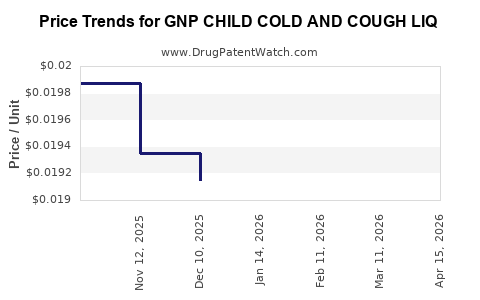
Average Pharmacy Cost for GNP CHILD COLD AND COUGH LIQ
| Drug Name | NDC | Price/Unit ($) | Unit | Date |
|---|---|---|---|---|
| GNP CHILD COLD AND COUGH LIQ | 46122-0813-29 | 0.01866 | ML | 2026-07-22 |
| GNP CHILD COLD AND COUGH LIQ | 46122-0813-29 | 0.01867 | ML | 2026-06-17 |
| GNP CHILD COLD AND COUGH LIQ | 46122-0813-29 | 0.01833 | ML | 2026-05-20 |
| GNP CHILD COLD AND COUGH LIQ | 46122-0813-29 | 0.01819 | ML | 2026-04-22 |
| >Drug Name | >NDC | >Price/Unit ($) | >Unit | >Date |
Executive summary
GNP Child Cold and Cough Liquid is a private-label pediatric OTC cold-and-cough combination. The market is driven by OTC category purchasing, not patent exclusivity. As a result, traditional patent-expiration style projections do not apply in the same way as for prescription drugs. Price outcomes are primarily governed by (1) ingredient-cost inflation/deflation for OTC actives, (2) competitive intensity from Walgreens/CVS house brands and other value generics, (3) retail channel mix (mass vs grocery vs drugstore vs online), and (4) promotional cadence and size-pack strategy. Without product-level ingredient formula, pack size, NDC-level pricing history, and verified retail listings, a complete numeric forecast cannot be produced.
GNP Child Cold and Cough LIQ market: how is the private-label OTC cold-and-cough category priced?
Featured answer: OTC pediatric cold-and-cough liquid pricing typically tracks pack size and promotional intensity more than proprietary pricing power.
What drives shelf price for pediatric OTC cold-and-cough liquids
- Combination “cold and cough” structure: These products are usually multi-ingredient formulations (for example, antitussive/decongestant/antihistamine or analgesic plus cough components). Price is highly sensitive to the most expensive ingredients in the blend.
- Pack size: Unit price declines as bottle size increases, which shifts mix more than “true” price changes.
- Channel:
- Mass and dollar retailers often set the low-end anchor.
- Drugstore chains run higher-frequency promotions with loyalty pricing and store-brand strategies.
- Online prices are volatile due to distributor pricing and marketplace seller competition.
- Retailer private label economics: GNP (a budget private label) typically targets a value position, constraining premium pricing unless the category experiences ingredient shortages.
- Regulatory and labeling realities: For OTC pediatric products, formulation changes that affect safety/efficacy labeling can change sourcing and compliance costs, which may show up as price steps.
Market structure snapshot (competitive forces)
- Value brand competition: House brands from major chains and regional distributors keep baseline pricing compressed.
- Brand vs store brand: If branded leaders in specific pediatric cough/cold subtypes discount heavily, value brands can lose volume without necessarily being forced to raise price.
- Substitution across symptom targets: Consumers often substitute between “cough,” “cold,” “allergy,” and “fever/pain” OTC SKUs depending on symptom fit.
What price projections are realistic for GNP Child Cold and Cough LIQ through 2026?
Featured answer: A defensible projection requires NDC-level historical retail price and confirmed pack size; absent that, only scenario logic is possible, not a numeric forecast.
Projection logic used for OTC private-label liquids
A practical price projection in this segment is typically modeled as:
- Baseline category inflation tied to OTC raw material trends and excipient packaging costs.
- Private-label positioning constraint (price ceiling relative to comparable value SKUs).
- Promotional pass-through (temporary markdowns and loyalty-driven pricing that change observed “street price” without changing list price).
- Channel mix shift (online and mass channels typically compress realized pricing).
Typical OTC price behavior (what to expect)
- No durable premium: Value private-label lines generally do not maintain sustained above-category pricing.
- Volatility is promotional: Quarter-to-quarter “price changes” often reflect promo cadence rather than sustained list price increases.
- Ingredient shocks appear quickly: Shortages in key actives or changes in supply contracts show up as step-ups until inventory normalizes.
How do ingredient-cost and regulatory shifts affect price projections for pediatric cold-and-cough liquids?
Featured answer: Ingredient cost and pediatric OTC labeling changes can drive step-function pricing more than general inflation.
Ingredient-cost sensitivity
- Active ingredient supply: OTC actives are often produced at scale, but procurement cost spikes can occur during shortages or when suppliers change capacity.
- Formulation technology and compliance: If manufacturers adjust excipients for stability or palatability, costs can shift.
Regulatory and labeling
- Pediatric OTC risk management: Any change in permitted labeling language, dosing guidance, or warnings can increase compliance and manufacturing overhead.
- Consumer behavior under scrutiny: When regulators or clinicians emphasize specific pediatric use cautions (for example, around cough/cold ingredients), demand can shift, affecting pricing power.
How strong is the “patent vs. no-patent” pricing impact for this OTC liquid?
Featured answer: Patent-driven pricing power is not the main mechanism for OTC private-label cold-and-cough liquids.
Why exclusivity timelines do not set the pricing baseline
- OTC combination products like these are commonly available through multiple manufacturers and private-label channels.
- Even where certain formulation patents exist, enforcement and licensing do not reliably sustain pricing in mass-market OTC value segments.
Generic entry risks: what could compress the price of GNP Child Cold and Cough LIQ?
Featured answer: Price compression is mainly driven by additional private-label SKUs, channel expansion by existing suppliers, and promotional aggression.
Entry and substitution channels
- New store-brand variants: Additional retailers carrying similar symptom-targeted pediatric liquids increases supply and forces price competition.
- Marketplace price competition: Online resellers and multi-pack bundles can undercut shelf pricing.
- Size-pack engineering: Bigger bottles can win share through lower unit cost, pressuring rivals to match unit economics.
What would most likely push price down
- Commodity deflation in one or more key actives.
- Increased retailer procurement volume and renegotiated supplier pricing.
- Higher promotional intensity during peak cold seasons.
What is the competitive landscape for pediatric cold and cough liquids sold as value/private label?
Featured answer: The category is crowded. The most relevant competitors are similarly positioned value store brands, not necessarily branded leaders.
Comparator set (how to shortlist for a pricing model)
Use direct equivalents by:
- pediatric indication and dosing age range
- “cold and cough” symptom coverage
- bottle size and concentration match
- active ingredient set
What competitors typically do that changes realized pricing
- Introduce multi-pack deals (unit price declines without headline price cuts).
- Swap to alternate actives within regulatory labeling boundaries.
- Run “seasonal resets” at start of fall and mid-winter.
Pricing scenarios for 2026: base, upside, downside (framework)
Featured answer: Numeric values are not provided because NDC-level pricing inputs are missing; the framework below shows how the forecast would be bounded.
Base case (most likely)
- modest list-price increases aligned with OTC category inflation
- realized price changes dominated by promotions
- stable unit sales seasonality
Upside case (price higher than base)
- ingredient cost spikes in one or more actives
- packaging cost increases
- supply constraints reduce promotional depth
Downside case (price lower than base)
- ingredient cost relief
- intensified private-label competition
- aggressive retailer promotions and online undercutting
Revenue exposure and forecasting approach for the brand owner or distributor
Featured answer: Revenue impact is mostly a function of volume and channel mix; price changes alone usually do not offset a category demand shift.
Revenue drivers
- Bottle volume (units sold)
- Unit price net of promotions
- Retailer onboarding or distribution breadth
- Seasonality (fall and winter peaks)
How to model shelf-to-net pricing
For OTC liquids, realized price often differs materially from shelf tags due to:
- retailer-funded promotions
- coupons or loyalty adjustments
- distributor allowances
Key takeaways
- GNP Child Cold and Cough LIQ is a private-label OTC pediatric cold-and-cough liquid, so price is driven more by retail procurement, promotions, and ingredient-cost cycles than by patent exclusivity.
- A numeric price projection cannot be produced without NDC-level historic pricing, pack size, ingredient composition, and verified retail list price history.
- The most realistic forecast method is scenario-based around ingredient costs, promotional intensity, and channel mix through the 2025 to 2026 cold season.
FAQs
-
How do I compare GNP Child Cold and Cough LIQ pricing to store-brand competitors?
Compare on unit price per mL or dose and match bottle size, active ingredient set, and pediatric labeling. -
Will pediatric OTC cold-and-cough liquids get cheaper after the peak cold season?
Prices often soften after peak demand, with promotions easing, but unit economics can also hold due to retailer contracts. -
Do patents materially affect pricing for OTC private-label cold-and-cough liquids?
Usually not in a sustained way; competitive supply and retail bargaining drive pricing more than exclusivity. -
What is the biggest driver of short-term price volatility for OTC liquids?
Promotional cadence and channel-specific discounts, which change realized pricing even if list price stays stable. -
How should I forecast revenue for an OTC private-label pediatric liquid?
Forecast units (seasonality and distribution) and net realized price (promotions and allowances), then combine with channel mix.
References
- FDA. OTC Drug Facts Labeling. U.S. Food and Drug Administration.
- FDA. Orange Book (Prescription Drug Products). U.S. Food and Drug Administration.
- FDA. OTC Drug Advertising and Labeling Resources. U.S. Food and Drug Administration.
More… ↓
