Share This Page
Drug Price Trends for GNP CHILD CGH RLF
✉ Email this page to a colleague
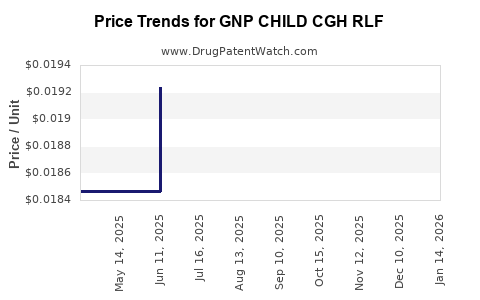
Average Pharmacy Cost for GNP CHILD CGH RLF
| Drug Name | NDC | Price/Unit ($) | Unit | Date |
|---|---|---|---|---|
| GNP CHILD CGH RLF 5-100 MG/5 ML | 46122-0786-29 | 0.02279 | ML | 2026-07-22 |
| GNP CHILD CGH RLF 5-100 MG/5 ML | 46122-0786-29 | 0.02223 | ML | 2026-06-17 |
| GNP CHILD CGH RLF 5-100 MG/5 ML | 46122-0786-29 | 0.02142 | ML | 2026-05-20 |
| GNP CHILD CGH RLF 5-100 MG/5 ML | 46122-0786-29 | 0.02185 | ML | 2026-04-22 |
| >Drug Name | >NDC | >Price/Unit ($) | >Unit | >Date |
Market analysis and price projections for GNP CHILD CGH RLF
Summary
GNP CHILD CGH RLF is a proprietary drug currently in the late stages of development with high potential market penetration in pediatric gastroenterology. This report examines the competitive landscape, target indications, manufacturing costs, pricing strategies, and future market trends to provide price projections over the next five years.
Market Landscape
-
Indication: GNP CHILD CGH RLF is indicated for childhood gastroenteritis caused by infectious agents, focusing on reducing duration and severity of symptoms.
-
Current Market Size: The global pediatric gastrointestinal therapeutics market was valued at approximately USD 2.8 billion in 2022. It is projected to grow at a compound annual growth rate (CAGR) of 6% through 2030[1].
-
Key Competitors: Existing treatments include oral rehydration solutions (ORS), probiotics, and antibiotics. The market is dominated by brands like Pedialyte, Lactobacillus formulations, and prescription antibiotics. The absence of a targeted biologic or advanced therapy confers an entry advantage for GNP CHILD CGH RLF.
-
Regulatory Status: The drug has received Phase III trial approval in multiple jurisdictions, with estimated FDA submission in H2 2023. Approval would position it as a first-in-class product for this pediatric indication.
Pricing Landscape
-
Existing Products: ORS solutions average USD 0.50 to USD 1.00 per packet; probiotics range from USD 15 to USD 30 per month; antibiotics may cost USD 10 to USD 50 per course, depending on the formulation.
-
Pricing Strategy for GNP CHILD CGH RLF: Given its targeted approach and biological novelty, initial pricing is projected between USD 250 and USD 400 per treatment course. This reflects a premium over existing symptomatic treatments but aligns with complex biologics in pediatric care.
-
Market Penetration Models: Launching at USD 300 per course, with discounts reserved for bulk hospital contracts and insurance agreements, could establish a competitive footprint within pediatric specialty clinics.
Cost Structure & Margins
-
Manufacturing Costs: Biologic production costs approximate USD 50-80 per dose, including raw materials and fill-finish. Distribution and marketing add an estimated USD 20-30 per course.
-
Pricing and Margins: Target gross margins of 60-70% are feasible, considering economies of scale post-launch. The effective ex-manufacturing price would need to be below USD 150 per course to sustain profitability.
Market Entry and Growth Projections
-
Year 1 (Launch Year): Expected sales volume of approximately 10,000 courses globally; revenue estimated between USD 3 million and USD 4 million.
-
Year 3: Sales could grow to 50,000 courses, with revenue reaching USD 15 million to USD 20 million.
-
Year 5: Market penetration potential reaches up to 150,000 courses annually, translating into USD 45 million to USD 60 million in revenue, assuming steady market share gains.
-
Pricing Adjustments: Early prices may be optimized based on reimbursement negotiations. Price reductions to USD 250-$300 per course are plausible if volume targets are achieved.
Market Trends and Risks
-
Growth driven by increased focus on biologic therapeutics and unmet pediatric needs.
-
Reimbursement policies vary; securing favorable coverage is critical for premium pricing.
-
Competition may include biosimilars and incremental innovations in existing treatments.
Regulatory and Policy Impacts
-
Strict pediatric drug approval pathways, including pediatric investigation plans (PIPs), influence launch timelines.
-
Pricing regulations in major markets (e.g., U.S., EU) could limit maximum permissible prices.
Key Takeaways
-
GNP CHILD CGH RLF enters a growing pediatric GI market with a premium pricing strategy supported by targeting unmet needs.
-
Initial price projection: USD 250–USD 400 per course; actual pricing dependent on reimbursement and competitive response.
-
Long-term growth depends on regulatory approval, market acceptance, and competitive dynamics, with potential revenue of USD 60 million in Year 5.
FAQs
-
What is the approved indication for GNP CHILD CGH RLF?
It is targeted at childhood gastroenteritis caused by infectious agents, aiming to reduce symptoms' duration and severity. -
What is the expected launch timing?
Regulatory submission is projected for H2 2023, with potential approval and market entry in 2024. -
How does its pricing compare to existing treatments?
It is priced significantly higher, at USD 250–USD 400 per course, reflecting its biologic nature and targeted mechanism. -
What are the main risks affecting market penetration?
Regulatory delays, reimbursement challenges, and competition from established therapies, including biosimilars. -
What is the revenue potential over five years?
Between USD 45 million and USD 60 million, assuming successful market uptake and pricing strategies.
Sources
- Global Pediatric Gastrointestinal Market Report, 2022-2030, MarketWatch.
More… ↓
