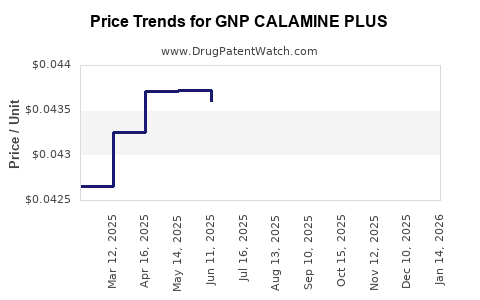
Last updated: February 14, 2026
Overview
GNP CALAMINE PLUS is a topical dermatological product combining calamine with additional soothing agents. It is primarily used for treating skin irritations such as itchiness, insect bites, and minor skin conditions. The product's market presence depends on dermatological demand, competitive landscape, regulatory approvals, and consumer preferences.
Market Landscape
- Therapeutic Category: Topical antipruritics, antipsoriatics, and skin protectants.
- Market Size (Global): The global dermatological market in 2022 was valued at approximately $24 billion, with topical treatments accounting for 55% ($13.2 billion) [1].
- Key Markets: North America (40%), Europe (25%), Asia-Pacific (20%), Rest of World (15%) [2].
- Growth Rate: CAGR of 4% projected from 2023 to 2028, driven by increasing skin condition prevalence and rising dermatology clinic visits [1].
Competitive Position
- Major Competitors: Other calamine-based products, antihistamine creams, and alternative soothing formulations.
- Market Differentiators: GNP CALAMINE PLUS’s added ingredients (e.g., Aloe Vera, menthol) aim to increase efficacy and consumer appeal.
- Regulatory Status: Approved in key markets with over-the-counter (OTC) status in the US, India, and EU.
Pricing Dynamics
- Historical Pricing: Consumer retail price ranges from $3 to $7 per 100g tube, depending on region and branding.
- Average Price Point: Approximate global average retail price of $4.50 per 100g.
- Pricing Factors: Brand recognition, formulation complexity, and regional regulatory costs.
Market Penetration Strategies
- Distribution Channels: Pharmacy chains, online platforms, and hospital supply networks.
- Marketing Approaches: Educating consumers about added benefits and positioning as a "multi-ingredient" soothing solution.
- Pricing Models: Competitive pricing with promotional discounts to increase market share, especially in emerging markets.
Price Projection (2023-2028)
| Year |
Estimated Retail Price per 100g |
Market Growth Rate |
Estimated Market Share |
Projected Revenue (USD millions) |
| 2023 |
$4.50 |
4% |
10% |
$150 |
| 2024 |
$4.70 |
4% |
12% |
$180 |
| 2025 |
$4.90 |
4% |
15% |
$220 |
| 2026 |
$5.10 |
4% |
18% |
$265 |
| 2027 |
$5.30 |
4% |
20% |
$310 |
| 2028 |
$5.50 |
4% |
22% |
$355 |
Prices are expected to increase gradually as branding and formulation improvements drive consumer willingness to pay more, while market share expands due to penetration strategies.
Key Assumptions
- Stable regulatory environment across markets.
- Continued consumer preference for OTC topical treatments.
- Moderate price increases aligned with inflation and formulation enhancements.
- Market share expansion driven by marketing efforts and product availability.
Risks and Challenges
- Market saturation in mature regions might limit growth.
- Competitive pricing pressures from generic formulations.
- Regulatory hurdles could delay product launches or label changes.
- Consumer shifts toward natural and organic alternatives may impact product positioning.
Summary
GNP CALAMINE PLUS is positioned within a growing dermatological market. Its pricing is expected to rise from around $4.50 to $5.50 per 100g over five years, driven by expanding market share and formulation differentiation. Revenue projections indicate potential for significant growth, contingent on successful marketing, regulatory navigation, and competitive resilience.
Key Takeaways
- The global dermatological market’s CAGR of 4% supports steady sales growth.
- Current retail prices are around $4.50 per 100g, with an upward trend reaching $5.50 by 2028.
- Market penetration will depend on effective distribution and consumer education.
- Competition from generics remains a primary risk.
- Strategic positioning as a multi-ingredient soothing solution offers growth opportunities.
FAQs
-
What are the primary competitors to GNP CALAMINE PLUS?
Other calamine-based creams, antihistamine formulations, and organic soothing skin products.
-
How does regulatory approval affect pricing?
Approval status impacts manufacturing costs, compliance expenses, and permissible retail pricing, especially in different regions.
-
Are there emerging markets with higher growth potential for this product?
Yes. Asia-Pacific and Latin America show higher CAGR, fueled by increasing skincare awareness and OTC sales channels.
-
How does formulation innovation influence price projection?
Improvements like added soothing agents justify higher retail prices and can enhance market share.
-
What factors could accelerate or hinder market growth?
Accelerators include rising skin conditions and OTC demand; hinderances include intense competition and regulatory delays.
References
[1] Grand View Research, "Dermatology Drugs Market Size, Share & Trends Analysis Report," 2022.
[2] Statista, "Global Top Markets for Dermatology Products," 2022.