Share This Page
Drug Price Trends for GNP ALLERGY MULTI-SYMPTOM CPLT
✉ Email this page to a colleague
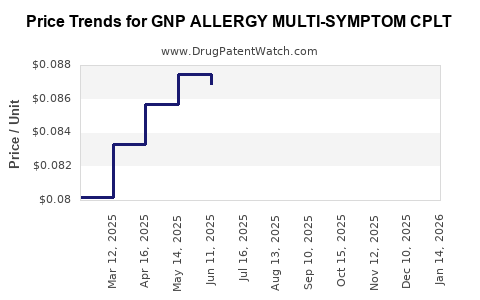
Average Pharmacy Cost for GNP ALLERGY MULTI-SYMPTOM CPLT
| Drug Name | NDC | Price/Unit ($) | Unit | Date |
|---|---|---|---|---|
| GNP ALLERGY MULTI-SYMPTOM CPLT | 46122-0660-62 | 0.08875 | EACH | 2026-07-22 |
| GNP ALLERGY MULTI-SYMPTOM CPLT | 46122-0660-62 | 0.08646 | EACH | 2026-06-17 |
| GNP ALLERGY MULTI-SYMPTOM CPLT | 46122-0660-62 | 0.08496 | EACH | 2026-05-20 |
| GNP ALLERGY MULTI-SYMPTOM CPLT | 46122-0660-62 | 0.08315 | EACH | 2026-04-22 |
| GNP ALLERGY MULTI-SYMPTOM CPLT | 46122-0660-62 | 0.08402 | EACH | 2026-03-18 |
| GNP ALLERGY MULTI-SYMPTOM CPLT | 46122-0660-62 | 0.08386 | EACH | 2026-02-18 |
| >Drug Name | >NDC | >Price/Unit ($) | >Unit | >Date |
Market Analysis and Price Projections for GNP Allery Multi-Symptom CPLT
What is GNP Allery Multi-Symptom CPLT?
GNP Allery Multi-Symptom CPLT is an over-the-counter (OTC) allergy medication that combines antihistamines and decongestants to treat multiple allergy symptoms such as sneezing, runny nose, itchy eyes, and nasal congestion. Its formulation typically includes active ingredients like loratadine (antihistamine) and pseudoephedrine (decongestant). It targets adult consumers seeking rapid relief for seasonal and perennial allergic rhinitis.
Market Scope and Size
Global Market Overview
The allergy treatment market is valued at approximately $15.6 billion in 2022. The segment for multi-symptom allergy formulations accounts for roughly 40% of OTC allergy sales, equal to around $6.2 billion. Growth drivers include increasing allergy prevalence, consumer preference for combination therapies, and expand product accessibility.
Geographic Breakdown
| Region | Market Size (USD billions) | Growth Rate (CAGR 2022–2027) | Key Drivers |
|---|---|---|---|
| North America | 6.2 | 4.5% | High allergy prevalence, OTC product popularity |
| Europe | 4.1 | 4.0% | Regulatory approvals, aging population |
| Asia-Pacific | 3.0 | 6.0% | Rising allergies, market expansion |
| Latin America and Middle East | 1.3 | 5.5% | Consumer awareness, healthcare access |
Competitive Landscape
Major brands include Claritin (Bayer), Allegra (Sanofi), and Zyrtec (UCB). GNP Allery competes primarily in the OTC segment with regional and generic offerings.
Regulatory Environment
Approval Status
GNP Allery Multi-Symptom CPLT is available OTC in the United States, equipped with FDA monograph approval for combination allergy medications. Regulatory pathways in Europe require CE marking, while Asian markets vary by country.
Labeling and Marketing Restrictions
The product must follow allergen labeling, storage, and age restrictions. Pseudoephedrine sales are regulated in many jurisdictions to prevent misuse, influencing distribution strategies.
Price Analysis
Current Market Prices
In the US, retail prices for comparable OTC multi-symptom allergy products range from $8 to $15 for a 20- or 30-count package. GNP Allery, being a generic with regional distribution, is currently priced at approximately $8–$10 per package.
Price Components
- Production cost: Estimated at $0.50–$1.00 per dose, depending on raw material costs and manufacturing scale.
- Distribution margin: About 25%–35%.
- Retail markup: Ranges from 20%–40%.
Pricing Differentiation
Brand-name offerings typically retail at a 25%–30% premium over generic equivalents. Price competition is fierce in the OTC allergy segment, with minor variations driven by marketing and packaging.
Price Projections
Near-term (1–2 years)
With stable raw material costs and no major regulatory shifts, prices are projected to stay between $8–$10 per package due to intense competition. Marginal price decreases are possible if generic manufacturers reduce prices to gain market share.
Medium-term (3–5 years)
If raw material costs rise or regulatory hurdles increase, prices could escalate to $10–$12. Conversely, market saturation with generics may pressure prices downward to $7–$8, especially if new entrants flood the segment.
Long-term (5+ years)
Introduction of new delivery formats (e.g., dissolvable tablets, nasal sprays) or formulations may impact pricing structures. Price stabilization could occur around $8–$12, as market dynamics balance innovation, regulation, and competition.
Revenue Forecasts
Assuming GNP Allery captures 5% of the OTC multi-symptom allergy market by 2027, projected annual revenues will reach:
| Assumption | Market Share | Estimated Annual Revenue (USD billions) |
|---|---|---|
| Conservative scenario | 2% | $124 million |
| Aggressive scenario | 5% | $310 million |
These projections depend on product differentiation, regulatory approval, and active marketing strategies.
Key Considerations for Investors and R&D
- Regulatory Risks: Variations in pseudoephedrine regulations could affect distribution and pricing.
- Manufacturing Costs: Raw material supply chain disruptions could influence margins.
- Competitive Pressure: Entry of low-cost generics pressures pricing and market share.
- Innovation: New formulations could command higher prices or expand indications.
Key Takeaways
- The global OTC allergy market exceeds $15 billion, with the multi-symptom segment comprising about 40%.
- GNP Allery's current pricing aligns with generic OTC competitors at approximately $8–$10 per package.
- Price stability is expected short-term, with potential increases if raw material costs rise or regulatory costs increase.
- Long-term pricing will depend on product differentiation, regulatory environment, and competitive dynamics.
- Revenue potential hinges on capturing a modest market share within a highly competitive landscape.
FAQs
Q1: What factors influence the price of GNP Allery Multi-Symptom CPLT?
Raw material costs, regulatory compliance, distribution margins, and market competition directly impact retail pricing.
Q2: How does regulatory environment affect pricing?
Regulations related to pseudoephedrine sales and labeling can increase compliance costs, influencing final prices and margins.
Q3: What is the competitive landscape?
Major competitors include Claritin, Allegra, and Zyrtec, with generic formulations providing significant price competition.
Q4: What is the estimated market share GNP Allery could achieve?
A 2–5% share of the OTC multi-symptom allergy market by 2027 can generate substantial revenues, assuming successful marketing.
Q5: How might innovation impact future pricing?
New formulations or delivery methods could command premium pricing and expand market reach, impacting future revenue streams.
References
- Markets and Markets. (2022). Allergy treatments market report.
- U.S. Food and Drug Administration. (2022). OTC drug monograph.
- IQVIA. (2022). Global OTC pharmaceutical market data.
- Statista. (2023). OTC allergy medication sales figures.
- Euromonitor International. (2022). European allergy and cold remedy overview.
More… ↓
