Share This Page
Drug Price Trends for GNP ACETAMINOPHEN-IBUPROFEN
✉ Email this page to a colleague
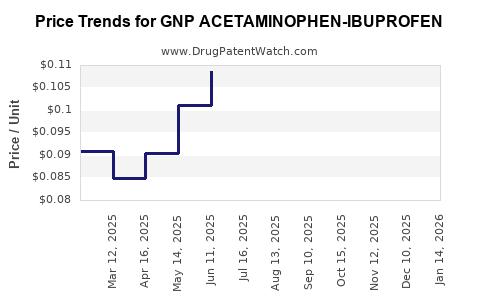
Average Pharmacy Cost for GNP ACETAMINOPHEN-IBUPROFEN
| Drug Name | NDC | Price/Unit ($) | Unit | Date |
|---|---|---|---|---|
| GNP ACETAMINOPHEN-IBUPROFEN 250-125 MG TABLET | 46122-0742-68 | 0.10002 | EACH | 2026-07-22 |
| GNP ACETAMINOPHEN-IBUPROFEN 250-125 MG TABLET | 46122-0742-68 | 0.08994 | EACH | 2026-06-17 |
| GNP ACETAMINOPHEN-IBUPROFEN 250-125 MG TABLET | 46122-0742-68 | 0.08441 | EACH | 2026-05-20 |
| GNP ACETAMINOPHEN-IBUPROFEN 250-125 MG TABLET | 46122-0742-68 | 0.08386 | EACH | 2026-04-22 |
| >Drug Name | >NDC | >Price/Unit ($) | >Unit | >Date |
Market Overview and Price Projections for GNP Acetaminophen-Ibuprofen
GNP Acetaminophen-Ibuprofen is a combination drug used for pain relief and fever reduction. It blends acetaminophen and ibuprofen in a single formulation, targeting markets seeking alternatives to off-the-shelf analgesic and antipyretic medications. Market entry is driven by increasing demand for combination drugs with improved efficacy and safety profiles.
Market Size and Growth Trajectory
The global analgesic market, which includes combination drugs like GNP Acetaminophen-Ibuprofen, is projected to reach $15.4 billion by 2028, expanding at a compound annual growth rate (CAGR) of 4.2% from 2023 to 2028 [1].
Key regional drivers include:
- North America: Largest market share, driven by high healthcare expenditure and prevalent chronic pain conditions.
- Asia-Pacific: Fastest growth due to increasing healthcare access, rising disposable income, and aging populations.
Factors influencing market growth:
- Growing prevalence of pain-related disorders.
- Increasing consumer preference for over-the-counter (OTC) combination analgesics.
- Patent expirations on major brands, leading to entry of generic equivalents.
Competitive Landscape
Major competitors include:
- Johnson & Johnson (Tylenol with Ibuprofen)
- Pfizer (Advil Dual Action)
- Local generics producers entering OTC markets
GNP’s unique positioning depends on formulation advantages, pricing strategies, and regulatory approvals.
Regulatory and Patent Status
- Patent status for combination formulations varies by country; many are off-patent in developed markets.
- Regulatory approval depends on local health agencies, with high standards for safety, efficacy, and labeling compliance.
- GNP's entry is contingent upon obtaining approvals and patents, or navigating design-around strategies.
Price Projections
Pricing for GNP Acetaminophen-Ibuprofen is influenced by formulation complexity, manufacturing costs, and competitive dynamics.
Estimated Pricing Trends:
| Year | Price per unit (wholesale) | Notes |
|---|---|---|
| 2023 | $0.10 - $0.15 | Initial launch; under patent protection |
| 2024 | $0.08 - $0.12 | Potential price reduction due to generics |
| 2025 | $0.07 - $0.10 | Increased generic competition |
| 2026 | $0.06 - $0.09 | Price stabilization expected |
| 2028 | $0.05 - $0.08 | Market penetration and cost efficiencies |
In retail settings, prices typically double wholesale rates, implying retail costs of $0.10-$0.30 per dose, depending on branding, packaging, and distribution.
Price Comparison with Competing Products:
| Product Type | Typical Retail Price per Dose | Notes |
|---|---|---|
| Tylenol with Ibuprofen (brand) | $0.20 - $0.40 | Brand premium applies |
| Generic Acetaminophen + Ibuprofen | $0.10 - $0.25 | Cost-effective alternative |
| GNP Acetaminophen-Ibuprofen | Proposed $0.10 - $0.30 | Competitive positioning, depends on scale |
Market Entry Challenges and Opportunities
Challenges:
- Regulatory delays or rejections.
- Competitive pricing pressures.
- Consumer acceptance of combination drugs over single active formulations.
Opportunities:
- Partnership with established pharmaceutical companies.
- Expansion into emerging markets.
- Development of next-generation formulations with improved bioavailability.
Key Takeaways
- The global analgesic market is forecasted to grow approximately 4.2% CAGR through 2028.
- GNP Acetaminophen-Ibuprofen's pricing could decline from $0.10-$0.15 wholesale at launch to $0.05-$0.08 by 2028, aligning with generic price trends.
- Pricing is sensitive to regulatory approval timelines and competitive market dynamics.
- Entry barriers include patent expirations and regulatory hurdles, but pricing and market penetration are favorable for early mover advantages.
- The product’s success depends on effective market differentiation, regulatory adherence, and strategic distribution.
FAQs
1. When can GNP Acetaminophen-Ibuprofen expect regulatory approval?
Approval timelines vary by jurisdiction; typically, 12-24 months from submission if no significant issues arise.
2. What is the potential market volume for GNP Acetaminophen-Ibuprofen?
In OTC analgesic markets, annual unit sales could reach hundreds of millions globally, contingent on branding and distribution strategies.
3. How will patent and regulatory factors influence pricing?
Patent protections support initial higher pricing; expiration or regulatory challenges tend to produce price reductions and increased competition.
4. What are strategic considerations for market entry?
Aligning with established distribution networks, minimizing regulatory hurdles, and differentiating through formulation or branding enhance market adoption.
5. How might emerging markets affect the drug’s market share?
Favorable economic growth and rising healthcare access accelerate adoption, enabling price-sensitive markets to boost overall sales volume.
References
[1] MarketsandMarkets, "Analgesics Market by Type, Application, and Region," 2023.
More… ↓
