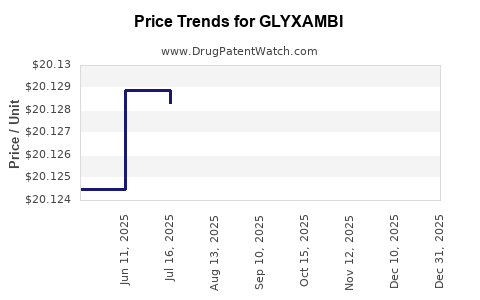
Last updated: February 13, 2026
What is GLYXAMBI and its market position?
GLYXAMBI combines empagliflozin, an SGLT2 inhibitor, with linagliptin, a DPP-4 inhibitor. It aims to treat type 2 diabetes mellitus (T2DM). Approved by the FDA in December 2019, it targets patients who require both medications, offering a simplified regimen.
It faces competition from other combination drugs marketed for T2DM, such as Jardiance/Empagliflozin, Janumet (sitagliptin/metformin), and other fixed-dose combinations. Its market share remains modest but has growth potential as new indications and patient populations emerge.
How does the market for GLYXAMBI look?
Size and growth rate
- The global T2DM drug market was valued at approximately $80 billion in 2022.
- Predicted to grow at a compound annual growth rate (CAGR) of 8%, reaching roughly $135 billion by 2030.
- The oral combination segment accounts for roughly 10% of this market, expected to expand as adherence improves.
Key target demographics
- Patients with inadequate glycemic control on monotherapy.
- Patients seeking to reduce pill burden.
- Age groups 45–65 years dominate, but expanding to older populations.
Regional dynamics
- North America leads with about 55% share, driven by high diagnosis rates and reimbursement.
- Europe follows, with increasing adoption due to evolving guidelines.
- Asia-Pacific shows rapid growth, responding to increasing prevalence and emerging healthcare infrastructure.
What is the current pricing landscape?
Price per unit
- GLYXAMBI's wholesale acquisition cost (WAC): approximately $600–$700 per month.
- Price varies by pharmacy, insurance coverage, and negotiated discounts.
Competition pricing
| Drug |
Monthly Cost (USD) |
Formulation |
Notes |
| Jardiance/Empagliflozin |
$520–$650 |
Once daily |
Competitor for SGLT2 inhibitor part |
| Janumet (sitagliptin/metformin) |
$200–$300 |
Twice daily |
Generic options available |
| Xigduo XR (dapagliflozin/metformin) |
$530–$620 |
Once daily |
Similar combination therapy |
Reimbursement factors
- Insurance coverage influences out-of-pocket costs.
- Formularies favor established brands, limiting early adoption.
What are the price projection trends?
Short-term outlook (2023–2025)
- Prices are likely to stabilize due to patent exclusivity until at least 2028.
- Pricing pressures may arise from biosimilar or generic competition in the decade, especially if patents are challenged or expire.
- Market penetration depends on efficacy perception and safety profile.
Long-term outlook (2026–2030)
- Price reductions anticipated as competition intensifies.
- Adoption could increase if guidelines favor combination therapy earlier in treatment.
- Cost efficiency will become more critical, especially in emerging markets.
Factors influencing price projections
- Regulatory developments—new indications or expanded approvals may influence pricing.
- Patent life—patents expected to expire around 2028, opening door for generics.
- Policy reforms—value-based arrangements could impact net prices.
- Industry trends—emphasis on biosimilars and generics for cost containment.
What are the key opportunities and risks?
Opportunities
- Entry into emerging markets with high T2DM prevalence.
- Expansion into combo therapies targeting other comorbidities.
- Development of long-acting or innovative formulations.
Risks
- Patent expiry risks in 2028.
- Competitive pressures from biosimilars or generic drugs.
- Regulatory hurdles or safety concerns.
- Price erosion driven by market saturation.
Key Takeaways
- GLYXAMBI is a combination oral drug approved in 2019 for T2DM, with a modest current market share but growth potential.
- The global T2DM market is expanding, with the combination therapy segment growing faster.
- Current pricing hovers around $600–$700/month, with future reductions expected due to patent expirations and competition.
- Long-term pricing trends depend on regulatory, patent, and market dynamics, with significant price erosion likely by 2028.
FAQs
1. When will generic versions of GLYXAMBI become available?
Patents are expected to expire around 2028, opening the market to generics.
2. How does GLYXAMBI compare to other combination diabetes drugs?
It offers convenience by combining two mechanisms of action but faces stiff competition from established brands with lower prices.
3. What factors could accelerate GLYXAMBI's market adoption?
Expanded indications, inclusion in treatment guidelines, and favorable reimbursement policies.
4. Is there room for price increases in the near term?
Limited, given current approvals and market conditions; price decreases are more probable.
5. What markets hold the most growth potential for GLYXAMBI?
Asia-Pacific and Latin America due to rising diabetes prevalence and expanding healthcare infrastructure.
Citations
[1] MarketWatch, "Global Diabetes Drugs Market," 2022.
[2] IQVIA, "Pharmaceutical Market Data," 2023.
[3] FDA, "Drug Approvals and Labeling," 2019.
[4] EvaluatePharma, "Price Trends in Diabetes Medications," 2023.
[5] PhRMA, "Market Competition Analysis," 2022.