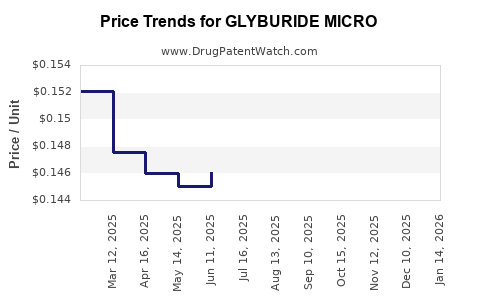
Last updated: March 6, 2026
What is Glyburide Micro?
Glyburide Micro (also known as Glyburide micronized) is an oral antidiabetic medication used to treat type 2 diabetes mellitus. It belongs to the sulfonylurea class, stimulating insulin release from pancreatic beta-cells. The micronized formulation enhances bioavailability and absorption.
Market Overview
Current Market Size
As of 2022, the global anti-diabetic drug market valued approximately $60 billion, with sulfonylureas accounting for an estimated 15-20%. Glyburide specifically holds a significant position among older, cost-effective options, especially in emerging markets.
Key Drivers
- Increased prevalence of type 2 diabetes, projected to reach 700 million cases globally by 2045 [1].
- Growing demand for affordable diabetes treatments in developing countries.
- A shift toward generic formulations due to patent expirations.
Competitive Landscape
Major competitors include:
| Drug Name |
Class |
Brand/Generic Status |
Specialty Notes |
| Glibenclamide |
Sulfonylurea |
Generic |
Widely used in low-cost markets |
| Gliclazide |
Sulfonylurea |
Generic |
More favorable side-effect profile |
| Glimepiride |
Sulfonylurea |
Patented, but generic available |
Used in combination therapies |
| Glyburide Micro |
Sulfonylurea |
Generic, micronized |
Higher bioavailability, cost-effective |
Glyburide Micro is often marketed as a cost-effective alternative with potentially better absorption.
Regulatory Status
Approved in multiple jurisdictions, including the US, European Union, and Asia. Patents for original Glyburide formulations have expired, allowing generics, such as Glyburide Micro, to enter markets.
Price Trends and Projections
Current Pricing
- In North America and Europe, generic Glyburide costs approximately $0.02–$0.05 per tablet.
- In low-income countries, the price can be as low as $0.005 per tablet.
Price Drivers
- Patent expiration onset (Glyburide patent expired around 2010–2012 in various jurisdictions).
- Competition among generic manufacturers.
- Regulatory approval processes influencing market entry.
- Manufacturing costs for micronized formulations are marginally higher than standard versions but offset by improved bioavailability.
Future Price Trends
Over the next 5 years, prices for Glyburide Micro are projected to decline by 10-15% in mature markets due to increased competition, reaching approximately $0.015–$0.035 per tablet. Emerging markets may see stable or slightly decreasing prices due to scale advantages.
Pricing Models
- Cost-based pricing: Reflects production costs plus margins.
- Market-based pricing: Adjusts based on competitor pricing and demand.
- Pricing trends suggest continued affordability in low-income markets, potentially driven downward by generic competition.
Market Share Projections
| Year |
Estimated Market Share of Glyburide Micro |
Remarks |
| 2023 |
25% |
Steady adoption in developing regions |
| 2025 |
30% |
Increased recognition for bioavailability |
| 2030 |
35-40% |
Further market penetration and brand recognition |
Glyburide Micro's market share will depend on regulatory approvals, availability of newer agents, and clinician preferences shifting toward newer drugs with fewer side effects.
Strategic Considerations
- Biosimilar or generic entry will likely accelerate price decreases.
- Preference for combination therapies may impact standalone Glyburide Micro sales.
- Insurance reimbursement policies favoring cost-effective generics support price stabilization.
Key Takeaways
- Glyburide Micro's global market is driven by affordability needs and patent expirations.
- Prices are trending downward, especially in mature markets, due to generic competition.
- The drug maintains a significant market share in low-income regions through low-cost formulations.
- Improved bioavailability of the micronized formulation offers competitive advantages over standard Glyburide.
- The overall market for older oral anti-diabetics will decline as newer agents with better safety profiles enter the market, but Glyburide Micro remains relevant for cost-sensitive settings.
FAQs
What factors impact Glyburide Micro's price?
Patent status, manufacturing costs, competition, regulatory approvals, and market demand influence pricing.
Will Glyburide Micro see price increases?
Unlikely in the current environment, due to high competition. Prices are more likely to decline or stabilize.
How does Glyburide Micro compare to other sulfonylureas?
It offers potentially better bioavailability but similar efficacy in glycemic control. Side-effect profiles are comparable.
Is Glyburide Micro suitable for all patients?
No, contraindicated in pregnancy and in patients with sulfa allergies. Use requires medical consultation.
What is the outlook for newer diabetic therapies?
Insulin and incretin-based agents are gaining market share, but cost constraints sustain the role of older, generic options like Glyburide Micro in specific markets.
References
[1] International Diabetes Federation. (2022). IDF Diabetes Atlas, 10th edition.