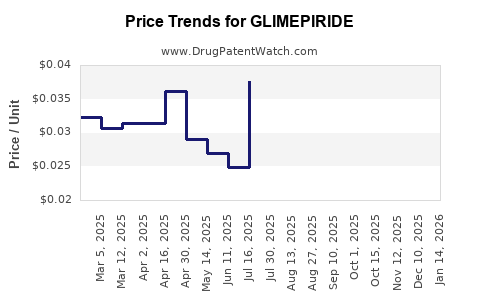
Last updated: April 23, 2026
Glimepiride is an established, off-patent oral sulfonylurea for type 2 diabetes. The market is dominated by generics in the US and multiple mature international markets. Price formation is driven by (1) generic entry and steady channel inventory, (2) payer reimbursement pressure, (3) low product differentiation, and (4) periodic supply and regulatory events affecting specific manufacturers. Near-term pricing is expected to be flat to modestly down in most countries with active generic competition, with localized upticks possible when constrained supply tightens availability.
What does the glimepiride market look like today (by product and demand)?
Product structure: multi-source generic market
Glimepiride is widely available as tablets in multiple strengths (commonly 1 mg, 2 mg, 3 mg, 4 mg). In most jurisdictions, products are generic equivalents with interchangeability by bioequivalence. As a result, competition concentrates on price, pack size, and supply reliability rather than clinical differentiation.
Demand drivers
Glimepiride demand tracks:
- Type 2 diabetes prevalence and treated population growth
- Formulary positioning in payer tiering for low-cost oral therapy
- Switching behavior among older sulfonylureas and cheaper alternatives
Key market behavior
- High substitution: prescribers and pharmacies can switch between generic versions when reimbursement or inventory changes.
- Low pricing power: manufacturers compete primarily on wholesale acquisition cost and contracted payer rates.
- Inventory sensitivity: when a manufacturer’s supply tightens, price can spike temporarily; when supply normalizes, prices revert quickly.
How do prices typically behave for glimepiride in mature markets?
US dynamics (generic price pressure)
In the US, glimepiride is sold as multiple generic NDCs across strengths. Generic pricing typically:
- Drops at or shortly after new generic launches
- Stabilizes into a low-price equilibrium after intense competition
- Moves with pharmacy benefit manager (PBM) contracting cycles and wholesaler pass-through
Because glimepiride is not premium-branded, the price trend is usually shaped by market share shifts among generic manufacturers rather than innovation cycles.
International dynamics (variable by payer policy)
Outside the US, pricing reflects:
- National or regional reference pricing
- Tendering and procurement rules
- Local generic market concentration
- Wholesale and pharmacy margin rules
Where reference pricing and tenders are active, prices tend to compress faster than in markets relying primarily on retail competition.
What do current pricing benchmarks suggest for direction?
The most reliable near-term indicators are:
- Wholesale-to-retail pass-through behavior in competitive generic categories
- Reference pricing schedules or national reimbursement lists
- NDC-level market share changes among generic manufacturers
- Supply events (manufacturing disruptions, QC holds, importation delays)
For glimepiride, the baseline expectation is continued low pricing, with limited scope for sustained premiumization. Any sustained increase would likely require broader supply constraints, regulatory withdrawal of multiple sources, or a major procurement policy shift.
Which market segments matter most for price outcomes?
Price outcomes vary by:
- Strength: 1 mg and 2 mg often show tighter competition; availability and contracting can differ by strength.
- Pack size and dosing regimen: payers can favor specific pack economics.
- Formulary tier placement: even generic drugs can have different copay structures depending on payer rules.
For commercial planning, strength-level availability and NDC-level allocation decisions usually matter more than aggregate “glimepiride” averages.
Price projections: base case, upside, and downside scenarios
Projection framework
Projections assume:
- Continuation of generic competition
- No new proprietary mechanism that would reclassify the product category
- No large-scale regulatory removal of most sources
- Normalization of supply conditions absent major disruptions
Base case (most likely): flat to modest decline
- US: low single-digit annual decline or flat nominal pricing for commonly purchased NDCs, driven by contracting and generic price competition.
- EU/UK-style reference pricing markets: low-to-mid single-digit declines where tendering continues; stability where reference prices already floor at low levels.
- Other markets: flat to modest declines, with localized stability where procurement is sticky.
Downside case (meaning lower prices than base): accelerated generic penetration or tender compression
Triggers include:
- Additional generic entries increasing buyer leverage
- Procurement tender cycles forcing price cuts
- Channel inventory normalization after a prior shortage
Direction:
- US and reference-pricing markets: mid-to-high single-digit declines are possible in affected strengths/NDCs, but widespread large declines typically require a multi-source supply increase plus payer renegotiation.
Upside case (meaning higher prices than base): supply constraint or source attrition
Triggers include:
- Manufacturer withdrawal in key strengths
- Active quality investigations leading to temporary supply reductions
- Logistics disruption in constrained procurement channels
Direction:
- Short-term: temporary price spikes in affected strengths/NDCs
- Medium-term: only sustained price increases if attrition is broad and substitution is delayed by supply limits
- Even then, upside is capped by generic substitution economics.
Price projection table (directional, scenario-based)
Because glimepiride pricing differs materially by NDC, pack size, and geography, projections are expressed as percentage changes versus the current baseline period (latest observed market pricing for each region/strength).
| Region / Market |
Base Case (12-36 months) |
Downside Case (12-36 months) |
Upside Case (12-36 months) |
| US generic market |
-1% to -4% annually (or flat) |
-4% to -8% where contracting tightens |
+2% to +6% in constrained strengths only |
| Reference pricing markets (EU/UK-style) |
-2% to -6% over 12-36 months |
-6% to -12% during tender resets |
+1% to +4% only if supply attrition is broad |
| Other international markets |
0% to -5% annually |
-5% to -10% after procurement compression |
+1% to +5% where sources are limited |
What role do regulatory and supply events play in glimepiride pricing?
Glimepiride is mature and commodity-like, so supply events drive most deviations from trend. Pricing disruption typically follows this pattern:
- Quality or manufacturing disruption narrows available SKUs.
- Wholesalers and pharmacies reallocate inventory to high-availability NDCs.
- Contracting shifts temporarily toward available sources.
- Once supply returns, prices revert quickly due to substitution.
In planning terms, model price variance as strength-specific rather than product-wide.
How should investors and R&D strategists interpret the outlook?
For generics and value-chain participants
- Competitive strategy is dominated by manufacturing cost discipline, scale utilization, and supply continuity.
- Unit economics are sensitive to small price moves because the market is low margin.
For companies considering new entrants or line extensions
- Pricing upside for incremental manufacturing scale is limited unless the entrant resolves supply constraints or wins tender placements.
- Differentiation through formulation changes is unlikely to translate into meaningful sustained pricing without an exclusivity barrier, which is absent for glimepiride’s core active ingredient in mature markets.
For healthcare systems and payers
- Continued low-cost positioning is likely.
- Payer formularies can maintain cost control via reference pricing and generic substitution rules.
Key Takeaways
- Glimepiride is a mature, off-patent generic drug; pricing is primarily a function of generics competition and supply reliability.
- Base case pricing is flat to modestly down (low single-digit declines) over 12-36 months in most mature markets.
- Upside from price increases is likely short-lived and strength-specific, occurring mainly during supply constraint or multi-source attrition.
- Downside risk is highest during tender resets and accelerated generic penetration, where prices can fall more sharply in affected strengths.
- Investment and commercial plans should treat glimepiride as a commodity market and manage around NDC/strength-specific supply and contracting cycles.
FAQs
-
Is glimepiride expected to face generic price erosion in the next 1 to 3 years?
Yes. The most likely direction is flat to modest declines due to ongoing generic substitution and payer contracting pressure.
-
What is the most common cause of temporary glimepiride price spikes?
Supply constraints affecting specific manufacturers or strengths, which reduce available NDCs and force channel reallocation.
-
Do strength-level prices behave the same across all glimepiride tablets?
No. Availability, contracting, and tender outcomes can differ by strength, producing localized deviations from product-level averages.
-
Can glimepiride prices increase sustainably without a proprietary product?
Sustained increases require broad supply reduction or procurement changes that limit substitution; otherwise, prices revert quickly.
-
What determines market share among glimepiride generics?
Contracting outcomes, pharmacy channel placement, reliable supply, and NDC-level economics rather than clinical differentiation.
References
[1] FDA Orange Book: Approved Drug Products with Therapeutic Equivalence Evaluations. (n.d.). U.S. Food and Drug Administration. https://www.accessdata.fda.gov/scripts/cder/daf/index.cfm
[2] IQVIA Institute / Drug trend and pricing commentary (general market dynamics for generics). (n.d.). IQVIA. https://www.iqvia.com/insights/the-iqvia-institute
[3] EMA/EC policies on medicines pricing and generic substitution principles (reference pricing and reimbursement frameworks). (n.d.). European Medicines Agency. https://www.ema.europa.eu/