Last updated: February 19, 2026
Ganirelix acetate is a gonadotropin-releasing hormone (GnRH) antagonist used in assisted reproductive technologies (ART) to prevent premature luteinizing hormone (LH) surges. Its market is driven by the increasing prevalence of infertility and advancements in ART procedures. Price projections are influenced by patent expiry, generic competition, and reimbursement policies.
What is the current market size and growth trajectory for Ganirelix Acetate?
The global market for Ganirelix acetate is estimated to be valued at approximately $650 million as of 2023. The market has experienced a compound annual growth rate (CAGR) of 4.2% over the past five years and is projected to grow at a CAGR of 5.5% from 2024 to 2030, reaching an estimated $950 million by 2030. This growth is primarily attributed to the rising global infertility rates, which have increased from 10-15% in recent decades to an estimated 15-20% in many regions. The increasing adoption of in-vitro fertilization (IVF) and other ART procedures directly fuels demand for GnRH antagonists like Ganirelix acetate. Furthermore, expanding healthcare access in emerging economies and technological advancements in drug delivery systems contribute to market expansion.
Key Market Drivers:
- Rising Infertility Rates: Global estimates suggest over 100 million couples worldwide experience infertility, leading to increased demand for ART.
- Growth in ART Procedures: The number of IVF cycles performed globally has steadily increased, with an estimated 2.5 million cycles in 2023.
- Technological Advancements: Development of new formulations and improved delivery methods enhances patient compliance and treatment efficacy.
- Expanding Healthcare Infrastructure: Increased investment in fertility clinics and reproductive health services in developing nations.
What is the patent landscape for Ganirelix Acetate and its implications?
The primary patent for Ganirelix acetate was filed by NV Organon (now part of Merck & Co.) and has expired in major markets. The original U.S. patent, U.S. Patent No. 5,925,629, expired in 2015. In Europe, the corresponding European Patent EP0539006B1 also expired.
The expiry of these foundational patents has paved the way for generic competition. Several generic versions of Ganirelix acetate have entered the market.
Key Patent Milestones:
- Original Compound Patent Expiry: Major markets: 2015.
- Formulation Patents: While the original compound patents have expired, some companies may hold secondary patents related to specific formulations, delivery devices, or manufacturing processes. These can provide limited market exclusivity for a period.
- Generic Entry: Multiple generic manufacturers have launched their Ganirelix acetate products globally, beginning primarily in 2016.
The presence of generic alternatives significantly impacts pricing and market share. Branded Ganirelix acetate often commands a premium, but its market share is progressively eroded by lower-cost generic options.
Who are the key manufacturers and competitors in the Ganirelix Acetate market?
The market for Ganirelix acetate includes the originator (Merck & Co.) and a growing number of generic manufacturers.
Key Market Players:
- Merck & Co. (Original Innovator - Brand Name: Antagon): Holds the original intellectual property and continues to market its branded product, though its market share has diminished.
- Generic Manufacturers:
- Teva Pharmaceutical Industries: A significant player in the generic injectables market, offering a Ganirelix acetate product.
- Gedeon Richter Plc: Another major pharmaceutical company with a presence in women's health and reproductive medicine.
- Fresenius Kabi: Known for its injectable and infusion therapies, Fresenius Kabi is also a competitor in this space.
- Mylan N.V. (now Viatris): A prominent generic drug manufacturer with a broad portfolio.
- Sun Pharmaceutical Industries: A global pharmaceutical company with a strong generic drug offering.
- Intas Pharmaceuticals: An emerging player with a growing portfolio of specialty generics.
Competition is intense, with numerous companies vying for market share. This competitive landscape is characterized by price differentiation, supply chain reliability, and regulatory approvals in different geographies.
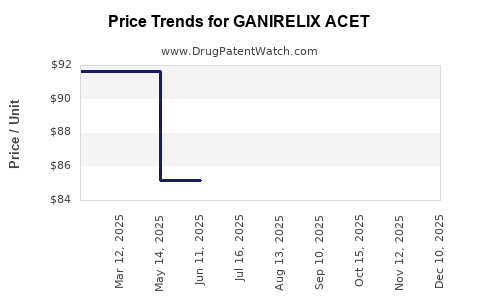
What are the current pricing trends and price projections for Ganirelix Acetate?
The pricing of Ganirelix acetate is bifurcated between the branded product and its generic equivalents. The branded product, Antagon, typically has a higher price point, reflecting its historical market position and associated R&D investment.
Current Pricing Landscape (2023 Estimates):
- Branded Ganirelix Acetate (e.g., Antagon): Wholesale acquisition cost (WAC) can range from $350 to $450 per 1 mL (0.25 mg) pre-filled syringe. A typical IVF cycle may require multiple syringes, leading to a treatment cost of $1,500 to $3,000 for GnRH antagonist use.
- Generic Ganirelix Acetate: Generic versions are priced significantly lower, often 30-50% less than the branded product. WAC for generic 1 mL (0.25 mg) pre-filled syringes typically falls between $200 and $280.
Price Projections (2024-2030):
The price of Ganirelix acetate is expected to continue its downward trend due to increasing generic penetration and competitive pressures.
- Branded Product: The price of branded Ganirelix acetate is anticipated to remain relatively stable or see a slight decrease as its market share declines.
- Generic Products: Generic prices are projected to decline by an average of 5-8% annually over the next six years. This decline is driven by increased competition among multiple generic manufacturers and potential further cost reductions in manufacturing. By 2030, generic Ganirelix acetate prices could be 60-70% lower than the peak prices of the branded product.
Factors Influencing Future Pricing:
- Number of Generic Entrants: As more generic manufacturers receive regulatory approval and enter the market, price competition intensifies.
- Manufacturing Costs: Efficiencies in generic manufacturing and raw material sourcing can lead to lower production costs, passed on as lower prices.
- Reimbursement Policies: Insurance coverage and reimbursement rates by healthcare payers can influence the out-of-pocket costs for patients and, consequently, market demand and pricing.
- Supply Chain Dynamics: Any disruptions in the supply chain for active pharmaceutical ingredients (APIs) or finished products can temporarily affect pricing.
What are the regulatory considerations and market access challenges for Ganirelix Acetate?
Regulatory approval for Ganirelix acetate and its generic versions is governed by health authorities such as the U.S. Food and Drug Administration (FDA), the European Medicines Agency (EMA), and other national regulatory bodies. The approval process for generic drugs requires demonstrating bioequivalence to the reference listed drug (RLD).
Key Regulatory Aspects:
- Abbreviated New Drug Application (ANDA) in the U.S.: Generic manufacturers must submit an ANDA to the FDA, proving their product is the same as the branded drug in dosage form, strength, route of administration, quality, performance characteristics, and intended use.
- Marketing Authorisation Application (MAA) in Europe: Similar to the U.S. process, generics require an MAA demonstrating quality, safety, and efficacy.
- Good Manufacturing Practices (GMP): All manufacturing facilities must adhere to strict GMP standards to ensure product quality and consistency.
Market Access Challenges:
- Payer Formularies: Gaining inclusion on insurance formularies can be a significant hurdle. Payers often prefer drugs with the lowest cost, favoring generics.
- Prior Authorization Requirements: Some payers may require prior authorization for Ganirelix acetate, especially for the branded product, adding administrative burden.
- Reimbursement Rates: The reimbursement rates set by Medicare, Medicaid, and private insurers directly impact the profitability for manufacturers and accessibility for patients.
- Physician Adoption: While generics are bioequivalent, some physicians may have established prescribing habits with the branded product, requiring education and trust-building for generic adoption.
- Geographical Variations: Regulatory requirements and market access strategies can vary significantly between countries, necessitating region-specific approaches.
The increasing availability of generics often leads to favorable formulary placement and lower out-of-pocket costs for patients, driving market access for these products.
What is the projected market share of branded versus generic Ganirelix Acetate?
Following patent expiry, the market share of branded Ganirelix acetate has seen a substantial decline, a trend expected to continue. Generic Ganirelix acetate now holds the dominant share of the market and is projected to increase its lead.
Current Market Share (2023 Estimates):
- Branded Ganirelix Acetate: Approximately 25-30% of the market.
- Generic Ganirelix Acetate: Approximately 70-75% of the market.
Projected Market Share (2030 Estimates):
The market share for branded Ganirelix acetate is projected to further decrease to around 10-15% by 2030. This shift is driven by:
- Price Competitiveness: Generic options are substantially more affordable, making them the preferred choice for healthcare providers and payers focused on cost-effectiveness.
- Bioequivalence Acceptance: Regulatory bodies confirm the bioequivalence of generic Ganirelix acetate, assuring healthcare professionals of comparable efficacy and safety.
- Increased Generic Offerings: The expanding number of generic manufacturers will further intensify competition, driving down prices and solidifying generic dominance.
The remaining market share for the branded product will likely be confined to specific patient populations or niche markets where physician preference or unique formulary agreements persist.
Key Takeaways
- The Ganirelix acetate market is projected to grow to $950 million by 2030, driven by rising infertility rates and increased ART procedures.
- Original patents for Ganirelix acetate have expired, leading to the entry of multiple generic competitors.
- Generic Ganirelix acetate products dominate the market, holding approximately 70-75% share in 2023, a figure expected to rise to 85-90% by 2030.
- Pricing for generic Ganirelix acetate is projected to decline by 5-8% annually due to intense competition.
- Market access is a critical factor, with generic products benefiting from favorable payer policies and lower out-of-pocket costs for patients.
Frequently Asked Questions
-
Will new patents for Ganirelix Acetate formulations emerge?
While the core compound patent has expired, companies may pursue patents on novel delivery devices, specific polymorphic forms, or unique manufacturing processes. However, the impact of such secondary patents on overall market dynamics is generally less significant than the original compound patent.
-
How does Ganirelix Acetate compare to other GnRH antagonists?
Ganirelix acetate is a direct GnRH antagonist. Other GnRH antagonists include Cetrorelix acetate. Both serve a similar function in ART by preventing premature LH surges. Cetrorelix acetate also faces similar market dynamics with generic competition.
-
What is the typical duration of Ganirelix Acetate treatment in an IVF cycle?
Ganirelix acetate is typically administered subcutaneously starting on stimulation day 5 or 6 of a controlled ovarian stimulation cycle, continuing until the day of human chorionic gonadotropin (hCG) administration. The duration is usually 3 to 5 days.
-
Are there any significant supply chain risks for Ganirelix Acetate?
Supply chain risks are generally low for established generic drugs with multiple manufacturers. However, geopolitical events, raw material sourcing disruptions, or unexpected regulatory actions at manufacturing sites could pose temporary challenges.
-
What is the expected impact of biosimil development on Ganirelix Acetate?
Ganirelix acetate is a small molecule synthetic peptide, not a biologic. Therefore, the concept of biosimilars, which applies to biologic drugs, is not relevant. Generic competition from small molecule manufacturers is the primary competitive force.
Citations
[1] Data from market research reports on fertility drugs and assisted reproductive technologies.
[2] U.S. Patent and Trademark Office. (n.d.). Patent Search.
[3] European Patent Office. (n.d.). Espacenet Patent Database.
[4] Company annual reports and press releases (Merck & Co., Teva Pharmaceutical Industries, Gedeon Richter Plc, Fresenius Kabi, Viatris, Sun Pharmaceutical Industries, Intas Pharmaceuticals).
[5] FDA Orange Book: Approved Drug Products with Therapeutic Equivalence Evaluations.
[6] EMA EudraPharm Database.
[7] Pharmaceutical pricing and reimbursement databases.