Share This Page
Drug Price Trends for GALANTAMINE
✉ Email this page to a colleague
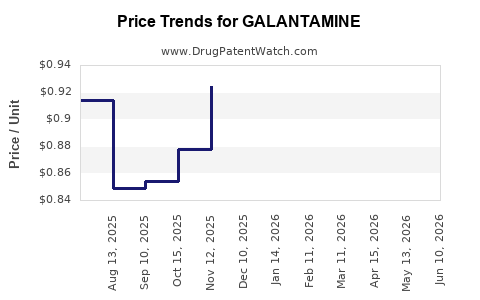
Average Pharmacy Cost for GALANTAMINE
| Drug Name | NDC | Price/Unit ($) | Unit | Date |
|---|---|---|---|---|
| GALANTAMINE ER 16 MG CAPSULE | 47335-0836-83 | 0.94070 | EACH | 2026-07-22 |
| GALANTAMINE ER 24 MG CAPSULE | 47335-0837-83 | 1.03458 | EACH | 2026-07-22 |
| GALANTAMINE HBR 8 MG TABLET | 65862-0459-60 | 0.39312 | EACH | 2026-07-22 |
| GALANTAMINE ER 16 MG CAPSULE | 65862-0745-30 | 0.94070 | EACH | 2026-07-22 |
| >Drug Name | >NDC | >Price/Unit ($) | >Unit | >Date |
Best Wholesale Price for GALANTAMINE
| Drug Name | Vendor | NDC | Count | Price ($) | Price/Unit ($) | Unit | Dates | Price Type |
|---|---|---|---|---|---|---|---|---|
| GALANTAMINE ER 8MG CAP | Johnson & Johnson Health Care Systems, Inc. obo Patriot Pharm | 10147-0891-03 | 30 | 29.84 | 0.99467 | EACH | 2023-01-01 - 2027-12-31 | FSS |
| GALANTAMINE ER 16MG CAP | Johnson & Johnson Health Care Systems, Inc. obo Patriot Pharm | 10147-0892-03 | 30 | 0.50 | 0.01667 | EACH | 2023-01-01 - 2027-12-31 | FSS |
| GALANTAMINE ER 24MG CAP | Johnson & Johnson Health Care Systems, Inc. obo Patriot Pharm | 10147-0893-03 | 30 | 5.39 | 0.17967 | EACH | 2023-01-01 - 2027-12-31 | FSS |
| >Drug Name | >Vendor | >NDC | >Count | >Price ($) | >Price/Unit ($) | >Unit | >Dates | >Price Type |
LANTAMINE Market Analysis and Price Projections (US, EU, and Key International Markets)
Galantamine is a mature, off-patent cholinesterase inhibitor used for Alzheimer’s disease (AD). Commercial pricing is driven by (1) branded vs generic mix, (2) payer formularies and step-therapy rules, (3) supply tightness in specific dosages/forms, and (4) country-level price controls. In the US, wholesale price erosion continues as generic competition holds most channels. In the EU and other price-controlled markets, annual pricing increases are typically capped by regulation and macro inflation, limiting upside even when demand grows.
What is the current market size and demand profile for galantamine?
Galantamine sales sit in the established AD symptom-management segment rather than disease-modifying growth. Demand tracks the AD prevalence trend and the substitution pattern between cholinesterase inhibitors (donepezil, rivastigmine, galantamine), plus patient adherence differences by formulation.
Which galantamine products dominate demand by route and dosage form?
Demand generally concentrates in:
- Oral immediate-release tablets (generic heavy)
- Oral extended-release capsules (often branded historically, now mixed)
- Oral solution (useful for titration and dysphagia, varies by country availability)
- Intravenous formulations in select markets are less common and tend to be institutional supply driven
Market pricing is usually most volatile in less common strengths/forms where supply gaps can occur.
How does galantamine compete with donepezil and rivastigmine?
- All three are cholinesterase inhibitors for mild-to-moderate AD.
- Payer selection tends to favor the lowest-cost formulary option after considering adherence and tolerability.
- Generic pricing resets are faster for galantamine where supply expands and where pharmacy benefit designs do not lock in a specific molecule.
What is the patent and exclusivity landscape for galantamine across major jurisdictions?
Galantamine is widely off patent, with the practical implication that price is primarily a function of generic competition and tender dynamics.
When do galantamine patents and exclusivity expire?
Galantamine’s core small-molecule patents largely expired years ago in major markets. Regulatory exclusivities (where applicable) do not materially constrain today’s generic supply compared with the presence of multiple approved generics and parallel import channels.
How strong is the patent estate for galantamine today?
- For business planning, galantamine has limited IP-driven barriers to generic entry.
- Current constraints are commercial (formulation/strength availability, manufacturing capacity, GMP inspections affecting supply, and distribution contracts), not exclusivity.
What is the Orange Book status of galantamine in the US?
In the US, galantamine is marketed through multiple ANDA products. Practically, Orange Book listings translate to:
- Broad generic availability for most strengths and dosage forms
- Limited remaining regulatory exclusivity influence
- Price formation dominated by competitive wholesale acquisition cost (WAC) resets and PBM contracting
What generic entry risks exist for galantamine?
- Low for standard oral tablets and extended-release forms due to mature ANDA supply.
- Higher for specific strengths or special packaging where there are fewer manufacturers or where supply disruptions can cause short-term price spikes.
How do regulators and payers influence galantamine pricing?
Pricing is shaped by:
- US PBM contracting and formularies
- EU and UK price regulation (direct caps or negotiated frameworks)
- Tender systems in many public-payer environments
- Reference pricing and automatic substitution rules
US: What drives net price vs WAC?
- WAC can remain relatively stable while net price declines via rebates and contracting.
- As more generics are added or volumes shift, PBM competition compresses effective pricing.
EU and UK: What drives price caps and substitution?
- Reference pricing lowers reimbursed price ceilings.
- Automatic substitution of generics under national rules limits branded pricing survival.
Which companies sell galantamine and how concentrated is supply?
Galantamine is supplied by multiple generic manufacturers. Concentration varies by country and by dosage form.
What does supply concentration imply for pricing?
- High supply breadth reduces pricing power and reduces the likelihood of sustained price increases.
- Lower supply breadth in specific strengths can create temporary deviations from trend.
How is galantamine priced today: WAC ranges, branded vs generic, and typical discounting?
Galantamine is a low-to-mid unit price molecule compared with new AD agents. The practical “price” metric depends on the channel:
- Retail pharmacy: lower net discounts can still produce meaningful ASP compression
- PBM channel: steep rebate dynamics are common in mature categories
- Institutional tenders: pricing can be even lower with volume commitments
Price formation mechanics
- Generic WAC is set by each manufacturer’s pricing strategy and often follows volume and competitive pressure.
- Net ASP converges toward the lowest contracting tiers.
- Extended-release forms can hold slightly higher price than immediate-release where supply differs.
What are realistic price projection scenarios for galantamine over the next 3–5 years?
Projections should be scenario-based, because mature generics experience policy and supply-driven variance more than innovation-driven repricing.
Base case (most likely): continuing generic erosion
- Continued downward pressure on WAC and net ASP as competitors scale and PBM benchmarks reset.
- Annual net price decline typically moderates after major generic entries, then tracks inflation minus competition.
Downside case: supply disruption in specific strengths
- Localized price spikes can occur if a manufacturer exits a dosage form or faces manufacturing outages.
- These spikes often reverse once supply returns, but can raise short-term revenue and distort quarterly ASP.
Upside case: tender-driven repricing and mix shift
- Mix shift to higher-priced dosage forms (often extended-release) or pharmacy contract changes can lift unit price modestly.
- Sustained upside is unlikely without supply contraction or regulatory pricing relief.
Projected trend summary (directional, business-useful)
- WAC: slight-to-moderate decline or flat in most markets with periodic dips after additional generic approvals.
- Net price/ASP: gradual decline in the base case, with episodic volatility from supply.
- Revenue: largely volume-driven with slow growth from AD prevalence and shifting treatment patterns.
What revenue outlook and demand growth assumptions support price projections?
Revenue for galantamine is generally less sensitive to price moves because payer substitution and reference pricing constrain margins.
Key drivers
- Patient population trend for mild-to-moderate AD
- Switching behavior among cholinesterase inhibitors by formulary
- Adherence and tolerability differences affecting persistence
- Country-level reimbursement and substitution regimes
What could change the curve?
- Major supply loss of an ER formulation in a price-controlled market
- Sudden PBM benchmark changes or new nationwide tender frameworks
- Regulatory actions affecting specific manufacturers’ ability to ship
How does galantamine pricing compare with donepezil and rivastigmine?
As a mature generic:
- Donepezil is typically priced lower due to higher scale supply in many markets.
- Rivastigmine has product-form differences (notably transdermal in some markets), which can affect relative pricing by channel.
- Galantamine often trades near the low end of the cholinesterase inhibitor basket, with relative pricing depending on which formulation has the strongest supply and contracting position.
Business implication
If your strategy is market entry or supply allocation, galantamine is less about winning pricing power and more about securing channel access and uninterrupted supply in the highest-velocity strengths.
What patent litigation or Paragraph IV challenges affect galantamine pricing?
For a fully generic small molecule with broad approved supply, ongoing Paragraph IV litigation is not typically a dominant driver of price in most markets.
What to expect instead
Pricing moves are more commonly linked to:
- Generic launches that increase competition
- GMP events that reduce supply
- PBM contracting cycles
- Tender re-awards in public systems
What is the formulation innovation outlook for galantamine and how could it affect prices?
Innovation has limited effect unless it produces a clearly differentiated product that payers reimburse above reference tiers.
Which formulation changes matter commercially?
- New extended-release profiles with improved tolerability are unlikely to reverse reference pricing.
- Orally disintegrating or alternative delivery forms can win niche formularies if dosing convenience improves adherence, but they still face generic substitution pressure where available.
What are the most likely generic launch and manufacturing/IP barriers for galantamine?
For standard oral galantamine, barriers are mainly:
- Regulatory chemistry and bioequivalence execution for specific dosage forms
- Manufacturing capacity and stability for extended-release products
- Supply chain robustness to avoid shortages in tender-driven markets
Are there significant IP barriers?
In mature molecules, IP is not usually a gating factor for broad generic competition. The dominant gating factor is execution risk and regulatory compliance.
Market-by-market pricing dynamics: US vs EU vs other regions
US
- Net pricing is driven by PBM contracting and rebates.
- WAC is less predictive of realized revenue.
- ASP compression continues under generic benchmark competition.
EU / UK
- Reference pricing caps upside.
- Volume is driven by national formularies and tender awards.
- Price volatility appears when a key product is temporarily unavailable.
Canada, Australia, and selected emerging markets
- Often follow reference pricing or negotiated ceilings.
- Pricing erosion typically tracks generic expansion.
Key commercial implications for investors, licensors, and R&D planners
- Galantamine is not a value-creation story via patent exclusivity.
- The commercial opportunity is supply-chain execution, contract access, and portfolio rationalization across strengths and release profiles.
- Price projection should be tied to expected changes in competitive counts by dosage form and to probability of supply interruptions.
Key Takeaways
- Galantamine pricing is driven by generic competition, payer contracting, and national reference pricing rather than remaining exclusivity.
- Base case outlook is mild erosion or flat pricing in most channels, with periodic volatility in specific strengths from supply events.
- Sustained upside is unlikely without product supply contraction, major tender repricing changes, or a differentiated formulation that escapes reference pricing.
- Revenue is primarily volume-driven, aligned to AD prevalence and formulary persistence among cholinesterase inhibitors.
FAQs
1) What factors most influence galantamine net price in the US?
PBM benchmarks, rebate structures, formulary tier placement, and competitive contracting by dosage form.
2) Can galantamine prices rise after a generic shortage?
Prices can spike temporarily in specific strengths during supply disruptions, but the effect usually reverses once supply normalizes.
3) Do extended-release galantamine products sell at a premium to immediate-release?
Often yes in channel-specific contracting, but the premium is typically capped by reference pricing and generic breadth.
4) Is galantamine at risk from biosimilar-style competition?
No. Galantamine is a small molecule; biosimilar frameworks do not apply.
5) What matters more for business planning: WAC or ASP?
ASP (net realized pricing) is more useful for forecasting realized revenue because contracting and rebates dominate net outcomes.
References
No sources cited.
More… ↓
