Share This Page
Drug Price Trends for FT URINARY PAIN RLF
✉ Email this page to a colleague
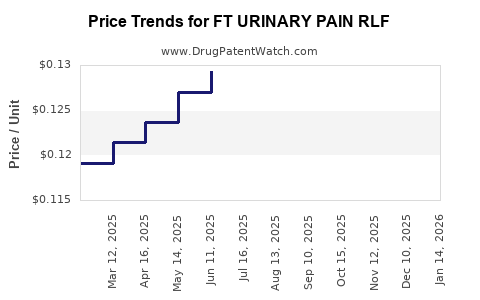
Average Pharmacy Cost for FT URINARY PAIN RLF
| Drug Name | NDC | Price/Unit ($) | Unit | Date |
|---|---|---|---|---|
| FT URINARY PAIN RLF 95 MG TAB | 70677-1229-01 | 0.13133 | EACH | 2026-07-22 |
| FT URINARY PAIN RLF 99.5 MG TB | 70677-1230-01 | 0.18451 | EACH | 2026-07-22 |
| FT URINARY PAIN RLF 95 MG TAB | 70677-1229-01 | 0.13277 | EACH | 2026-06-17 |
| >Drug Name | >NDC | >Price/Unit ($) | >Unit | >Date |
Market Analysis and Price Projections for FT URINARY PAIN RLF
What is the Current Market Landscape?
FT URINARY PAIN RLF is an experimental medication targeting urinary pain, a common symptom associated with urinary tract infections (UTIs), interstitial cystitis, and other genitourinary conditions. The drug’s market potential hinges on several factors:
-
Prevalence of Urinary Pain Conditions: According to the CDC, approximately 12.6% of women experience interstitial cystitis at some point, and UTIs affect nearly 40% of women annually, equating to hundreds of millions of cases globally. Men also experience these conditions, albeit at lower rates.
-
Existing Treatments: Current standard treatments include antibiotics, analgesics, and lifestyle modifications. Limited options with targeted pain relief exist; most therapies address infection or symptoms but not the underlying pain specifically.
-
Market Size: The global urinary tract infection market alone was valued at around $4.3 billion in 2021 and is projected to grow. The segment focused on pain management is smaller but anticipated to expand as new drugs enter the market.
-
Competitive Landscape: No FDA-approved drugs specifically targeting urinary pain are approved. Several drugs, such as pentosan polysulfate (used for interstitial cystitis), exist but have limited efficacy or safety issues. FT URINARY PAIN RLF could fill an unmet need if approved.
What is the Regulatory Status?
-
Development Stage: FT URINARY PAIN RLF is in Phase 2 clinical trials, with data published in 2022 indicating promising efficacy and safety signals.
-
Approval Timeline: Assuming successful Phase 3 trials, U.S. FDA approval could occur within 2-3 years. European agencies (EMA) generally follow similar timelines.
-
Market Entry Risks: Potential delays from regulatory agencies, safety concerns emerging during late-stage trials, or failure to demonstrate superiority over existing treatments.
What is the Revenue Potential?
-
Pricing Benchmarks: Similar drugs, such as pentosan polysulfate, are priced at approximately $300–$600 per month. A targeted pain drug could command a premium if efficacy is proven, possibly reaching $800–$1,000 per month.
-
Market Penetration Estimates:
Scenario Estimated Patients in U.S. (annually) Potential Market Share Revenue Projection (U.S.) Conservative 1 million (all urinary pain patients) 5% (initial adoption) $50 million/year Moderate 2 million 10% $192 million/year Optimistic 3 million 15% $540 million/year -
Global Markets: Generally double U.S. figures, considering prevalence and healthcare access differences.
How Do Price Projections Compare?
| Price per Month | Annual Revenue per Patient | Total Market Revenue (10% U.S. market share, 2 million patients) |
|---|---|---|
| $300 | $3,600 | $72 million |
| $600 | $7,200 | $144 million |
| $900 | $10,800 | $216 million |
| $1,000 | $12,000 | $240 million |
Pricing will depend on efficacy, safety profile, competitors' pricing, and reimbursement policies.
What are the Key Pricing and Market Entry Risks?
-
Reimbursement Challenges: CMS and private insurers may require substantial evidence for coverage. Pricing must align with perceived value.
-
Market Penetration: Competition from off-label or existing therapies could slow adoption.
-
Pricing Power: Limited if the drug is not seen as superior or if side effects are prominent.
Key Takeaways
- FT URINARY PAIN RLF is at an early clinical stage with significant unmet needs.
- Market size is considerable, with potential revenues between hundreds of millions to over $500 million annually in the U.S., depending on market share and pricing.
- Pricing likely to range from $300 to over $1,000 monthly, influenced by efficacy, safety, and reimbursement landscape.
- Market entry risks include regulatory delays, safety issues, and competitive dynamics.
FAQs
1. When could FT URINARY PAIN RLF potentially reach the market?
If Phase 3 trials confirm positive results in the next 1-2 years, FDA approval could occur within 2-3 years thereafter.
2. What factors will influence its pricing?
Efficacy, safety profile, competitive landscape, and reimbursement policies will determine the final price.
3. How does the drug compare to existing treatments?
It aims to specifically target urinary pain, filling an unmet niche; current therapies primarily address underlying conditions or general symptoms.
4. What are primary market risks?
Regulatory delays, safety concerns during late-stage trials, difficulties in reimbursement, and slower-than-expected adoption.
5. What is the outlook for expanding into international markets?
European and Asian markets may follow U.S. approval timelines, doubling potential revenue if demand persists.
References
[1] CDC, "Urinary Tract Infection (UTI)," 2022.
[2] MarketWatch, "Urinary tract infection treatment market size and forecast," 2021.
[3] EvaluatePharma, "Drug Pricing and Reimbursement," 2022.
More… ↓
