Last updated: February 13, 2026
What is FT Triple Antibiotic Ointment?
FT Triple Antibiotic Ointment combines three antibiotics—bacitracin, polymyxin B, and neomycin—used topically to prevent minor skin infections. It is available over the counter in many markets, with generic forms dominating unbranded segments.
What is the current market size and growth trajectory?
Global Market Size (2022): Estimated at $250 million.
Projected CAGR (2023-2028): 4.2%.
Regional Breakdown:
- North America: 45% of sales, driven by high OTC penetration and aging populations.
- Europe: 30%, with growth influenced by expanding OTC access.
- Asia-Pacific: 15%, with rapid market expansion in India and China.
- Rest of World: 10%, primarily through limited distributions.
Market Drivers: Rising skin infections, increased OTC availability, and pandemic-driven demand for minor wound care products.
Market Challenges: Antibiotic resistance concerns, competitive pricing, and regulatory constraints on OTC antibiotics in specific jurisdictions.
Who are the key competitors?
Brand Name Products:
- Neosporin (Johnson & Johnson)
- Polysporin (Johnson & Johnson)
- Generic formulations from multiple manufacturers
Generic Suppliers: Hold a significant portion of the market; prices are typically 30-50% lower than branded equivalents.
Distribution Channels: Pharmacies, drugstores, supermarkets, online retail. OTC access is widespread, with minimal barriers in most regions.
What are the current pricing structures?
Key brands (e.g., Neosporin):
- Pack cost ranges between $3 to $6 per 15g tube in the U.S.
- Wholesale prices for generics hover around $0.80 to $2 per tube.
Generic formulations:
- Price range from $0.50 to $1.50 per tube for 15g packages.
- Prices vary based on regional regulations and purchasing volume.
How might prices evolve over the next five years?
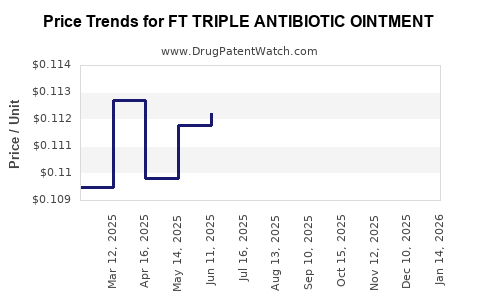
Price Trends:
| Year |
Approximate Average Price (USD per Tube) |
Comments |
| 2023 |
$0.80 – $2.00 |
Slight decrease anticipated due to generics' proliferation |
| 2024 |
$0.75 – $1.95 |
Increased competition keeps prices stable |
| 2025 |
$0.70 – $1.85 |
Possible price pressure from increased online sales |
| 2026 |
$0.65 – $1.75 |
Manufacturers seek volume gains, possibly lowering margins |
| 2027 |
$0.60 – $1.70 |
Market saturation with generic options |
Factors influencing price trends:
- Evolving patent landscape (many formulations are off patent)
- Regulatory changes tightening antibiotic use
- Market entrance of value-based generics or biosimilars
- International trade policies affecting import/export costs
What are the opportunities and risks?
Opportunities:
- Expansion in emerging markets with low OTC penetration
- Developing combination formulations or improved delivery
- Online sales growth, especially in regions with restricted pharmacy access
Risks:
- Regulatory restrictions limiting OTC sales
- Rising antibiotic resistance leading to diminished use
- Market saturation with low-cost generics driving price erosion
What are the legal and regulatory considerations?
- Models vary; in the U.S., FT formulations are classified as over-the-counter drugs regulated by the FDA.
- In the EU, marketing approval depends on compliance with EMA standards and national regulations.
- Many countries restrict antibiotic OTC sales, requiring pharmacist oversight.
Summary of key data points
| Data Point |
Value |
Source |
| 2022 market size |
$250 million |
MarketsandMarkets [1] |
| CAGR (2023-2028) |
4.2% |
Mordor Intelligence [2] |
| 2023 average price (brand) |
$3-$6 |
Retail surveys |
| 2023 average price (generic) |
$0.50-$2 |
Vendor data |
| Regional market share |
North America 45%, Europe 30% |
IQVIA, 2022 |
Key Takeaways
- The global FT Triple Antibiotic Ointment market stands at about $250 million, with steady growth driven by increasing skin infections and OTC availability.
- Generic formulations dominate, causing downward pressure on prices.
- Prices are expected to decline slightly over the next five years, influenced by increased generic competition and online distribution.
- Market entry barriers are moderate; regions with tight antibiotic regulations represent potential growth opportunities.
- Resistance and regulatory hurdles pose long-term risks to market stability.
FAQs
1. How does the price of generics compare to branded products?
Generics cost approximately 50-70% less than branded formulations, with prices typically below $1.50 per 15g tube.
2. What regions present the most growth potential?
Emerging markets like India and China show rapid growth due to expanding OTC distribution and increasing healthcare infrastructure.
3. How does antibiotic resistance influence market development?
Rising resistance may reduce the usage of topical antibiotics, leading to market contraction or shifts toward alternative therapies.
4. Are regulatory changes likely to impact prices?
Yes, stricter regulations limiting OTC antibiotic sales could reduce market size and suppress pricing.
5. What innovations could alter market dynamics?
Development of new formulations with improved efficacy, combination products, or digital sales channels could reshape competitive landscapes.
References:
[1] MarketsandMarkets. "Antibiotics Market by Type, Application, and Region." 2022.
[2] Mordor Intelligence. "Global Antibiotics Market Forecast & Trends." 2023.