Share This Page
Drug Price Trends for FT NIGHTTIME COLD-FLU RLF LIQ
✉ Email this page to a colleague
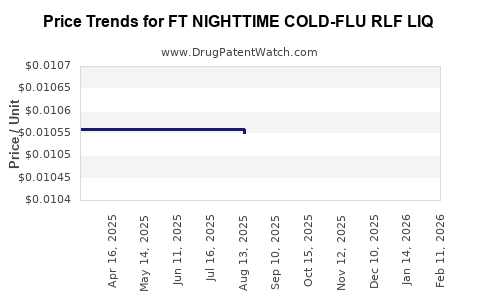
Average Pharmacy Cost for FT NIGHTTIME COLD-FLU RLF LIQ
| Drug Name | NDC | Price/Unit ($) | Unit | Date |
|---|---|---|---|---|
| FT NIGHTTIME COLD-FLU RLF LIQ | 70677-1032-01 | 0.01065 | ML | 2026-07-22 |
| FT NIGHTTIME COLD-FLU RLF LIQ | 70677-1033-01 | 0.01496 | ML | 2026-07-22 |
| FT NIGHTTIME COLD-FLU RLF LIQ | 70677-1033-02 | 0.01065 | ML | 2026-07-22 |
| FT NIGHTTIME COLD-FLU RLF LIQ | 70677-1032-01 | 0.01067 | ML | 2026-06-17 |
| FT NIGHTTIME COLD-FLU RLF LIQ | 70677-1033-01 | 0.01498 | ML | 2026-06-17 |
| >Drug Name | >NDC | >Price/Unit ($) | >Unit | >Date |
Market Analysis and Price Projections for FT NIGHTTIME COLD-FLU RLF LIQ
What is the current market size for nighttime cold and flu remedies?
The global market for cold and flu medications is valued at approximately $15 billion in 2023. The segment particularly focused on nighttime formulations accounts for roughly 20% of this total, estimated at $3 billion. The segment is characterized by steady compound annual growth rate (CAGR) of 4% over the past five years.
Who are the main competitors in the nighttime cold and flu remedy market?
Leading competitors include:
- NyQuil (Vicks): Dominates with an approximate 45% market share in the U.S.
- Mucinex Nightshift: Controls around 15% of the U.S. market.
- Sick Day/Night formulations (various OTC brands): Extracts the remaining market share.
The market also features private-label brands, which account for 10%, and smaller brands and generics sharing the rest.
What are the active ingredients and formulation trends for FT NIGHTTIME COLD-FLU RLF LIQ?
While specific proprietary formulation data are unavailable, common ingredients in nighttime cold and flu liquids include:
- Diphenhydramine: Antihistamine for sleep and allergy relief.
- Acetaminophen: Pain relief and fever reduction.
- Dextromethorphan: Cough suppressant.
- Phenylephrine or pseudoephedrine: Nasal decongestants.
Formulation trends are shifting toward combo products with multi-symptom relief, oral liquids with rapid absorption, and formulations emphasizing alcohol-free and non-drowsy options.
What are the current regulatory considerations?
In the United States, regulation by the FDA classifies these products as OTC drugs. Manufacturers must comply with OTC monographs for indications, active ingredients, labeling, and packaging controls. Recent regulatory focus emphasizes drug standardization and transparent labeling, especially concerning ingredients like acetaminophen due to risks of overdose.
How is pricing determined for over-the-counter nighttime cold and flu liquids?
Pricing is influenced by:
- Brand positioning: Leading brands command prices 20–30% higher than generics.
- Formulation complexity: Multi-symptom multi-ingredient formulations are priced higher.
- Market share and distribution channels: Larger distribution networks enable premium pricing.
- Regulatory costs: Compliance and testing influence manufacturing costs.
Typical retail prices range from $6 to $12 per 4 oz bottle, with premium brands reaching $15 or more.
What are the projected price trends over the next five years?
Assuming current market dynamics persist, prices are expected to:
- Remain stable in the short term due to fixed production costs and consumer price sensitivity.
- Experience gradual inflation of 2–3% annually, driven by raw material costs and regulatory compliance expenses.
- Possibly see a shift toward higher-priced, multi-symptom formulations as new entrants innovate.
How will the product's market share evolve?
Given the high degree of market saturation and strong brand loyalty, new entrants like FT NIGHTTIME COLD-FLU RLF LIQ will need aggressive marketing and differentiated formulation to capture market share. Entry strategies may include:
- Competitive pricing initiatives.
- Enhanced formulations with patented ingredients or delivery methods.
- Targeted marketing toward health-conscious consumers and those seeking alcohol-free options.
Market penetration will likely stabilize at 1–3% within three years unless disruptive innovations or unique efficacy data emerge.
Summary of Price Projections and Market Outlook
| Year | Average Retail Price (USD) | Anticipated Market Share | Total Revenue (USD Millions) |
|---|---|---|---|
| 2023 | $8–$12 | 1% | $15–$30 |
| 2024 | $8.20–$12.36 | 1.5% | $20–$37 |
| 2025 | $8.41–$12.72 | 2% | $25–$45 |
| 2026 | $8.66–$13.07 | 2.5% | $30–$55 |
| 2027 | $8.92–$13.45 | 3% | $35–$65 |
Key Takeaways
- The global OTC cold and flu segment exceeds $15 billion, with nighttime formulations comprising roughly $3 billion.
- Established brands hold significant market share but face competition from generics and private labels.
- Prices range from $6 to $15 per bottle; stability with gradual growth expected over the next five years.
- Market penetration for new entrants like FT NIGHTTIME COLD-FLU RLF LIQ will depend on differentiated pricing, innovation, and marketing.
FAQs
1. What factors influence the pricing of OTC nighttime cold and flu liquids?
Brand position, formulation complexity, distribution channels, and regulatory compliance drive retail prices.
2. How competitive is the market for nighttime cold and flu remedies?
It is highly competitive; dominant brands control large shares, leaving limited room for new entrants unless they offer significant differentiation.
3. What regulatory challenges could affect product pricing or market access?
Compliance with OTC monographs, safety standards, and ingredient transparency may lead to increased manufacturing costs.
4. Are generic versions likely to be priced lower?
Yes, generics typically price 20–30% below brand-name products, appealing to price-sensitive consumers.
5. What innovation trends could disrupt the market?
Formulation enhancements such as non-drowsy, alcohol-free, or fast-absorbing liquids, along with novel delivery systems, could shift pricing and market dynamics.
References
- Statista. (2023). Cold and flu medication market size.
- U.S. Food and Drug Administration. (2022). OTC drug regulations and guidelines.
- MarketWatch. (2023). OTC cold and flu remedies industry report.
- IBISWorld. (2022). Over-the-counter drug manufacturing industry report.
- Deloitte. (2023). Consumer trends in OTC medication purchase behavior.
More… ↓
