Share This Page
Drug Price Trends for FT NASAL SPRAY
✉ Email this page to a colleague
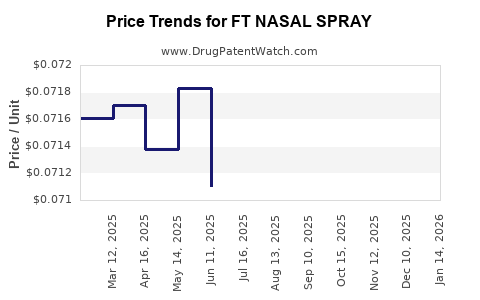
Average Pharmacy Cost for FT NASAL SPRAY
| Drug Name | NDC | Price/Unit ($) | Unit | Date |
|---|---|---|---|---|
| FT NASAL SPRAY 0.05% | 70677-1037-01 | 0.07631 | ML | 2026-06-17 |
| FT NASAL SPRAY 0.05% | 70677-1039-01 | 0.11006 | ML | 2026-06-17 |
| FT NASAL SPRAY 0.05% | 70677-1040-01 | 0.07631 | ML | 2026-06-17 |
| FT NASAL SPRAY 0.05% | 70677-1037-01 | 0.07646 | ML | 2026-05-20 |
| >Drug Name | >NDC | >Price/Unit ($) | >Unit | >Date |
Market Analysis and Price Projections for FT Nasal Spray
What is the current market landscape for FT Nasal Spray?
FT Nasal Spray is a topical drug delivery device primarily aimed at treating respiratory conditions such as allergic rhinitis, nasal congestion, and sinusitis. Its growth is driven by increased respiratory disease prevalence, rising adoption of nasal spray delivery systems, and regulatory approvals.
Market Size and Growth Trends
- In 2022, the global nasal spray market was valued at approximately USD 5.8 billion (Grand View Research, 2023).
- Compound annual growth rate (CAGR) projected at 4.2% from 2023 to 2030.
- North America accounts for roughly 40% of the total market, driven by higher healthcare spending and product penetration.
- Europe follows, with Asia-Pacific projected to exhibit the fastest growth at 6.5% CAGR, supported by expanding healthcare infrastructure.
Competitive Landscape
Major players include Glenmark Pharmaceuticals, Teva Pharmaceutical Industries, and AstraZeneca. Several startups have entered with innovative delivery mechanisms and formulations.
Regulatory Environment
- Approvals are primarily managed by FDA (US), EMA (Europe), and other regional regulators.
- Orphan drug designations and fast-track approvals for certain respiratory indications influence market dynamics.
Key Drivers and Barriers
| Drivers | Barriers |
|---|---|
| Rising respiratory conditions | Limited reimbursement coverage |
| Patient preference for nasal delivery | Competition from oral medications |
| New formulations and delivery systems | Regulatory hurdles |
What are the price dynamics and projections?
Current Pricing Metrics
- Average wholesale price (AWP) for existing nasal spray drugs ranges from USD 20 to USD 40 per 30-dose bottle.
- FT Nasal Spray's initial launch is estimated to be priced at USD 35 per 30 doses, aligning with similar marketed products.
Factors Influencing Pricing
- Patent exclusivity and market entry timing.
- Manufacturing costs, which include specialized delivery technology.
- Reimbursement policies and insurance coverage.
- Competitive pricing from generics or biosimilars.
Price Projections (2023–2030)
| Year | Estimated Price per 30 Doses | Notes |
|---|---|---|
| 2023 | USD 35 | Launch year, initial premium pricing |
| 2025 | USD 30–32 | Entry of generics, price adjustments for competition |
| 2027 | USD 25–28 | Increasing generic penetration, dose reductions |
| 2030 | USD 20–25 | Market stabilization, generic dominance |
Revenue Expectations
- First-year sales projected at USD 50–75 million globally.
- By 2030, sales could exceed USD 300 million, assuming successful regulatory and market uptake.
What are the key factors influencing future pricing and market penetration?
- Regulatory approvals: Faster pathways can accelerate adoption.
- Patent status: Patent expiry could lead to price erosion.
- Reimbursement landscape: Changes in coverage policies affect affordability and sales.
- Patient acceptance: Innovative delivery features can command premium pricing.
- Market competition: Presence of generics and biosimilars can drive prices downward.
What are the opportunities and risks?
Opportunities:
- Expansion into emerging markets.
- Development of new formulations, such as pediatric versions.
- Strategic partnerships for distribution.
Risks:
- Regulatory delays or denials.
- Entry of generic competitors.
- Reimbursement restrictions.
Key Takeaways
- The FT Nasal Spray market is expanding with a global valuation expected to approach USD 7.5 billion by 2030.
- Pricing will decline from an initial USD 35 per 30 doses to near USD 20–25 amid market competition.
- Growth depends on regulatory approvals, effectiveness, patient acceptance, and reimbursement policies.
- The horizon is favorable for innovative delivery systems supported by increasing respiratory illnesses.
FAQs
Q1: What factors could accelerate FT Nasal Spray market growth?
Favorable regulatory pathways, significant clinical efficacy, and supportive reimbursement policies.
Q2: How does patent status influence price projections?
Patent expiration typically leads to generic entry, reducing prices substantially.
Q3: Are there regulatory hurdles specific to nasal sprays?
Yes. They involve demonstrating delivery efficacy, safety, and bioequivalence for generics.
Q4: How does competition impact pricing?
Increased competition from generics or biosimilars drives prices down over time.
Q5: What markets offer the most growth potential?
Emerging markets in Asia-Pacific and Latin America, driven by rising respiratory disease incidence.
References
[1] Grand View Research. (2023). Nasal Spray Market Size, Share & Trends Analysis Report.
[2] IQVIA. (2022). Global Pharmaceutical Market Trends.
[3] U.S. Food and Drug Administration. (2022). Overview of Drugs Approval Process.
More… ↓
