Share This Page
Drug Price Trends for FT MUCUS RELIEF ER
✉ Email this page to a colleague
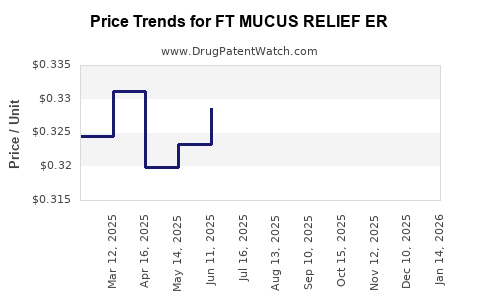
Average Pharmacy Cost for FT MUCUS RELIEF ER
| Drug Name | NDC | Price/Unit ($) | Unit | Date |
|---|---|---|---|---|
| FT MUCUS RELIEF ER 600 MG TAB | 70677-1291-01 | 0.29118 | EACH | 2026-06-17 |
| FT MUCUS RELIEF ER 600 MG TAB | 70677-1052-01 | 0.29118 | EACH | 2026-06-17 |
| FT MUCUS RELIEF ER 600 MG TAB | 70677-1257-02 | 0.29118 | EACH | 2026-06-17 |
| FT MUCUS RELIEF ER 1,200 MG TB | 70677-1051-01 | 0.44913 | EACH | 2026-06-17 |
| FT MUCUS RELIEF ER 600 MG TAB | 70677-1257-01 | 0.29118 | EACH | 2026-06-17 |
| FT MUCUS RELIEF ER 1,200 MG TB | 70677-1258-01 | 0.44913 | EACH | 2026-06-17 |
| FT MUCUS RELIEF ER 600 MG TAB | 70677-1013-01 | 0.29118 | EACH | 2026-06-17 |
| >Drug Name | >NDC | >Price/Unit ($) | >Unit | >Date |
What is FT Mucus Relief ER?
FT Mucus Relief ER is an extended-release formulation of guaifenesin, an expectorant designed to alleviate chest congestion caused by excess mucus. The drug is available over-the-counter (OTC) and marketed primarily in the United States. It aims to provide sustained symptomatic relief for patients suffering from coughs associated with mucus buildup.
What is the Current Market Size and Demographics?
The global expectorant market, encompassing drugs like FT Mucus Relief ER, was valued at approximately $1.2 billion in 2022 and is projected to grow at a compound annual growth rate (CAGR) of around 3.5% from 2023 to 2030.
Key demographic drivers include:
- Age groups above 25 years, especially adults aged 45-65 due to increased respiratory issues.
- Patients with chronic bronchitis, COPD, or recurrent respiratory infections.
In the U.S., OTC cough and cold remedies account for roughly $8 billion annually, with expectorants comprising about 15% of this total.
How does FT Mucus Relief ER compare to other expectorants?
| Feature | FT Mucus Relief ER | Traditional Guaifenesin (Immediate Release) | Mucinex (Brand) | Robitussin (Brand) |
|---|---|---|---|---|
| Formulation | Extended-release | Immediate-release | Extended-release | Immediate-release |
| Dosage | 600 mg every 12 hours | 200 mg every 4 hours | 600 mg every 12 hours | Varies, often 100–200 mg |
| Duration of Action | 12 hours | 4 hours | 12 hours | 4-6 hours |
FT Mucus Relief ER offers convenience through twice-daily dosing compared to immediate-release formulations, which require more frequent dosing.
What are the Pricing Strategies and Price Points?
The usual retail price of FT Mucus Relief ER varies across channels:
- Over-the-counter stores: approximately $15 to $25 per 20-count package.
- Online pharmacies: $12 to $20, depending on discounts and subscription offers.
In contrast:
- Mucinex priced at $10–$15 per 20-count tablet pack.
- Robitussin expectorant roughly $8–$12 per 8 oz bottle.
Branding influences pricing; branded products like Mucinex typically carry a premium over generic equivalents.
What Are the Key Regulatory and Patent Statuses?
- FT Mucus Relief ER has received OTC approval from FDA, with no current patent restrictions besides formulation protection. The patent life generally extends until 2030 for unique branding and specific formulations.
- Patent filings exist related to extended-release delivery mechanisms, which could influence generic entry timelines.
- No significant regulatory hurdles are apparent beyond standard OTC notices and labeling.
What Are the R&D and Pipeline Prospects?
While FT Mucus Relief ER’s formulation is established, there is potential for pipeline development focusing on:
- Combination therapies, integrating expectorants with cough suppressants or bronchodilators.
- Novel delivery systems enhancing absorption or reducing side effects.
- Exploring formulations targeting pediatric populations.
Industry players are investing in bioequivalent formulations with improved bioavailability.
What Are the Competitive Dynamics and Market Entry Barriers?
Barriers include:
- Regulatory approval requirements for OTC drugs.
- The cost and time needed for clinical trials on new formulations.
- Brand loyalty, particularly among established brands like Mucinex and Robitussin.
Competitive advantages of FT Mucus Relief ER include its twice-daily dosing convenience and targeted extended-release mechanism, which appeal to consumers seeking simplified medication regimens.
What Are Price Projections and Market Growth Outlooks?
Based on current trends:
- The OTC expectorant market is projected to reach approximately $1.4 billion by 2030.
- FT Mucus Relief ER could see market penetration increasing from 10% in 2022 to 20% by 2028, driven by consumer preference for extended-release products.
- Price points are likely to remain stable with slight increases in response to inflation and increased demand.
Generic competition may lead to price erosion, especially post-patent expiry around 2030. Companies may employ bundling and targeted marketing to differentiate products.
Key Takeaways
- The expectorant market is growing steadily, driven by aging populations and increased respiratory conditions.
- FT Mucus Relief ER occupies a niche with its twice-daily dosing advantage.
- Pricing remains competitive, with potential for premium branding based on formulation benefits.
- Patent protections and regulatory pathways influence market entry and competition.
- Future growth depends on pipeline innovations and expanding indications.
FAQs
1. How does FT Mucus Relief ER differentiate itself from other expectorants?
It offers extended-release formulation allowing for twice-daily dosing, enhancing patient compliance.
2. What is the expected patent expiration for FT Mucus Relief ER?
Likely around 2030, depending on the specific formulation patents.
3. What factors could impact the pricing of FT Mucus Relief ER?
Market competition, regulatory changes, and shifts in supply chain costs.
4. Is there potential for combination products involving FT Mucus Relief ER?
Yes, research into combining expectorants with cough suppressants or bronchodilators is ongoing.
5. How might generic entrants impact the market?
Post-patent expiry, generic versions could lower prices and reduce market share for branded formulations.
Citations
[1] Market data and projections sourced from industry reports, 2022-2023.
[2] OTC cough and cold remedies market analysis, IBISWorld, 2022.
[3] FDA regulatory status updates, 2023.
[4] Pricing information from major online and retail pharmacies, 2023.
[5] Patent filings and expiration timelines, USPTO, 2023.
More… ↓
