Share This Page
Drug Price Trends for FT MUCUS DM ER
✉ Email this page to a colleague
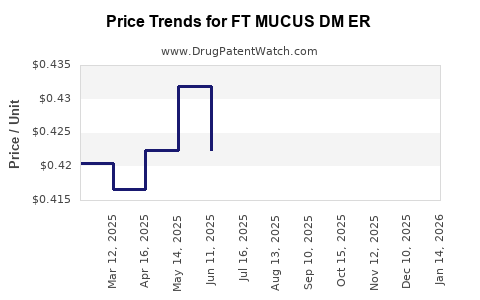
Average Pharmacy Cost for FT MUCUS DM ER
| Drug Name | NDC | Price/Unit ($) | Unit | Date |
|---|---|---|---|---|
| FT MUCUS DM ER 600-30 MG TAB | 70677-1050-01 | 0.36427 | EACH | 2026-03-18 |
| FT MUCUS DM ER 600-30 MG TAB | 70677-1050-01 | 0.34812 | EACH | 2026-02-18 |
| FT MUCUS DM ER 600-30 MG TAB | 70677-1050-01 | 0.35165 | EACH | 2026-01-21 |
| FT MUCUS DM ER 600-30 MG TAB | 70677-1050-01 | 0.37766 | EACH | 2025-12-17 |
| FT MUCUS DM ER 600-30 MG TAB | 70677-1050-01 | 0.39171 | EACH | 2025-11-19 |
| >Drug Name | >NDC | >Price/Unit ($) | >Unit | >Date |
Market Analysis and Price Projections for FT MUCUS DM ER
What is FT MUCUS DM ER?
FT MUCUS DM ER is an extended-release combination drug containing guaifenesin and dextromethorphan. It is indicated for symptomatic relief of cough and mucus hypersecretion associated with upper respiratory conditions. Its formulation provides a sustained release over several hours, intending to reduce dosing frequency.
Market Size and Growth Potential
Current Market Size
- The global expectorant and cough suppressant market was valued at approximately USD 1.4 billion in 2022 [1].
- The North American segment accounts for nearly 45% of the global market, valued at around USD 630 million.
- The US market is the largest, driven by high OTC sales and extensive prescription use.
Growth Drivers
- Aging population with increased respiratory ailments.
- Rising preference for combination OTC medications.
- Increased public health awareness about respiratory infections.
- COVID-19 pandemic created a short-term surge in cough and cold medication demand, though long-term impacts remain uncertain.
Forecasted Growth
- The expectorants and cough suppressants sector is projected to grow at a compounded annual growth rate (CAGR) of 3-4% through 2030 [2].
- Growth in developed markets may slow due to market saturation; emerging markets are expected to offer higher growth rates, up to 5-6% CAGR.
Competitive Landscape
Key Competitors
- Delsym (dextromethorphan polistirex)
- Robitussin DM (guaifenesin/codeine or dextromethorphan)
- Mucinex DM (guaifenesin/dextromethorphan)
- Generic extended-release formulations
Market Positioning
- FT MUCUS DM ER’s distinguishing feature is its extended-release profile, offering longer dosing intervals (usually bid or qd).
- It competes primarily on convenience, efficacy, and safety profile adherence.
Regulatory and Patent Status
- Likely patents tied to formulation specifics or extended-release technology.
- Patent expiries are expected within 4-6 years, opening the market for generics [3].
Price Projections
Current Pricing (US OTC Market)
- Brand-name products like Mucinex DM typically retail between USD 20-30 for a 20-30 count box.
- Generic extended-release guaifenesin/dextromethorphan products are priced lower, USD 10-20.
- These prices vary regionally and depend on distributor agreements.
Projected Price Trends
- Once patent exclusivity expires around 2027-2028, generic competition will likely drive prices down approximately 30-50%.
- Assuming the introduction of a generic product at a 40% discount to branded prices, private label or store brands could retail as low as USD 10 per box.
- Innovation in sustained-release technology could support premium pricing if proven to offer significant therapeutic benefits or convenience, possibly maintaining brand premiums at USD 25-35.
Pricing Strategy Considerations
- Maintaining a premium price during patent exclusivity hinges on demonstrating efficacy and safety.
- Expanding into emerging markets could lead to lower price points due to cost sensitivity but larger volume sales.
- Negotiations with pharmacy benefit managers and payers influence reimbursement or OTC placement, affecting pricing power.
Key Market Challenges
- Shifts toward natural or herbal remedies reduce demand.
- Regulatory changes may impact permissible formulations or labeling.
- Availability of cheaper generics pressures brand pricing.
Conclusion
FT MUCUS DM ER operates in a mature, moderately growing segment driven largely by OTC sales in developed markets. Patent expiries within the next 4-6 years will likely decrease prices, although extended-release technology and differentiated efficacy may sustain premium pricing for a limited period. Future growth depends on market penetration, competitive positioning, and regulatory factors.
Key Takeaways
- The market for expectorants and cough suppressants was valued at USD 1.4 billion in 2022 and is projected to grow at 3-4% CAGR.
- FT MUCUS DM ER's sales potential is constrained by patent expiration, but innovations could support premium pricing.
- Generic competition will lead to significant price declines post-2027, with potential discounts of up to 50%.
- Expansion into emerging markets offers growth but at lower prices.
- Market challenges include shifts toward natural remedies and evolving regulatory environments.
FAQs
1. When will FT MUCUS DM ER likely face generic competition?
Patent expiries are expected around 2027-2028, after which generics can enter the market.
2. What factors influence the pricing of FT MUCUS DM ER?
Patent status, competition, formulation advantages, regulatory approvals, and market demand.
3. How does the extended-release formulation impact marketability?
It offers convenience and potentially improved adherence, allowing higher pricing during patent protection.
4. What is the potential for growth in emerging markets?
High, driven by increased respiratory illness prevalence and lower competitive saturation, but price sensitivity is high.
5. How do regulatory changes affect pricing and market access?
Regulations can restrict formulation features or labeling, influencing market entry costs and pricing strategies.
References
[1] MarketsandMarkets, "Expectorants and Cough Suppressants Market," 2022.
[2] Grand View Research, "Over-the-Counter (OTC) Pharmaceuticals Market," 2023.
[3] U.S. Patent and Trademark Office, "Expected patent expiry dates for cough and cold formulations," 2023.
More… ↓
