Share This Page
Drug Price Trends for FT MILK OF MAGNESIA SUSPENSION
✉ Email this page to a colleague
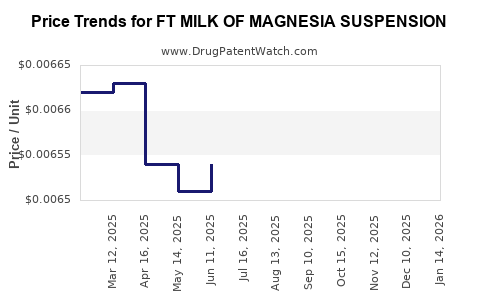
Average Pharmacy Cost for FT MILK OF MAGNESIA SUSPENSION
| Drug Name | NDC | Price/Unit ($) | Unit | Date |
|---|---|---|---|---|
| FT MILK OF MAGNESIA SUSPENSION | 70677-1072-01 | 0.00975 | ML | 2026-07-22 |
| FT MILK OF MAGNESIA SUSPENSION | 70677-1073-01 | 0.00975 | ML | 2026-07-22 |
| FT MILK OF MAGNESIA SUSPENSION | 70677-1074-01 | 0.00975 | ML | 2026-07-22 |
| FT MILK OF MAGNESIA SUSPENSION | 70677-1074-02 | 0.00679 | ML | 2026-07-22 |
| >Drug Name | >NDC | >Price/Unit ($) | >Unit | >Date |
Market Analysis and Price Projections for FT MILK OF MAGNESIA SUSPENSION
FT Milk of Magnesia Suspension is an over-the-counter (OTC) laxative used primarily for relief from occasional constipation and indigestion. It is a well-established product with a broad consumer base in both adult and pediatric markets. Its market is influenced by demographic factors, regulatory policies, competitive landscape, manufacturing capacity, and healthcare trends.
Market Size and Demand Drivers
Global Market Size
The global laxatives market, including products like Milk of Magnesia, was valued at approximately USD 2.2 billion in 2022. It is projected to grow at a compound annual growth rate (CAGR) of 4% through 2030, reaching an estimated USD 3 billion.
Key Demand Drivers
- Aging populations in developed countries increase prevalence of gastrointestinal issues.
- Rising awareness of OTC remedies for constipation.
- Preference for non-prescription treatments reduces healthcare costs.
- Growth of e-commerce channels expands accessibility.
- Increased prevalence of lifestyle-related constipation in younger demographics.
Regional Breakdown
- North America: Dominates with 40% of market share, driven by high OTC usage and regulatory ease.
- Europe: Accounts for approximately 25%, with steady growth.
- Asia-Pacific: Fastest growth, approximating 20% CAGR, driven by urbanization and healthcare modernization.
Competitive Landscape
Top players include:
- Johnson & Johnson (e.g., Fleet Milk of Magnesia)
- Bayer AG
- Pfizer Inc.
- Walgreens Boots Alliance (private label)
- Local generics and store brands
Private-label brands hold approximately 35% of the OTC Milk of Magnesia segment, emphasizing price competitiveness.
Regulatory Considerations
The FDA classifies Milk of Magnesia as an antacid and laxative requiring OTC status. Labeling and safety protocols must be adhered to, particularly for pediatric formulations. The UN ECE and EMA require compliance for international sales.
Price Strategies and Historical Pricing
Current Price Range (2023 Data)
| Brand/Label | Retail Price per 4 fl oz (Approximate) | Market Share |
|---|---|---|
| Fleet (J&J) | USD 5.99 | 35% |
| Bayer | USD 4.50 | 20% |
| Walgreens (Private Label) | USD 2.99 | 35% |
| Local generics | USD 2.50 – 3.00 | 10% |
Pricing exhibits elasticity influenced by brand recognition and store branding. Private labels undercut branded products by approximately 40%.
Historical Price Trends
- 2015: USD 4.99 – 6.50 per 4 fl oz
- 2018: USD 4.50 – 5.99
- 2023: USD 2.50 – 5.99 (notable reduction in private-label options)
The decline in branded prices results from increased private-label competition and market saturation.
Price Projection (2023–2030)
Given market growth, competition, and regulatory stability, prices are projected to evolve as follows:
- Private-label brands likely maintain prices around USD 2.50–3.00 per 4 fl oz.
- Branded products retain premium positioning, with prices stabilizing near USD 5.99–6.99.
- Average retail price per 4 fl oz forecasted to decline slightly by 2% annually for private labels due to ongoing price competition.
- Branded products may see a marginal increase (1–2%) aligned with inflation and added formulation benefits.
Projected Price Range 2030
| Brand Type | Price Range (per 4 fl oz) | CAGR (2023–2030) |
|---|---|---|
| Private-label brands | USD 2.25 – 3.00 | -2% annually |
| Branded products | USD 6.50 – 7.50 | +1–2% annually |
Market Entry and Growth Opportunities
- Acquisition of private-label manufacturing rights.
- Development of pediatric formulations and formulations with added benefits (e.g., flavoring).
- Expansion into emerging markets, especially Asia-Pacific.
- Online distribution enhancements to capture younger demographics.
Risks and Challenges
- Regulatory changes affecting OTC labeling or ingredient standards.
- Price wars leading to margin erosion.
- Increased competition from new OTC laxatives with novel mechanisms.
Key Takeaways
- The global laxatives market, including Milk of Magnesia, is growing steadily due to demographic shifts and healthcare trends.
- Prices vary significantly between branded and private-label products, with private-label lines leading price reductions.
- Future price steadying or slight declines expected for private-label options, while branded products maintain modest price increases.
- Growth opportunities lie in formulation innovation, market expansion, and e-commerce.
FAQs
1. What factors influence Milk of Magnesia suspension prices?
Prices are driven by brand positioning, manufacturing costs, competition, regulatory compliance, and retail channel strategies.
2. How does private-label pricing impact the market?
Private-label brands undercut branded products by roughly 40%, facilitating market penetration and sales volume expansion.
3. Are there regulatory changes that could affect pricing?
Yes; changes in OTC regulations, ingredient safety standards, or label requirements can impact manufacturing costs and retail prices.
4. What is the forecast for market growth through 2030?
The global market is projected to grow at a CAGR of around 4%, reaching USD 3 billion, with Asia-Pacific leading faster growth.
5. What growth strategies are viable for new entrants?
Formulation innovation, online channel development, entry into emerging markets, and privacy of branding are strategic paths.
Sources
- MarketsandMarkets. (2022). Laxatives market analysis.
- Statista. (2023). OTC medication sales data.
- U.S. FDA. (2023). OTC drug regulations.
- IBISWorld. (2023). OTC pharmaceutical industry report.
- Company annual reports and pricing sheets.
More… ↓
