Share This Page
Drug Price Trends for FT ISOPROPYL ALCOHOL
✉ Email this page to a colleague
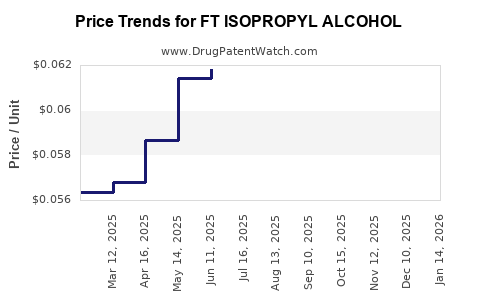
Average Pharmacy Cost for FT ISOPROPYL ALCOHOL
| Drug Name | NDC | Price/Unit ($) | Unit | Date |
|---|---|---|---|---|
| FT ISOPROPYL ALCOHOL 91% | 70677-1250-01 | 0.05547 | ML | 2026-07-22 |
| FT ISOPROPYL ALCOHOL 91% | 70677-1250-01 | 0.05548 | ML | 2026-06-17 |
| FT ISOPROPYL ALCOHOL 91% | 70677-1250-01 | 0.05532 | ML | 2026-05-20 |
| >Drug Name | >NDC | >Price/Unit ($) | >Unit | >Date |
Market Analysis and Price Projections for FT Isopropyl Alcohol
Market Overview
FT Isopropyl Alcohol (IPA) is primarily used as an antiseptic, disinfectant, solvent in manufacturing, and in cleaning products. The global demand for IPA has grown due to increased hygiene standards, particularly post-pandemic, and its extensive usage across pharmaceuticals, cosmetics, and industrial sectors.
Key Market Drivers
- Rising public health standards boost demand for disinfectants.
- Expanding pharmaceutical segment for sanitizing products.
- Increased industrial use in electronics, cleaning, and manufacturing processes.
- Supply chain disruptions impacting raw material availability.
Market Size and Historical Growth
According to Grand View Research, the global IPA market was valued at approximately USD 3.2 billion in 2021. The compound annual growth rate (CAGR) from 2022 to 2027 is projected at around 4.5%. The Asia-Pacific region accounts for over 45% of the market, driven by large manufacturing bases in China, India, and Southeast Asia.
| Year | Market Size (USD billion) | CAGR (2022-2027) |
|---|---|---|
| 2021 | 3.2 | |
| 2022 | 3.34 | 4.5% |
| 2023 | 3.49 | 4.5% |
| 2024 | 3.64 | 4.5% |
| 2025 | 3.79 | 4.5% |
| 2026 | 3.95 | 4.5% |
| 2027 | 4.11 | 4.5% |
Pricing Landscape
The price trajectory of FT Isopropyl Alcohol exhibits volatility linked closely to raw material costs, energy prices, and regional demand-supply dynamics. In 2022, FOB Asia prices averaged USD 1,200–1,300 per metric ton, with fluctuations driven by feedstock methanol costs.
Price fluctuations are typically within a range of ±10% annually. Raw methyl acetone or acetone supply constraints can cause earlier price surges, with costs often impacting Wholesale and FOB prices significantly.
Factors Influencing Supply and Pricing
- Raw Material Costs: Methanol and acetone prices directly impact IPA costs. Rising crude oil prices increase acetone and methanol prices.
- Production Capacity: An oversupply can depress prices; capacity additions tend to stabilize market prices.
- Regulatory Changes: Environmental regulations can increase operational costs, affecting product pricing.
- Global Supply Chain Disruptions: Container shortages and geopolitical tensions influence availability and freight costs.
Price Projections (2023–2027)
Based on current trends, FOB Asia prices are expected to increase gradually. The average FOB price is projected to reach USD 1,350–1,450 per metric ton by 2027, driven by raw material costs and logistical constraints.
| Year | Estimated FOB Price (USD/MT) |
|---|---|
| 2023 | 1,250–1,350 |
| 2024 | 1,300–1,400 |
| 2025 | 1,330–1,430 |
| 2026 | 1,350–1,450 |
| 2027 | 1,350–1,450 |
Regional Price Variations
- North America: Prices hover around USD 1,400–1,500 per metric ton.
- Europe: Slightly higher, USD 1,420–1,520, impacted by stricter environmental regulations.
- Asia-Pacific: The lowest, USD 1,200–1,300, because of large bulk manufacturing and raw material availability.
Market Challenges
- Raw material price volatility.
- Regulatory pressures especially in Europe and North America.
- Environmental norms that potentially restrict production processes.
- Competitive landscape with new capacity developments in Asia.
Opportunities
- Growth in healthcare sectors propels demand for high-purity IPA.
- Expansion in emerging markets increases regional consumption.
- Innovation in formulations boosting demand for specialty IPA grades.
Key Takeaways
- Global IPA market reached USD 3.2 billion in 2021, projecting a 4.5% CAGR to 2027.
- Prices are driven by raw material costs, supply chain factors, and regional regulations.
- FOB Asia prices are expected to range between USD 1,350–1,450 per metric ton by 2027.
- Market growth is contingent on supply chain stability, raw material pricing, and regulatory environment.
- Asia-Pacific remains dominant, with significant capacity additions impacting regional prices.
FAQs
1. How does raw material cost influence FT Isopropyl Alcohol pricing?
Raw material costs, primarily methanol and acetone, have a direct impact. Price increases in these commodities inflate IPA manufacturing costs, leading to higher FOB and CIF prices.
2. What factors could disrupt the supply chain for FT Isopropyl Alcohol?
Disruptions can arise from geopolitical tensions, container shortages, environmental regulations, or raw material shortages, which all affect marketplace supply and pricing stability.
3. Which regions are the largest consumers of FT Isopropyl Alcohol?
Asia-Pacific leads in consumption, driven by growth in manufacturing and healthcare sectors. North America and Europe also represent significant markets but are more affected by regulatory constraints.
4. How will environmental policies affect market prices?
Stricter emissions and waste management regulations increase operational costs, potentially raising market prices. Facilities may also face reductions in capacity or operational constraints.
5. What is the outlook for new capacity investments in FT Isopropyl Alcohol?
Investments are primarily in Asia-Pacific, aiming to meet rising demand. Capacity additions may stabilize or moderate price increases but depend on raw material availability and environmental compliance costs.
Sources
[1] Grand View Research, "Isopropyl Alcohol Market Size, Share & Trends Analysis Report," 2022.
More… ↓
