Share This Page
Drug Price Trends for FT INFANT PAIN-FEVER
✉ Email this page to a colleague
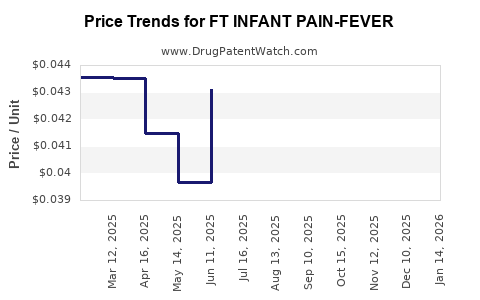
Average Pharmacy Cost for FT INFANT PAIN-FEVER
| Drug Name | NDC | Price/Unit ($) | Unit | Date |
|---|---|---|---|---|
| FT INFANT PAIN-FEVER 160 MG/5 | 70677-1253-01 | 0.05165 | ML | 2026-06-17 |
| FT INFANT PAIN-FEVER 160 MG/5 | 70677-1253-01 | 0.05751 | ML | 2026-05-20 |
| FT INFANT PAIN-FEVER 160 MG/5 | 70677-1253-01 | 0.05383 | ML | 2026-04-22 |
| FT INFANT PAIN-FEVER 160 MG/5 | 70677-1253-01 | 0.04760 | ML | 2026-03-18 |
| FT INFANT PAIN-FEVER 160 MG/5 | 70677-1253-01 | 0.04301 | ML | 2026-02-18 |
| FT INFANT PAIN-FEVER 160 MG/5 | 70677-1253-01 | 0.04263 | ML | 2026-01-21 |
| >Drug Name | >NDC | >Price/Unit ($) | >Unit | >Date |
What is the current market landscape for FT Infant Pain-Fever?
FT Infant Pain-Fever is a pediatric medication indicated for mild to moderate pain and fever relief in infants. It is primarily used by healthcare providers and caregivers for managing common pediatric ailments. The drug enters a highly regulated market with established therapeutic options such as acetaminophen and ibuprofen.
What is the global market size for pediatric pain and fever medications?
The global pediatric analgesics market was valued at approximately USD 2.5 billion in 2022. This market is expected to expand at a compound annual growth rate (CAGR) of nearly 4% from 2023 to 2030, driven by increasing awareness of pediatric healthcare and rising prevalence of infectious diseases.
Regional Market Overview
| Region | Market Size (2022) | CAGR (2023-2030) | Key Drivers |
|---|---|---|---|
| North America | USD 1.2 billion | 3.5% | High healthcare expenditure, strong pediatric care standards. |
| Europe | USD 700 million | 4.2% | Aging population, increased healthcare access. |
| Asia-Pacific | USD 400 million | 5.0% | Growing middle class, expanding healthcare infrastructure. |
| Rest of World | USD 200 million | 4.5% | Improved healthcare awareness, rural healthcare development. |
How does FT Infant Pain-Fever compare to existing therapies?
FT Infant Pain-Fever competes primarily with ibuprofen and acetaminophen pediatric formulations. Key differentiators include formulation safety, dosing convenience, and regulatory approvals. Patent status influences market exclusivity; if FT Infant Pain-Fever holds patents, it can command premium pricing initially.
What are the factors influencing pricing strategies?
Pricing depends on multiple factors:
- Regulatory status: Approval by agencies such as the FDA or EMA allows for pricing premiums.
- Patent protections: Exclusive rights prevent generic competition, enabling higher prices.
- Market penetration: Distribution channels, healthcare provider acceptance, and caregiver awareness influence pricing.
- Competitive landscape: Presence of generics drives prices downward.
- Manufacturing costs: Formulation complexity affects profit margins.
What are current price ranges in key markets?
| Market | Typical Retail Price (per dose) | Approximate Price Range | Notes |
|---|---|---|---|
| US | USD 0.50 - 1.50 | USD 0.50 - 1.50 | Higher if branded, lower for generics |
| Europe | EUR 0.40 - 1.20 | EUR 0.40 - 1.20 | Similar to US, varies by country |
| Asia-Pacific | USD 0.30 - 1.00 | USD 0.30 - 1.00 | Lower overall prices, influenced by market maturity |
Price projections for a new entrant like FT Infant Pain-Fever typically assume a premium over generics initially, with potential reductions following patent expiry or increased competition.
What are the projected price trends?
Over the next 5 years:
- North America and Europe: Prices are expected to decrease by 10-15% as generic versions enter the market.
- Asia-Pacific: Prices may remain relatively stable due to lower brand penetration.
- Post-patent expiry: Prices could fall by up to 50% as generics increase market share.
What revenue opportunities exist?
Assuming successful market entry and favorable regulatory positioning, the estimated global sales revenue for FT Infant Pain-Fever could reach USD 50-100 million annually within five years, depending on market penetration rates and pricing strategies.
Conclusion
FT Infant Pain-Fever is positioned in a market with steady growth, competitive pressures, and regulatory considerations. Pricing strategies will fluctuate based on patent status and regional dynamics. Early premium pricing can be achieved with strong clinical validation and regulatory approval, followed by declines as competition intensifies.
Key Takeaways
- The pediatric pain and fever market is expanding annually at 4%, with North America and Europe leading.
- FT Infant Pain-Fever will face competition from existing generics, impacting initial pricing.
- Price projections suggest a decline of 10-15% over five years post-launch in mature markets.
- Revenue estimates for the product could reach USD 50-100 million per year within five years.
- Regulatory approval, patent protection, and market acceptance are critical for achieving targeted prices.
FAQs
1. How quickly can FT Infant Pain-Fever gain market share?
Market share depends on regulatory timing, healthcare provider acceptance, and caregiver awareness. With successful marketing, initial penetration could be 10-20% within two years.
2. Will patent expiries affect FT Infant Pain-Fever’s pricing?
Yes. Upon patent expiry, generics will enter, leading to significant price reductions and potential loss of exclusivity.
3. How do regulatory hurdles influence pricing?
Regulatory approval allows for higher pricing and market access. Delays or restrictions can suppress initial pricing potential.
4. What influences regional pricing differences?
Reimbursement policies, healthcare infrastructure, local manufacturing costs, and competition levels vary regionally, influencing prices accordingly.
5. Can price competition come from OTC alternatives?
Yes. Over-the-counter formulations by established brands and generics pose significant competition, especially in markets with loose regulations on pediatric medications.
References
- MarketsandMarkets, Pediatric analgesics market report, 2023.
- GlobalData, Pediatric Pain Management Market Analysis, 2022.
- U.S. Food and Drug Administration, Pediatric Drug Approvals Summary, 2023.
More… ↓
