Last updated: February 20, 2026
What is FT Ibuprofen IB?
FT Ibuprofen IB is a generic formulation of ibuprofen, a non-steroidal anti-inflammatory drug (NSAID) used primarily to reduce fever, pain, and inflammation. It is marketed internationally under various brand names and through different formulations, with FT Ibuprofen IB being a specific branded version, potentially associated with a patent or regulatory approval in select markets.
Current Market Landscape
| Aspect |
Details |
| Market Size (2022) |
Estimated at USD 5.2 billion globally for NSAID segment, with ibuprofen accounting for roughly 40% of this market. |
| Leading Markets |
United States, China, Europe, Japan |
| Key Competitors |
Advil (Pfizer), Nurofen (Reckitt Benckiser), Brufen (AbbVie), Generic brands |
| Market Share |
Top brands hold 60-70% combined; generics approximate 30-40% globally |
| Regulatory Status |
Approved as OTC in over 80 countries, prescription in some regions for specific uses |
Patent and Regulatory Status
| Aspect |
Details |
| Patent Expiry Date |
Most patents expired between 2012 and 2018; some formulations may have active exclusivity periods or additional patents. |
| Regulatory Approvals |
Widely approved as OTC; specific formulations approved in respective markets. |
| Exclusive Rights |
Limited to patents in certain formulations or delivery mechanisms; generic versions dominate after patent expiry. |
Market Dynamics
- Demand Drivers: Growing awareness of NSAID efficacy, aging populations, increasing prevalence of chronic pain conditions, OTC availability.
- Supply Factors: High generic penetration results in price competition, pressure on profit margins.
- Regulatory Trends: Stricter regulations on OTC labeling and safety warnings in specific markets; potential for reformulation to extend patent life.
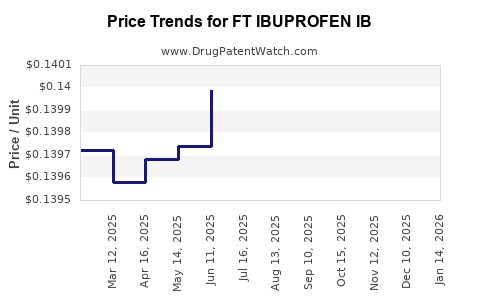
Price Trends and Projections
| Time Frame |
Price Range (USD per unit) |
Key Factors |
| 2022 (Current) |
USD 0.02 – 0.05 per tablet |
Generics dominate pricing; high competition limits prices |
| 2023–2025 (Near term) |
USD 0.02 – 0.05 per tablet |
Price stability due to mature market; patent protections have lapsed in most jurisdictions |
| 2026–2030 (Mid-term) |
USD 0.02 – 0.07 per tablet |
Potential for slight increase with reformulation or brand recovery attempts, driven by manufacturing costs and regulatory adjustments |
Cost and Profitability Considerations
- Manufacturing costs for ibuprofen tablets range from USD 0.005 to 0.01 per unit.
- Average retail price (USD 0.02–0.05) yields margins of approximately 50–75%, with higher margins in countries with less price regulation.
- Price increases are limited primarily by intense generic competition, with options for brand differentiation through formulation or delivery.
Geographical Market Projections
| Region |
Price Range (USD per tablet) |
Market Growth (2023–2030) |
Notes |
| North America |
USD 0.03 – 0.05 |
1-2% annual |
Mature market, pressure on prices from generics |
| Europe |
USD 0.02 – 0.04 |
1-2% annual |
Regulatory environment remains stable |
| Asia-Pacific |
USD 0.02 – 0.06 |
3-4% annual |
Growing demand, potential for higher pricing in emerging markets |
| Latin America |
USD 0.02 – 0.05 |
2-3% annually |
Price sensitivities influence margins |
Strategic considerations
- Reformulation for extended patent life remains low-return due to low margins.
- Investment in clinical labeling or new delivery methods could create premium pricing opportunities but face regulatory hurdles.
- Brand differentiation strategies, such as unique formulations or co-formulations, may support higher prices locally.
Key Takeaways
- The global market for ibuprofen, including FT Ibuprofen IB, remains highly competitive, with generics accounting for the majority of sales.
- Pricing is constrained by intense competition, with current retail prices generally between USD 0.02 and 0.05 per tablet.
- Price projections indicate stability through 2025, with slight increases possible in mid-term periods driven by regulatory changes or formulation innovations.
- Emerging markets such as Asia-Pacific present growth opportunities, with higher potential price points.
- Patent expiry has facilitated widespread generic competition, minimizing price inflation potential.
FAQs
1. What factors influence ibuprofen tablet prices?
Pricing is affected by manufacturing costs, market competition, regulatory environment, and brand positioning.
2. Are there opportunities for higher margins with FT Ibuprofen IB?
Opportunities are limited; differentiation through formulation or delivery is possible but often not cost-effective outside premium markets.
3. How does patent expiry affect market prices?
Patent expiry increases generic competition, reducing prices and margins, typically stabilizing within a narrow range.
4. What is the outlook for ibuprofen demand?
Demand is expected to remain stable, driven by OTC sales, aging populations, and chronic pain management trends.
5. Which markets offer the most growth potential?
Emerging markets, particularly in Asia-Pacific, exhibit higher growth potential due to increasing healthcare access and rising demand.
References
[1] IBISWorld. (2022). NSAID Market Report.
[2] IMS Health. (2022). Global Pain Management Market Analysis.
[3] U.S. Food and Drug Administration (FDA). (2023). OTC Drug Approvals and Regulations.
[4] European Medicines Agency (EMA). (2022). NSAID Market and Regulatory Landscape.
[5] McKinsey & Company. (2021). Pharmaceutical Industry Competition Dynamics.