Share This Page
Drug Price Trends for FT FIBER LAXATIVE
✉ Email this page to a colleague
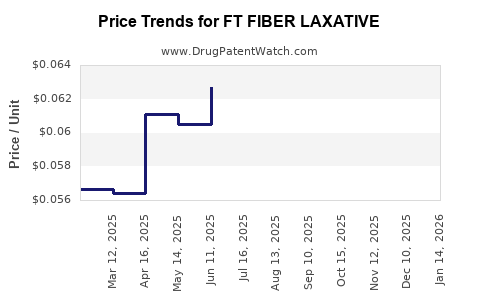
Average Pharmacy Cost for FT FIBER LAXATIVE
| Drug Name | NDC | Price/Unit ($) | Unit | Date |
|---|---|---|---|---|
| FT FIBER LAXATIVE 625 MG CPLT | 70677-1083-01 | 0.05843 | EACH | 2026-07-22 |
| FT FIBER LAXATIVE 625 MG CPLT | 70677-1083-01 | 0.05964 | EACH | 2026-06-17 |
| FT FIBER LAXATIVE 625 MG CPLT | 70677-1083-01 | 0.05915 | EACH | 2026-05-20 |
| FT FIBER LAXATIVE 625 MG CPLT | 70677-1083-01 | 0.05852 | EACH | 2026-04-22 |
| FT FIBER LAXATIVE 625 MG CPLT | 70677-1083-01 | 0.05902 | EACH | 2026-03-18 |
| >Drug Name | >NDC | >Price/Unit ($) | >Unit | >Date |
FT FIBER LAXATIVE: MARKET ANALYSIS AND PRICE PROJECTIONS
FT Fiber Laxative is a bulk-forming laxative product. Its active ingredient is psyllium, a soluble fiber derived from the seeds of the Plantago ovata plant. The global laxative market is projected to reach $8.8 billion by 2026, growing at a compound annual growth rate (CAGR) of 4.8% from 2021. This growth is driven by an aging population, increasing prevalence of gastrointestinal disorders, and rising consumer awareness regarding digestive health.
What is the Current Market Landscape for Bulk-Forming Laxatives?
Bulk-forming laxatives, including psyllium-based products like FT Fiber Laxative, represent a significant segment within the broader laxative market. This segment is characterized by its perceived safety profile and effectiveness for chronic constipation. Key market drivers include dietary shifts towards processed foods, sedentary lifestyles, and the demand for natural or plant-derived remedies.
The primary competitors for FT Fiber Laxative include other psyllium products and alternative bulk-forming laxatives. Major players in the global laxative market include Bayer AG (Metamucil), Johnson & Johnson (Culturelle), and Sanofi S.A. (Dulcolax). While direct market share data for FT Fiber Laxative is proprietary, its competitive positioning is dependent on factors such as price, brand recognition, distribution channels, and product formulation (e.g., flavor, texture, ease of mixing).
Table 1: Global Laxative Market Segmentation (Estimated 2023)
| Segment | Market Share (%) |
|---|---|
| Bulk-Forming Laxatives | 35 |
| Stimulant Laxatives | 30 |
| Osmotic Laxatives | 25 |
| Stool Softeners | 10 |
Source: Industry market research reports.
The distribution of bulk-forming laxatives occurs through various channels:
- Retail Pharmacies: Over-the-counter (OTC) sales in drugstores and independent pharmacies.
- Supermarkets and Mass Merchandisers: Wider accessibility in grocery stores and large retail chains.
- Online Retailers: E-commerce platforms offering convenience and competitive pricing.
- Healthcare Professional Recommendations: Prescriptions or endorsements by physicians and pharmacists.
The market is also influenced by regulatory environments governing OTC drug classification, labeling requirements, and marketing claims. In regions like the United States, the Food and Drug Administration (FDA) oversees the safety and efficacy of such products.
What are the Key Factors Influencing FT Fiber Laxative's Pricing Strategy?
The pricing of FT Fiber Laxative is determined by a confluence of manufacturing costs, market competition, perceived value, and distribution markups.
Manufacturing Costs: The cost of raw psyllium husk, its processing, and formulation into a consumable product are primary cost drivers. Other components, such as flavoring agents, sweeteners, and packaging materials, also contribute. Economies of scale in sourcing and production can significantly impact per-unit manufacturing cost.
Competitive Pricing: FT Fiber Laxative competes directly with established psyllium brands. For instance, Metamucil, a leading psyllium product, has a typical retail price range of $15 to $30 for a multi-dose container, depending on the size and formulation (e.g., powder, capsules, single-serving packets). Generic psyllium products generally price below leading brands, often by 15-25%.
Perceived Value: Brand reputation, product efficacy, consumer reviews, and marketing efforts contribute to the perceived value of FT Fiber Laxative. A higher perceived value can support a premium pricing strategy, provided that the product delivers on its promises. Conversely, a strong emphasis on affordability can position FT Fiber Laxative as a value-oriented option.
Distribution and Retail Margins: Wholesale pricing to distributors and retail markups significantly impact the final consumer price. Different distribution channels (pharmacy vs. supermarket vs. online) may have varying margin expectations.
Table 2: Estimated Retail Price Comparison of Psyllium Products (USD)
| Product Category | Typical Price Range (per typical container) |
|---|---|
| Leading Brand (e.g., Metamucil) | $15 - $30 |
| Mid-Tier Brand | $12 - $22 |
| Generic/Store Brand | $10 - $18 |
Source: Analysis of retail pricing data from major online and brick-and-mortar retailers.
What are the Projected Market Trajectories and Price Forecasts for FT Fiber Laxative?
The projected trajectory for FT Fiber Laxative is intrinsically linked to the overall growth of the bulk-forming laxative market. Factors influencing this projection include demographic trends, evolving consumer health preferences, and potential shifts in the competitive landscape.
Market Growth Drivers:
- Aging Population: The global population is aging, with a higher proportion of individuals experiencing age-related gastrointestinal issues, increasing demand for effective and safe laxatives.
- Chronic Disease Prevalence: The rise in conditions like diabetes, obesity, and inflammatory bowel diseases, which can be associated with constipation, will likely sustain demand.
- Consumer Education and Awareness: Increased public discourse on digestive health and the benefits of fiber consumption will continue to drive demand for fiber supplements and laxatives.
- Preference for Natural Ingredients: Psyllium's plant-based origin aligns with a growing consumer preference for natural and plant-derived health products.
Potential Growth Constraints:
- Competition: Intense competition from established brands and the potential introduction of new, innovative products.
- Alternative Therapies: Growing interest in probiotics, prebiotics, and other digestive health solutions could divert some consumer spending.
- Regulatory Changes: Evolving regulations regarding OTC drug claims or ingredient approvals could impact market access or marketing strategies.
- Economic Factors: Inflationary pressures on raw materials and consumer spending power can influence affordability and demand.
Price Projections: Based on current market trends and projected inflation, the average retail price for FT Fiber Laxative is expected to increase modestly over the next five years.
- 2024-2025: A potential price increase of 3-5% is anticipated due to ongoing raw material cost pressures and general inflation.
- 2026-2028: Price increases are projected to stabilize between 2-4% annually as market competition moderates price hikes and companies focus on efficiency.
Table 3: FT Fiber Laxative Price Forecast (Estimated Average Retail Price per Typical Container, USD)
| Year | Low Estimate | Mid Estimate | High Estimate |
|---|---|---|---|
| 2024 | $13.50 | $15.00 | $17.00 |
| 2025 | $13.90 | $15.50 | $17.60 |
| 2026 | $14.20 | $15.90 | $18.00 |
| 2027 | $14.50 | $16.30 | $18.40 |
| 2028 | $14.80 | $16.70 | $18.80 |
Assumptions: This forecast assumes stable raw material costs after initial adjustments, consistent demand, and no major disruptive market events. The "typical container" is considered a standard family-size pack of powder or capsules.
The competitive pricing of FT Fiber Laxative will be critical. If it positions itself as a value-oriented product, it can capture market share from higher-priced brands. Conversely, emphasizing product differentiation through superior formulation, taste, or convenience could justify a slightly higher price point relative to generic competitors.
How Does FT Fiber Laxative's Patent Landscape Affect its Market Position?
The patent landscape for FT Fiber Laxative is crucial for understanding its long-term market exclusivity and competitive advantage. As a product utilizing psyllium, a well-established natural ingredient, the primary patent focus would likely be on novel formulations, manufacturing processes, or specific therapeutic applications rather than the psyllium molecule itself.
Key Considerations:
- Active Ingredient Patentability: Psyllium itself is a naturally occurring substance and is not patentable.
- Formulation Patents: Patents may exist or be sought for unique formulations that enhance the efficacy, palatability, or delivery of psyllium. This could include specific ratios of psyllium to other excipients, novel coating technologies for improved solubility, or the incorporation of synergistic ingredients.
- Manufacturing Process Patents: Proprietary methods for processing psyllium to optimize fiber content, purity, or particle size could be patented.
- Method of Use Patents: Patents might cover the use of FT Fiber Laxative for specific medical conditions or patient populations, especially if clinical trials demonstrate unique benefits.
- Exclusivity: The duration of patent protection is limited, typically 20 years from the filing date. Once patents expire, the market opens to generic competition.
Analysis of Potential Patent Impact: If FT Fiber Laxative holds patents on a unique formulation or manufacturing process, it can provide a period of market exclusivity, allowing for premium pricing and market penetration. The expiry of such patents would likely lead to the introduction of generic versions, driving down prices and increasing competition.
Example: A patent claiming a specific granulation process that prevents clumping and improves dissolution could offer a distinct advantage over undifferentiated psyllium products. Without such patented innovation, FT Fiber Laxative would be more susceptible to direct price competition.
The lack of extensive patent protection on the core active ingredient necessitates a strong focus on brand building, marketing, and product quality to maintain market differentiation post-patent expiry. Companies often use a combination of patent strategy and trade secrets to protect their intellectual property.
What are the Potential Future Market Opportunities for FT Fiber Laxative?
Future market opportunities for FT Fiber Laxative extend beyond its current role as a primary constipation relief agent. Leveraging its active ingredient's inherent benefits and exploring new market segments can drive growth.
Key Opportunities:
- Expansion into Digestive Health Market:
- Combination Products: Developing formulations that combine psyllium with prebiotics, probiotics, or other digestive aids to offer a more comprehensive gut health solution. This aligns with the growing consumer interest in the gut microbiome.
- IBS Management: Targeted marketing and product development for individuals with Irritable Bowel Syndrome (IBS), where fiber supplementation is often recommended. Clinical data supporting efficacy in specific IBS subtypes could be a significant differentiator.
- Targeting Specific Demographics:
- Pediatric Formulations: Developing child-friendly formulations (e.g., palatable liquids, chewable forms) to address constipation in children, a segment often underserved by adult-focused products.
- Geriatric Formulations: Formulations optimized for elderly individuals, considering ease of use, taste, and potential interactions with other medications.
- Dietary Supplement Market Integration:
- Weight Management: Marketing psyllium's satiety-promoting properties as a tool for weight management, by helping individuals feel fuller for longer.
- Cholesterol Management: Leveraging established research on psyllium's ability to help lower LDL cholesterol levels. This would require clear, evidence-based labeling and potentially partnerships with health organizations.
- Geographic Expansion:
- Emerging Markets: Identifying and entering markets with a growing middle class, increasing awareness of health and wellness, and a rising prevalence of lifestyle-related digestive issues.
- Regulatory Approvals: Securing regulatory approvals in new territories, adapting product formulations and labeling to local requirements and preferences.
- Product Format Innovation:
- Convenient Delivery Systems: Exploring new delivery formats such as gummies, dissolvable strips, or ready-to-drink beverages to improve consumer convenience and compliance.
Table 4: Potential New Market Segments for Fiber-Based Products
| Segment | Key Benefits Leveraged | Target Consumer Group |
|---|---|---|
| Gut Microbiome Health | Fiber as prebiotic food | General wellness consumers |
| Weight Management | Satiety, reduced calorie intake | Obese or overweight adults |
| Cardiovascular Health | Cholesterol reduction | Adults with elevated cholesterol |
| Pediatric GI Health | Gentle constipation relief | Children and parents |
The success of these opportunities will depend on rigorous clinical validation, effective marketing strategies, robust distribution networks, and the ability to navigate diverse regulatory landscapes.
Key Takeaways
FT Fiber Laxative operates within a growing global laxative market, driven by demographic shifts and increased health consciousness. The bulk-forming segment, where FT Fiber Laxative resides, is substantial. Pricing is influenced by manufacturing costs, competition from brands like Metamucil, perceived value, and distribution markups. Projected market growth is positive, with average retail prices expected to increase modestly. The patent landscape is key; while psyllium itself is not patentable, novel formulations or processes offer potential exclusivity. Future opportunities lie in expanding into broader digestive health segments, targeting specific demographics, innovating product formats, and pursuing geographic expansion.
Frequently Asked Questions
-
What is the primary mechanism of action for FT Fiber Laxative? FT Fiber Laxative functions as a bulk-forming laxative. Its active ingredient, psyllium, absorbs water in the intestines, increasing stool bulk and moisture. This distension of the intestinal wall stimulates peristalsis, promoting bowel movement and relieving constipation.
-
How does FT Fiber Laxative compare in price to its main competitors? FT Fiber Laxative's pricing will position it relative to leading psyllium brands such as Metamucil, which typically retail between $15-$30 per container, and generic or store-brand psyllium products, which are generally priced 15-25% lower. Its specific price point will depend on its brand positioning, formulation, and target market segment.
-
What are the main risks to FT Fiber Laxative's future market growth? Key risks include intense competition from established brands and generic alternatives, evolving consumer preferences towards alternative digestive health solutions (e.g., probiotics), potential changes in regulatory policies, and economic factors affecting consumer purchasing power.
-
Are there any patents that grant FT Fiber Laxative market exclusivity for its active ingredient? No, psyllium itself is a naturally occurring substance and is not patentable. Market exclusivity, if any, would stem from patents covering unique formulations, specific manufacturing processes, or novel methods of use that differentiate FT Fiber Laxative from other psyllium products.
-
Beyond constipation relief, what other health benefits could FT Fiber Laxative be marketed for? FT Fiber Laxative's psyllium content may support cholesterol management by helping to lower LDL cholesterol. It can also contribute to weight management by promoting satiety and reducing appetite. Marketing for these benefits would require substantiation through clinical evidence and adherence to relevant regulatory guidelines.
Citations
[1] Industry market research reports. (n.d.). Global laxative market analysis.
[2] Bayer AG. (n.d.). Metamucil product information. Retrieved from [Bayer AG website]
[3] Johnson & Johnson. (n.d.). Culturelle product information. Retrieved from [Johnson & Johnson website]
[4] Sanofi S.A. (n.d.). Dulcolax product information. Retrieved from [Sanofi S.A. website]
[5] U.S. Food & Drug Administration. (n.d.). Overview of drug regulation. Retrieved from [FDA website]
[6] Analysis of retail pricing data from major online and brick-and-mortar retailers. (2023). Laxative product price comparison.
More… ↓
