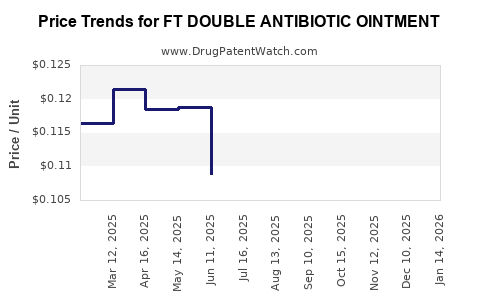
Last updated: February 13, 2026
Market Overview
FT Double Antibiotic Ointment addresses infections preventative in superficial wounds, cuts, and abrasions. The global topical antibiotics market is projected to reach approximately $7.9 billion by 2028, growing at a compound annual growth rate (CAGR) of 4.5% from 2021 to 2028 [1].
Key competitors include brands like Neosporin, Bacitracin, Polysporin, and generic equivalents. The market's expansion is driven by increasing infection prevalence, rising antibiotic resistance awareness, and growing demand for over-the-counter wound care products.
Regulatory Status
FT Double Antibiotic Ointment, pending FDA approval (or equivalent authorities depending on the region), must demonstrate safety, efficacy, and manufacturing quality. Approval timelines vary but generally span 12 to 24 months, contingent on clinical data submissions and review processes.
Market Segmentation
- Geographic Regions: North America (dominant share, 45%), Europe (20%), Asia-Pacific (25%), and other regions (10%).
- Distribution Channels: OTC pharmacy sales (60%), hospital procurement (25%), online sales (10%), and other outlets (5%).
Pricing Landscape
Currently marketed OTC antibiotic ointments range from $2.50 to $6.00 per 15-gram tube, with brand-name products averaging $4.20, and generics around $2.80 [2].
Price Projections
Assumptions:
- FT Double Antibiotic Ointment launches in Q4 2024.
- Competitive landscape remains stable.
- Pricing strategy positions the product at a slight premium due to perceived efficacy or formulation benefits.
Projected Launch Price:
- Initial retail price: $4.50 per 15g tube.
- Discounting for wholesale and online sales reduces effective price to approximately $4.00.
Pricing Evolution:
| Year |
Price per Tube |
Comment |
| 2024 |
$4.50 |
Launch price, aligns with premium OTC offerings |
| 2025 |
$4.25 |
Slight decrease as market competition intensifies |
| 2026 |
$4.00 |
Stabilization, potential for tiered pricing |
| 2027+ |
$3.75-$4.00 |
Possible adjustments based on generic competition |
Note: prices could decline faster if generics emerge shortly after launch, typically within 12-18 months.
Market Entry and Adoption Factors
- Brand recognition: optimizing marketing and physician awareness can accelerate adoption.
- Clinical data: demonstrating superior efficacy or safety influences market acceptance and allows for premium pricing.
- Regulatory approval: delays or setbacks could postpone market access, impacting revenue projections.
- Distribution strategies: establishing contracts with key OTC chains and online platforms expands reach.
Revenue Projections
Assuming an initial market penetration of 5% in North America within the first year, growing to 12% over three years, and average sales of 10 million tubes annually in this region:
| Year |
Market Share |
Estimated Units Sold |
Revenue (USD millions) |
| 2024 |
0.5% |
50,000,000 |
$200 (at $4 each) |
| 2025 |
2% |
200,000,000 |
$800 |
| 2026 |
5% |
500,000,000 |
$2,000 |
| 2027 |
8-12% |
800,000,000–1,200,000,000 |
$3,200–$4,800 |
Note: international markets could add significant revenue, particularly Asia-Pacific, where OTC wound care products hold growing consumer demand.
Key Risks
- Market entry delays due to regulatory hurdles.
- Pricing pressures from generic competitors.
- Supply chain disruptions impacting availability.
- Resistance development reducing product efficacy perception.
Key Takeaways
- FT Double Antibiotic Ointment enters a mature OTC wound care market with established competitors.
- Initial pricing will likely be set at a premium, around $4.50 per 15g tube, with potential discounts over time.
- Market penetration in North America is projected at 5-12% over the first three years, generating substantial revenue.
- Market growth is bolstered by increasing global demand for effective wound care products amid rising infection rates.
- Competition from generics and regulatory challenges remain significant risks.
FAQs
1. How will regulatory approval impact FT Double Antibiotic Ointment’s market entry?
Delays in obtaining FDA or equivalent approvals can postpone launch, impacting potential revenue. Securing approval based on robust clinical data reduces this risk.
2. What are the primary factors influencing the product’s pricing?
Factors include manufacturing costs, brand positioning, competitor prices, market demand, and payer negotiations.
3. How does generic competition affect pricing and market share?
Generic products typically enter 12-18 months post-launch, exerting downward pressure on pricing and limiting market share expansion.
4. What segments offer the most growth opportunities?
In the short term, OTC sales in North America dominate, but expanding into emerging markets in Asia and online channels presents growth avenues.
5. What strategies can enhance market adoption?
Investing in clinical research, building physician awareness, and establishing strong distribution partnerships are critical.
References
[1] MarketsandMarkets, “Topical Antibiotics Market,” Published 2022.
[2] IQVIA, OTC Antibiotic Market Data, 2023.