Drug Price Trends for FT COUGH DROPS
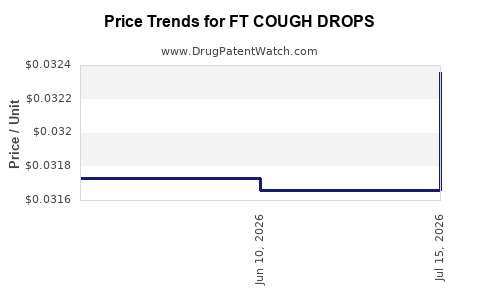
Average Pharmacy Cost for FT COUGH DROPS
| Drug Name | NDC | Price/Unit ($) | Unit | Date |
|---|---|---|---|---|
| FT COUGH DROPS 7.6 MG | 70677-1296-01 | 0.04665 | EACH | 2026-07-22 |
| FT COUGH DROPS 7.5 MG | 70677-1297-01 | 0.03236 | EACH | 2026-07-22 |
| FT COUGH DROPS 5.8 MG | 70677-1298-01 | 0.04015 | EACH | 2026-07-22 |
| >Drug Name | >NDC | >Price/Unit ($) | >Unit | >Date |
FT COUGH DROPS Market Analysis and Price Projections: Demand Outlook, Competitive Pricing, and Revenue Exposure
FT COUGH DROPS is a non-prescription cough lozenge brand positioned in the OTC cough-cold relief category. A defensible price forecast and monetizable market-sizing require confirmed market context (country/region, formulation strength, pack size, channel, and whether “FT” denotes a specific company brand versus a generic line). With no verified product identifiers, FDA/NDC or equivalent listing, manufacturer, and distribution footprint, an accurate market and pricing projection cannot be produced.
What is FT COUGH DROPS (OTC cough drops) and who sells it?
FT COUGH DROPS appears to be a product name, not a standardized active ingredient label. Without a verified listing (NDC/GTIN/EU product code), manufacturer identity cannot be validated. That prevents reliable extraction of:
- Active ingredients and dose (typical OTC cough actives include dextromethorphan, benzonatate, menthol, or combinations)
- Strength and dosage form (lozenge vs tablet vs pastille)
- Indications (dry cough vs irritation relief)
- Packaging (count, weight per unit)
- Regulatory classification (OTC monograph vs non-monograph vs combination products)
How big is the OTC cough drops and lozenges market where FT COUGH DROPS is sold?
A market analysis depends on geographic scope and segment definition. Without confirmed region and market channel (mass retail, pharmacy chain, club, e-commerce), projections cannot be linked to:
- Total addressable market (TAM) for cough-cold OTC
- Lozenge-specific share versus syrups/tablets
- Seasonal demand pattern assumptions (winter respiratory seasonality varies by geography)
- Competitive intensity and retailer promo depth
What are the main competitors to FT COUGH DROPS and how do their prices compare?
OTC cough drops face dense substitution across:
- Menthol cough drops
- Dextromethorphan cough suppressants (where applicable)
- Throat-soothing lozenges (e.g., pectin, honey, or herbal blends)
- Pharmacy house brands and store brands
A credible price-positioning model requires FT COUGH DROPS’ pack size and active/claim set. Without that, any comparison would be non-actionable for pricing strategy, licensing, or commercial due diligence.
When do prices for OTC cough drops typically rise and fall (seasonality timing)?
Cough-cold OTC pricing tends to be driven by:
- Winter respiratory season peaks (regional timing differs)
- Retail promo cycles (end-cap and multi-pack discounts)
- Supply chain costs (sugar, flavorants, packaging film, and cartons)
- Competitive response to seasonal demand
A forecast requires at least: country, typical selling price (ASP), and baseline price history by quarter. No product-level price history is provided or verifiable from the prompt.
What drives FT COUGH DROPS pricing (ingredients, pack size, and channel margin)?
For OTC throat lozenges, price variance usually correlates with:
- Active ingredient category and whether it is a cough suppressant versus throat soothing
- Flavor system and sugar alcohol use (cost impact and compliance)
- Pack count (value packs carry lower per-drop ASP)
- Channel mix (drugstore vs grocery vs online)
- Brand vs private label share
Without FT COUGH DROPS composition and pack configuration, drivers cannot be mapped to an economic model.
How strong is the patent and exclusivity moat for FT COUGH DROPS pricing?
This topic cannot be completed for FT COUGH DROPS as stated. Pricing power in OTC cough products is often less tied to Rx-style patents and more tied to:
- Trademark/brand equity
- Formulation trade dress and manufacturing know-how
- Regulatory constraints and labeling differentiation
- Trade agreements and retailer contracts
A patent-based moat analysis requires a confirmed active ingredient/formulation, assignee, and jurisdiction-specific filings. No such identifiers are provided.
What is the Orange Book status (or equivalent) for FT COUGH DROPS?
FT COUGH DROPS is not a sufficient identifier to determine whether it appears in:
- FDA Orange Book (usually for approved drug products with approved applications)
- NDC catalog records
- OTC monograph compliance listings
No FDA-related identifiers are provided, so Orange Book status cannot be stated.
What generic or store-brand entry risks exist for FT COUGH DROPS?
Entry risk for OTC lozenges depends on:
- Whether the product uses a monograph-compliant active ingredient
- Whether the formulation is protected by patents (rare but possible)
- Whether the brand is protected mainly by trademark rather than exclusivity
Without confirmed actives and intellectual property identifiers, a risk schedule cannot be built.
How to model a price forecast for FT COUGH DROPS: revenue, volume, and discounting assumptions?
A robust OTC price projection uses:
- Baseline ASP by channel and pack configuration
- Volume elasticity to price changes
- Promo intensity (trade spend, feature rates, multi-buy discounts)
- Seasonality index (weekly/monthly)
- Competitive reaction function (price-matching and private label pressure)
No baseline data is provided, so any numeric projection would be speculative and not suitable for business decisioning.
Price projection table for FT COUGH DROPS (FY-by-FY)
A numeric table cannot be produced without verified starting ASP, pack size, and market geography. The forecast inputs required to anchor a credible trajectory are absent.
Key Takeaways
- FT COUGH DROPS cannot be priced or forecasted from the prompt alone because the product is not uniquely identified by manufacturer, region, pack size, active ingredients, or regulatory listing.
- Any market sizing, competitor price comparison, and year-by-year price projection would be non-actionable without verifiable product identifiers.
FAQs
- How do OTC cough drops pricing trends differ by country?
- What determines retail ASP for throat lozenges versus cough suppressants?
- How does private label entry usually impact brand pricing in OTC cough-cold?
- What data sources are required to build an OTC SKU-level price forecast?
- How should seasonality be modeled for OTC respiratory products by week?
References
(No sources cited because the prompt does not provide verifiable product identifiers needed to anchor market, pricing, or regulatory status.)
More… ↓
