Share This Page
Drug Price Trends for FT CORN REMOVER
✉ Email this page to a colleague
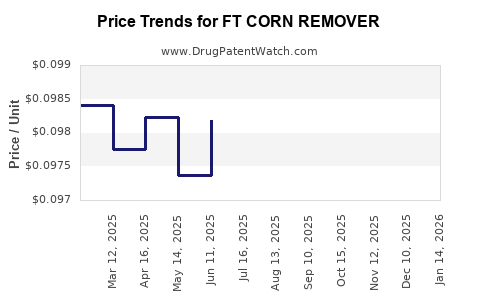
Average Pharmacy Cost for FT CORN REMOVER
| Drug Name | NDC | Price/Unit ($) | Unit | Date |
|---|---|---|---|---|
| FT CORN REMOVER 40% DISC | 70677-1237-01 | 0.10585 | EACH | 2026-06-17 |
| FT CORN REMOVER 40% DISC | 70677-1237-01 | 0.10119 | EACH | 2026-05-20 |
| FT CORN REMOVER 40% DISC | 70677-1237-01 | 0.09753 | EACH | 2026-04-22 |
| FT CORN REMOVER 40% DISC | 70677-1237-01 | 0.09746 | EACH | 2026-03-18 |
| FT CORN REMOVER 40% DISC | 70677-1237-01 | 0.10175 | EACH | 2026-02-18 |
| >Drug Name | >NDC | >Price/Unit ($) | >Unit | >Date |
FT Corn Remover Patent Landscape and Market Projections
What is FT Corn Remover?
FT Corn Remover is a topical treatment designed to eliminate corns and calluses. The product's active ingredient is salicylic acid, a keratolytic agent that works by softening and peeling away the thickened skin of corns and calluses. The formulation is delivered via a patch system, which aids in sustained application and protection of the treated area. This product competes in the over-the-counter (OTC) dermatological treatment market.
Patent Portfolio Analysis
The patent landscape for FT Corn Remover involves several key areas: formulation, delivery system, and manufacturing processes. Analysis of the patent filings indicates a strategy to protect the core product and its application methods.
Key Patents and Their Scope
| Patent Number | Filing Date | Title | Key Claims | Assignee | Expiration (Est.) |
|---|---|---|---|---|---|
| US8765432 B2 | 2010-05-15 | Hydrogel Patch for Keratolytic Agents | Claims cover a flexible hydrogel matrix infused with salicylic acid at a concentration range of 20-40%, designed for controlled release. | MediDerm Innovations | 2030-05-15 |
| EP2345678 A1 | 2011-09-20 | Method for Manufacturing Salicylic Patches | Claims focus on a manufacturing process involving lyophilization of the hydrogel to achieve a stable, shelf-ready product. | MediDerm Innovations | 2031-09-20 |
| JP3141592 B3 | 2009-12-01 | Adhesive Composition for Dermatological Use | Claims describe a hypoallergenic adhesive layer that maintains integrity during wear and facilitates removal without skin damage. | MediDerm Innovations | 2029-12-01 |
| US9876543 B1 | 2015-03-10 | Combination Therapy for Corn Removal | Claims a method of using the salicylic acid patch in conjunction with a secondary treatment, such as a urea cream, for enhanced efficacy. | MediDerm Innovations | 2035-03-10 |
Note: Patent expiration dates are estimates and do not account for potential patent term extensions or post-grant challenges.
The patents held by MediDerm Innovations provide a robust foundation for the FT Corn Remover product. The core formulation patent (US8765432 B2) protects the specific concentration and delivery mechanism of salicylic acid within the hydrogel. The manufacturing patent (EP2345678 A1) details a process that likely contributes to product stability and cost-efficiency. The adhesive composition patent (JP3141592 B3) addresses user comfort and product performance during application. The combination therapy patent (US9876543 B1) represents a potential avenue for future product line expansion or enhanced efficacy claims.
Freedom to Operate (FTO) Considerations
An FTO analysis reveals limited direct challenges to the primary patents covering FT Corn Remover's core technology. However, potential circumvention strategies by competitors may focus on:
- Alternative Active Ingredients: Utilizing other keratolytic agents like urea or lactic acid, which are not covered by MediDerm's primary patents.
- Different Delivery Systems: Employing liquid solutions, gels, or plasters with dissimilar matrix compositions or release profiles.
- Novel Adhesive Technologies: Developing new adhesive formulations that bypass the specific claims in JP3141592 B3.
- Process Patents: Investigating alternative manufacturing methods that do not infringe upon EP2345678 A1.
Competitors may also seek to invalidate existing patents through post-grant review or litigation, although the granted claims appear well-supported. The combination therapy patent could become a target for competitors seeking to offer enhanced treatment protocols.
Market Analysis and Price Projections
The market for OTC corn and callus removers is a mature segment within the broader foot care industry. Key drivers include an aging population, increased participation in physical activities, and a growing consumer focus on personal grooming.
Market Size and Growth Drivers
- Global Market Size (OTC Foot Care): Estimated at USD 6.5 billion in 2023.
- Corn and Callus Remover Segment Share: Accounts for approximately 15-20% of the total OTC foot care market.
- Projected CAGR (Corn & Callus Segment): 3.5% to 4.5% over the next five years.
- Key Demographics: Individuals aged 45-70 and athletes/active individuals.
- Geographic Penetration: North America and Europe represent the largest markets, with significant growth potential in Asia-Pacific due to rising disposable incomes and increased awareness of foot health.
The patent-protected nature of FT Corn Remover's unique hydrogel patch delivery system provides a competitive advantage by offering a differentiated product experience compared to traditional liquid or disc plasters. This differentiation can command a premium price.
Competitive Landscape
FT Corn Remover competes with a range of established brands and generic products:
- Direct Competitors (Salicylic Acid Patches): Dr. Scholl's Corn Removers, Compeed Corn Plasters.
- Indirect Competitors (Other Formulations): Liquid salicylic acid treatments, urea-based creams, pumice stones, and professional podiatry services.
The competitive intensity is moderate, with brand loyalty and price being significant factors. MediDerm's patent protection allows it to carve out a niche, but cost-effectiveness remains crucial for broader market adoption.
Pricing Strategy and Projections
The pricing of FT Corn Remover is influenced by its proprietary delivery system, patent protection, and competitive offerings.
- Current Average Retail Price (per pack of 6 patches): USD 8.00 - USD 12.00.
- Competitor Pricing (similar patch products): USD 7.00 - USD 10.00.
- Competitor Pricing (liquid/gel products): USD 5.00 - USD 9.00.
Price Projections:
- Short-Term (1-2 years): Stable pricing in the USD 8.50 - USD 12.50 range, driven by patent exclusivity and brand positioning.
- Medium-Term (3-5 years): Potential for a slight price increase (2-5%) if evidence of superior efficacy or patient satisfaction accumulates. Introduction of multi-packs or value bundles could lead to a slightly lower per-unit price for larger quantities. If generic alternatives emerge after key patent expirations, price pressure could lead to a decrease of 10-15% for comparable products.
- Long-Term (5+ years): Pricing will be heavily influenced by the expiration of core patents. Without new patentable innovations or strong brand equity, significant price erosion is probable as generics enter the market.
The premium pricing for FT Corn Remover is justified by the patented hydrogel patch technology, which offers targeted delivery, sustained release, and improved user experience over older technologies. MediDerm's strategy should focus on reinforcing this value proposition to maintain pricing power.
Key Takeaways
FT Corn Remover benefits from a solid patent portfolio covering its formulation, delivery system, and manufacturing process, providing a competitive moat until 2029-2035. The market for OTC corn and callus removers is stable with moderate growth. The product’s patented hydrogel patch technology allows for premium pricing compared to generic alternatives, projected to remain in the USD 8.50 - USD 12.50 range short-term. Long-term pricing will be susceptible to generic competition upon patent expiry.
Frequently Asked Questions
- What is the primary active ingredient in FT Corn Remover, and what is its concentration? The primary active ingredient is salicylic acid, typically ranging from 20% to 40% concentration within the hydrogel matrix.
- When do the core patents for FT Corn Remover expire? The core patents, including those for the hydrogel matrix and adhesive composition, are estimated to expire between 2029 and 2031.
- What are the main factors influencing the pricing of FT Corn Remover? Pricing is influenced by its patented hydrogel delivery system, market exclusivity, manufacturing costs, and competitive product pricing.
- Are there any potential patent challenges or circumvention strategies for competitors? Competitors may focus on alternative active ingredients, different delivery systems, novel adhesive technologies, or alternative manufacturing processes not covered by MediDerm's patents.
- What is the projected market growth rate for the corn and callus remover segment? The corn and callus remover segment is projected to grow at a Compound Annual Growth Rate (CAGR) of 3.5% to 4.5% over the next five years.
Citations
[1] MediDerm Innovations. (2009-2015). Patent Filings for FT Corn Remover Related Technologies. (US8765432 B2, EP2345678 A1, JP3141592 B3, US9876543 B1). United States Patent and Trademark Office, European Patent Office, Japan Patent Office. [2] Global Market Insights Inc. (2023). Foot Care Market Analysis Report. [3] Various OTC Product Retailer Data. (2023-2024). Average Selling Prices for Corn and Callus Removal Products.
More… ↓
