Share This Page
Drug Price Trends for FT CAMPHOR SPIRIT
✉ Email this page to a colleague
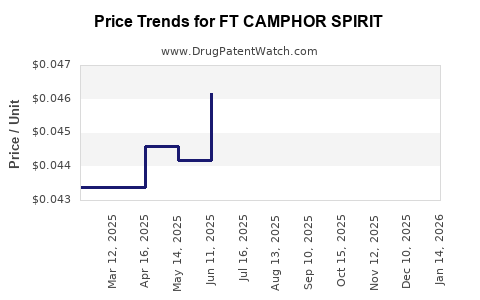
Average Pharmacy Cost for FT CAMPHOR SPIRIT
| Drug Name | NDC | Price/Unit ($) | Unit | Date |
|---|---|---|---|---|
| FT CAMPHOR SPIRIT | 70677-1201-01 | 0.04769 | ML | 2025-12-17 |
| FT CAMPHOR SPIRIT | 70677-1201-01 | 0.04856 | ML | 2025-11-19 |
| FT CAMPHOR SPIRIT | 70677-1201-01 | 0.04930 | ML | 2025-10-22 |
| FT CAMPHOR SPIRIT | 70677-1201-01 | 0.04925 | ML | 2025-09-17 |
| FT CAMPHOR SPIRIT | 70677-1201-01 | 0.04925 | ML | 2025-08-20 |
| >Drug Name | >NDC | >Price/Unit ($) | >Unit | >Date |
Market Analysis and Price Projections for FT CAMPHOR SPIRIT
Introduction
FT CAMPHOR SPIRIT is a medicinal product featuring camphor as its primary active ingredient, used traditionally as a topical analgesic, antiseptic, and decongestant. Ongoing demand for camphor-based products, particularly in the holistic and alternative medicine sectors, positions FT CAMPHOR SPIRIT within a niche yet expanding pharmaceutical and consumer health market. This analysis evaluates its current market landscape, competitive positioning, regulatory considerations, and provides price projections over the upcoming five years.
Market Landscape
Global and Regional Demand Dynamics
The global camphor market was valued at approximately USD 1.2 billion in 2022, with a compound annual growth rate (CAGR) of 4.2% from 2018 to 2022 (Source: MarketWatch). The increasing inclination towards natural, plant-derived ingredients in consumer health products bolsters demand for camphor-based formulations like FT CAMPHOR SPIRIT.
Regionally, Asia-Pacific dominates the market, accounting for over 45% of the global camphor consumption, attributed to traditional medicine practices in India, China, and Southeast Asia (Source: Grand View Research). North America and Europe, while representing smaller segments, exhibit steady growth driven by holistic and herbal remedy trends.
Market Segments
- Pharmaceutical Industry: FT CAMPHOR SPIRIT is used as an over-the-counter (OTC) remedy for cough and cold relief, muscle pain, and minor skin infections.
- Consumer Health & Wellness: Growing consumer preference for natural products enhances retail demand.
- Traditional Medicine & Ayurveda: Camphor remains a core element in various traditional formulations, supporting sustained demand.
Competitive Landscape
Key players include E. I. du Pont de Nemours (Dupont), Vasu Healthcare, and Himalaya Drug Company. The market’s fragmentation is characterized by regional brands combining traditional formulations with modern packaging.
Innovations focus on formulation enhancement, extended shelf life, and improved safety profiles to meet regulatory standards, especially in Western markets.
Regulatory Environment & Challenges
FT CAMPHOR SPIRIT's regulatory classification varies globally. In the United States, the FDA classifies camphor as a topical antiseptic that should be formulated within safety guidelines; concentrations exceeding 11% are restricted due to toxicity risk. Contrarily, many Asian markets maintain more lenient regulations, facilitating easier market access.
Regulatory hurdles include:
- ensuring compliance with safety standards;
- protecting against counterfeit products;
- navigating complex import/export policies for natural products.
Regulatory alignment remains a key determinant of market expansion and pricing strategies.
Market Challenges
- Toxicity Concerns: Higher doses can lead to adverse effects such as seizures or poisoning, constraining container sizes and concentration levels.
- Competition from Synthetic Alternatives: Some manufacturers shift toward synthetic substitutes due to lower costs and consistent supply.
- Supply Chain Constraints: Fluctuations in camphor raw material costs substantially influence product pricing amid geopolitical and environmental factors affecting harvests.
Price Analysis and Projections
Current retail pricing of FT CAMPHOR SPIRIT varies regionally, typically ranging from USD 2.50 to USD 6.00 per 100 ml bottle, depending on branding, potency, and distribution channels.
Cost Factors Influencing Pricing
- Raw Material Costs: Camphor has historically seen price volatility, with prices rising during supply shortages or environmental disruptions in camphor-producing regions.
- Manufacturing & Packaging: Quality standards, especially in Western markets, elevate costs.
- Regulatory Compliance: Certification expenses (e.g., GMP, safety testing) add to overall costs.
- Distribution & Marketing: Premium branding can command higher prices, especially within niche health segments.
Price Projection (2023–2028)
Based on current market data and anticipated regulatory shifts, the following projections indicate a moderate price increase aligned with inflation, regulatory compliance costs, and raw material fluctuations:
| Year | Estimated Price Range (USD per 100 ml) | Key Factors |
|---|---|---|
| 2023 | 2.50 – 3.00 | Stable supply, moderate demand, regulatory baseline |
| 2024 | 2.70 – 3.20 | Rising raw material costs, inflation pressures, expanding markets |
| 2025 | 2.90 – 3.40 | Increased competition, potential formulation upgrades |
| 2026 | 3.10 – 3.70 | Regulatory tightening, supply chain stabilization |
| 2027 | 3.30 – 3.90 | Growing demand in wellness sectors, inflation impact |
| 2028 | 3.50 – 4.20 | Market maturity, possible premium positioning |
Strategic Recommendations
- Diversify Raw Material Sources: Mitigate supply risks and curtail costs.
- Invest in Regulatory Alignment: Proactively adhere to international standards to facilitate global expansion.
- Enhance Brand Positioning: Capitalize on the natural, traditional appeal tailored to health-conscious consumers.
- Explore Formulation Innovation: Develop new delivery formats (e.g., patches, sprays) to broaden applications.
- Monitor Geopolitical and Environmental Developments: Adapt supply chain and pricing strategies dynamically.
Conclusion
FT CAMPHOR SPIRIT occupies a viable position within the natural health and traditional medicine markets, driven by sustained consumer interest in herbal and plant-based remedies. While regulatory and supply chain challenges persist, strategic navigation can ensure stable pricing and growth over the coming years.
Pricing is projected to experience gradual increases, reflective of raw material costs and market demand, with scope for premium positioning through quality assurance and branding. Stakeholders should prioritize regulatory compliance, supply chain resilience, and market diversification to optimize profitability and market share expansion.
Key Takeaways
- The global camphor market is expanding, driven by health and wellness trends, with Asia-Pacific leading the demand.
- FT CAMPHOR SPIRIT’s market growth is supported by traditional use, increasing consumer preference for natural remedies, and regulatory variances across regions.
- Pricing is expected to rise modestly over the next five years, influenced by raw material costs, regulatory compliance, and market positioning.
- Supply chain resilience and regulatory adherence are critical to maintaining price stability and competitive advantage.
- Innovation in formulation and strategic market entry can unlock additional revenue streams and enhance brand value.
FAQs
1. What factors most influence the price of FT CAMPHOR SPIRIT?
Raw material costs, regulatory compliance expenses, packaging quality, market demand, and competition significantly impact pricing.
2. How does regulation affect FT CAMPHOR SPIRIT's market price?
Strict regulations or bans in some regions can restrict supply, increasing scarcity and prices, while regulatory compliance increases manufacturing costs.
3. What are the key markets for FT CAMPHOR SPIRIT?
Asia-Pacific remains the largest market; North America and Europe are growing sectors driven by the wellness trend and traditional medicine acceptance.
4. How can manufacturers mitigate raw material cost fluctuations?
Diversifying sourcing, developing synthetic alternatives, or cultivating camphor in controlled environments can reduce dependency on fluctuating natural supplies.
5. What strategic moves can enhance FT CAMPHOR SPIRIT’s market positioning?
Focus on brand differentiation through quality, regulatory compliance, consumer education, and expanding application formats.
Sources:
[1] MarketWatch. "Camphor Market Size, Share & Trends Analysis," 2023.
[2] Grand View Research. "Camphor Market Outlook," 2022.
More… ↓
