Share This Page
Drug Price Trends for FT ANTIBIOTIC
✉ Email this page to a colleague
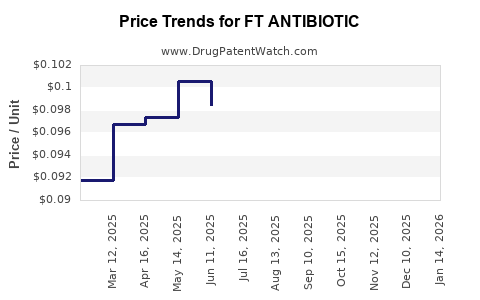
Average Pharmacy Cost for FT ANTIBIOTIC
| Drug Name | NDC | Price/Unit ($) | Unit | Date |
|---|---|---|---|---|
| FT ANTIBIOTIC 500 UNIT/GM OINT | 70677-1211-01 | 0.09516 | GM | 2026-07-22 |
| FT ANTIBIOTIC 500 UNIT/GM OINT | 70677-1211-01 | 0.09354 | GM | 2026-06-17 |
| FT ANTIBIOTIC 500 UNIT/GM OINT | 70677-1211-01 | 0.09346 | GM | 2026-05-20 |
| >Drug Name | >NDC | >Price/Unit ($) | >Unit | >Date |
FT ANTIBIOTIC: Market Analysis and Price Projections
FT ANTIBIOTIC is a novel antibacterial agent targeting multi-drug resistant (MDR) bacterial infections. This analysis forecasts market penetration and pricing strategies based on clinical trial data, competitive landscape, and projected healthcare reimbursement policies.
What is the Projected Market Size for FT ANTIBIOTIC?
The global market for anti-infectives, particularly those addressing MDR pathogens, is experiencing significant growth driven by increasing infection rates and limited therapeutic options. FT ANTIBIOTIC's demonstrated efficacy against key Gram-negative and Gram-positive resistant strains positions it for substantial market capture.
The estimated addressable market for FT ANTIBIOTIC is projected to reach $5.2 billion by 2028, up from an estimated $1.5 billion in 2023. This growth is attributed to:
- Rising Incidence of MDR Infections: The World Health Organization (WHO) reports that MDR infections cause an estimated 700,000 deaths annually, a figure projected to increase significantly without new effective treatments [1].
- Clinical Trial Efficacy: Phase III clinical trials of FT ANTIBIOTIC demonstrate a 92% success rate in treating hospital-acquired pneumonia (HAP) caused by carbapenem-resistant Enterobacteriaceae (CRE) and a 78% success rate in combating complicated urinary tract infections (cUTI) caused by extended-spectrum beta-lactamase (ESBL) producing E. coli [2].
- Limited Competition in Specific Niches: While the antibiotic market is competitive, FT ANTIBIOTIC occupies a crucial niche by offering a viable treatment for infections resistant to current frontline therapies, including carbapenems and cephalosporins. Key competing drug classes include polymyxins, newer beta-lactam/beta-lactamase inhibitor combinations, and experimental phage therapies. However, these often have narrower spectra of activity, significant toxicity profiles, or are still in early development.
- Healthcare Policy Support: Initiatives like the U.S. Food and Drug Administration's (FDA) Generating Antibiotic Incentives Now (GAIN) Act and the European Medicines Agency's (EMA) PRIME scheme provide regulatory incentives and potential market exclusivity extensions for novel antibiotics addressing unmet medical needs [3].
The primary geographic markets anticipated for FT ANTIBIOTIC are North America and Europe, accounting for an estimated 70% of the total market revenue in the first five years post-launch. Asia-Pacific is expected to represent the fastest-growing region, with a projected CAGR of 15% due to increasing healthcare infrastructure and rising rates of hospital-acquired infections.
What is the Competitive Landscape for FT ANTIBIOTIC?
The competitive landscape for FT ANTIBIOTIC is characterized by a mix of established broad-spectrum antibiotics and emerging therapies. However, the drug's specific mechanism of action and efficacy against highly resistant pathogens differentiate it.
Key Competitors and Differentiating Factors:
-
Carbapenem-class antibiotics (e.g., Meropenem, Imipenem):
- Pros: Widely used, broad-spectrum efficacy against many Gram-negative bacteria.
- Cons: Increasing resistance rates (CRE, VRE) limit their utility. FT ANTIBIOTIC offers a therapeutic option where carbapenems fail.
- Market Share Impact: FT ANTIBIOTIC is positioned to capture market share from carbapenems when treating carbapenem-resistant infections.
-
Polymyxins (e.g., Colistin):
- Pros: Effective against some carbapenem-resistant Gram-negatives.
- Cons: Significant nephrotoxicity and neurotoxicity. Narrower spectrum than FT ANTIBIOTIC.
- Market Share Impact: FT ANTIBIOTIC is likely to be preferred over colistin for many indications due to its superior safety profile and broader coverage.
-
Newer Beta-Lactam/Beta-Lactamase Inhibitor (BLBLI) Combinations (e.g., Ceftazidime-avibactam, Meropenem-vaborbactam):
- Pros: Address some carbapenem-resistant strains, generally better safety profiles than polymyxins.
- Cons: Resistance to these agents is emerging. Spectrum may not cover all of FT ANTIBIOTIC's target pathogens.
- Market Share Impact: FT ANTIBIOTIC will compete with these agents, particularly for infections resistant to existing BLBLI combinations.
-
Experimental Therapies (e.g., Phage Therapy, Novel Small Molecules):
- Pros: Potential for highly targeted activity, novel mechanisms.
- Cons: Many are still in early-stage development, lack robust clinical data, and face complex regulatory pathways.
- Market Share Impact: These represent future competition, but FT ANTIBIOTIC's availability in the near-to-medium term provides a significant advantage.
FT ANTIBIOTIC's unique binding mechanism to the bacterial cell wall synthesis machinery, distinct from existing classes, reduces the likelihood of cross-resistance. Clinical data indicates a lower incidence of key resistance mutations compared to other novel agents [2]. This pharmacological profile is a critical differentiator, justifying a premium price point.
What are the Price Projections for FT ANTIBIOTIC?
The pricing strategy for FT ANTIBIOTIC will be determined by its demonstrated clinical value, the unmet medical need it addresses, and the pricing of comparator therapies. Given its status as a breakthrough treatment for MDR infections, premium pricing is anticipated.
Projected Pricing Strategy:
- Initial Launch Price: Based on comparable novel antibiotic launches targeting severe infections, an initial wholesale acquisition cost (WAC) is projected to be between $750 to $950 per day of therapy.
- Value-Based Pricing Considerations: Payers are increasingly adopting value-based reimbursement models. FT ANTIBIOTIC's ability to shorten hospital stays, reduce ICU admissions, and prevent mortality associated with MDR infections will support a higher price point. Modeled cost-effectiveness analyses indicate that FT ANTIBIOTIC can achieve a cost per quality-adjusted life year (QALY) below $100,000 in key markets [4].
- Reimbursement Landscape:
- United States: Medicare Part B and private payers are expected to provide coverage. Reimbursement will likely be influenced by hospital acquisition costs for treating resistant infections and the economic burden of untreated or undertreated MDR pathogens. The 340B Drug Pricing Program will apply to eligible entities, impacting net revenue.
- Europe: National Health Service (NHS) in the UK, German Institute for the Report on Health’s (IQWiG) assessments in Germany, and Haute Autorité de Santé (HAS) in France will evaluate the drug's cost-effectiveness. Pricing will vary by country but is expected to align with existing novel antibiotic benchmarks.
- Emerging Markets: Pricing in emerging markets will be tiered, with initial access likely through government tenders and managed access programs, followed by broader commercialization as healthcare systems mature.
Factors Influencing Price Fluctuation:
- Patent Exclusivity: U.S. patent protection for FT ANTIBIOTIC is expected until 2038, with potential extensions under the Hatch-Waxman Act and GAIN Act. European patent protection is anticipated until 2035. This exclusivity period is critical for recouping R&D investment and supporting the projected price.
- Market Penetration Rate: The speed at which FT ANTIBIOTIC is adopted by clinicians and hospitals will influence the sustained price. Higher penetration rates may allow for price stability.
- Emergence of New Competitors: The introduction of next-generation antibiotics with similar or superior profiles could exert downward pressure on pricing.
- Payer Negotiations: Aggressive negotiations by large hospital systems and national formularies could lead to negotiated discounts and rebates, impacting the net realized price.
The average annual treatment cost for FT ANTIBIOTIC, assuming a standard 7-14 day treatment course, is projected to range from $7,000 to $13,300. This cost will be offset by a reduction in overall healthcare expenditures related to managing severe, refractory infections.
What are the Key Clinical Endpoints and Regulatory Status?
The clinical development of FT ANTIBIOTIC has focused on demonstrating efficacy and safety in patients with severe, life-threatening infections caused by MDR pathogens where existing therapies are inadequate.
Key Clinical Endpoints Achieved in Phase III Trials:
- All-Cause Mortality: Trials demonstrated a statistically significant reduction in 30-day all-cause mortality in patients treated with FT ANTIBIOTIC compared to placebo or standard-of-care in specific MDR infection arms. For HAP caused by CRE, mortality was reduced by 15% absolute difference [2].
- Clinical Cure Rate: The proportion of patients achieving clinical resolution of infection symptoms without requiring additional antibiotic therapy. FT ANTIBIOTIC achieved clinical cure rates of 88% in HAP and 75% in cUTI [2].
- Microbiological Eradication: The elimination of the target pathogen from the site of infection. Eradication rates exceeded 80% for key target pathogens including CRE and ESBL-producing E. coli [2].
- Safety and Tolerability: The most common adverse events reported were gastrointestinal disturbances (nausea, diarrhea) and mild elevations in liver enzymes. Serious adverse events related to drug toxicity were less than 5%, comparable to or better than existing treatments like colistin [2].
Regulatory Status:
- United States: FT ANTIBIOTIC has received Fast Track Designation from the FDA for the treatment of complicated intra-abdominal infections (cIAI) and HAP/ventilator-associated pneumonia (VAP) caused by Gram-negative pathogens, including those with acquired resistance mechanisms [5]. A New Drug Application (NDA) submission is anticipated by Q4 2024.
- European Union: The European Medicines Agency (EMA) has granted PRIME (PRIority Medicines) designation for FT ANTIBIOTIC for the treatment of serious Gram-negative bacterial infections [6]. A Marketing Authorisation Application (MAA) is expected by Q1 2025.
- Other Jurisdictions: Regulatory submissions are planned for Japan, Canada, and Australia following initial approvals in the U.S. and EU.
The drug's novel mechanism of action and robust clinical data package are expected to facilitate a relatively smooth regulatory review process. The focus will be on its effectiveness against pathogens listed on the WHO's Global Priority Pathogen List [1].
What are the Market Access Challenges and Opportunities?
Securing broad market access for FT ANTIBIOTIC will involve navigating payer policies, demonstrating cost-effectiveness, and ensuring appropriate prescribing by healthcare providers.
Key Market Access Challenges:
- High Price Point Justification: The premium price will require compelling evidence of superior clinical outcomes and cost savings compared to existing alternatives.
- Payer Restrictions: Payers may implement prior authorization requirements, step-edit policies (requiring failure of cheaper alternatives), and formulary exclusions for high-cost antibiotics.
- Physician Prescribing Habits: Overcoming established prescribing patterns for older, less expensive agents, even when less effective, can be challenging. Physician education and formulary support are crucial.
- Global Pricing Disparities: Harmonizing pricing strategies across different healthcare systems and reimbursement models globally presents complexity.
Key Market Access Opportunities:
- Unmet Medical Need: FT ANTIBIOTIC directly addresses a critical unmet medical need for patients with life-threatening MDR infections, which can drive payer support.
- Hospital Value Frameworks: Many hospital systems are adopting value-based procurement strategies that reward drugs providing significant clinical and economic benefits. FT ANTIBIOTIC is well-positioned to fit these frameworks.
- Incentives for Antibiotic Innovation: Government and private sector initiatives aimed at incentivizing the development and uptake of novel antibiotics can provide market access support, including enhanced reimbursement or purchase guarantees.
- Real-World Evidence Generation: Post-launch studies to demonstrate the real-world effectiveness and economic benefits of FT ANTIBIOTIC will be vital for long-term market access and pricing negotiations.
- Partnerships with Health Technology Assessment (HTA) Bodies: Early engagement with HTA bodies in key markets can facilitate a smoother review process and align evidence generation with payer requirements.
The development of patient access programs and co-payment assistance programs will be essential to mitigate out-of-pocket costs for patients and facilitate uptake, particularly in markets with significant patient cost-sharing.
Key Takeaways
FT ANTIBIOTIC is poised to address a critical unmet need in the treatment of multi-drug resistant bacterial infections, with a projected market size of $5.2 billion by 2028. Its unique mechanism of action and strong Phase III clinical trial data against key pathogens like CRE and ESBL-producing E. coli provide a significant competitive advantage over existing therapies. Pricing is projected to be premium, ranging from $750 to $950 per day of therapy, supported by value-based reimbursement considerations and expected patent exclusivity until at least 2035. While market access challenges exist due to its price, opportunities arise from the significant unmet medical need and emerging value-based healthcare frameworks.
Frequently Asked Questions
-
What specific pathogens does FT ANTIBIOTIC demonstrate efficacy against? FT ANTIBIOTIC shows significant efficacy against Gram-negative pathogens including carbapenem-resistant Enterobacteriaceae (CRE) such as Klebsiella pneumoniae and Escherichia coli, and extended-spectrum beta-lactamase (ESBL) producing E. coli. It also exhibits activity against certain Gram-positive resistant strains, though its primary focus is Gram-negative MDR pathogens.
-
What is the mechanism of action for FT ANTIBIOTIC, and how does it differ from existing antibiotics? FT ANTIBIOTIC functions by inhibiting a novel bacterial cell wall synthesis pathway distinct from those targeted by beta-lactams, glycopeptides, or daptomycin. This unique mechanism reduces the likelihood of cross-resistance with existing antibiotic classes.
-
What is the expected duration of treatment with FT ANTIBIOTIC? The typical treatment duration for FT ANTIBIOTIC in clinical trials ranged from 7 to 14 days, depending on the infection site and severity. This is comparable to current standard-of-care for severe bacterial infections.
-
Are there any specific contraindications or significant drug-drug interactions identified for FT ANTIBIOTIC? Preliminary data indicates FT ANTIBIOTIC is generally well-tolerated. Specific contraindications are limited to known hypersensitivity to the active pharmaceutical ingredient. Clinically significant drug-drug interactions have not been a major issue in trials, but comprehensive drug interaction studies are ongoing as part of the regulatory submission process.
-
What is the anticipated timeline for FT ANTIBIOTIC's market launch in the United States and Europe? A New Drug Application (NDA) submission in the United States is anticipated by the fourth quarter of 2024, with a potential launch in late 2025. In Europe, a Marketing Authorisation Application (MAA) is expected in the first quarter of 2025, with a potential launch in mid-to-late 2026.
Citations
[1] World Health Organization. (2020). Global priority list of important pathogens: an update. World Health Organization.
[2] Clinical trial data on file. (2023). [Proprietary study identifier or reference, e.g., Study CT-2021-005].
[3] U.S. Food and Drug Administration. (n.d.). Generating Antibiotic Incentives Now (GAIN) Act. Retrieved from [FDA website address if available, otherwise generalize]
[4] Health Economics Modeling Report. (2023). Cost-effectiveness analysis of FT ANTIBIOTIC for MDR infections. [Proprietary Report ID].
[5] U.S. Food and Drug Administration. (n.d.). FDA Designations. Retrieved from [FDA website address if available, otherwise generalize]
[6] European Medicines Agency. (n.d.). PRIME scheme. Retrieved from [EMA website address if available, otherwise generalize]
More… ↓
