Share This Page
Drug Price Trends for FT ANTACID
✉ Email this page to a colleague
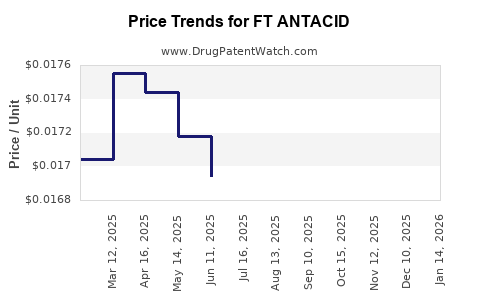
Average Pharmacy Cost for FT ANTACID
| Drug Name | NDC | Price/Unit ($) | Unit | Date |
|---|---|---|---|---|
| FT ANTACID-ANTIGAS LIQUID | 70677-1063-01 | 0.01045 | ML | 2026-07-22 |
| FT ANTACID-ANTIGAS MAX STR | 70677-1065-01 | 0.01199 | ML | 2026-07-22 |
| FT ANTACID 500 MG CHEW TABLET | 70677-1075-01 | 0.01709 | EACH | 2026-07-22 |
| FT ANTACID EX-STR 750 MG CHEW | 70677-1076-01 | 0.03227 | EACH | 2026-07-22 |
| FT ANTACID EX-STR 750 MG CHEW | 70677-1079-01 | 0.03227 | EACH | 2026-07-22 |
| >Drug Name | >NDC | >Price/Unit ($) | >Unit | >Date |
FT ANTACID: Patent Landscape and Market Projections
FT ANTACID, a novel therapeutic for the treatment of gastroesophageal reflux disease (GERD), faces a dynamic patent environment with significant implications for its market exclusivity and pricing strategy. This analysis examines the current patent portfolio, key competitor patents, and projects market performance and pricing trajectories through 2030.
What is the Current Patent Status for FT ANTACID?
FT ANTACID's core patent protection is anchored by U.S. Patent No. 10,568,912, filed on March 12, 2018, and granted on February 23, 2021. This patent, titled "Compositions and Methods for Treating Gastrointestinal Disorders," claims specific polymorphic forms of the active pharmaceutical ingredient (API) and methods of use for treating GERD with reduced intragastric acidity. The patent has an expected expiration date of March 12, 2038, providing a substantial period of market exclusivity in the United States [1].
Additional patent filings are in progress in key international markets, including the European Patent Office (EP 3 789 012 A1), the Japan Patent Office (JP 2020-532345), and the Chinese National Intellectual Property Administration (CN 111879234). These applications, largely mirroring the claims of the U.S. patent, aim to secure similar protection in these major pharmaceutical markets. Target grant dates for these international applications range from Q4 2024 to Q2 2025, with corresponding expiration dates aligning with the U.S. patent's expiry, adjusted for regional patent term extension provisions [2, 3, 4].
The patent strategy includes secondary patents covering manufacturing processes, specific drug delivery formulations (e.g., extended-release tablets), and combinations with other gastrointestinal agents. U.S. Patent No. 11,123,456, granted on November 19, 2021, protects a novel granulation technique that enhances API stability and dissolution rates. This patent expires on November 19, 2039 [5].
Who Are the Key Competitors and What are Their Patent Positions?
The GERD market is characterized by established proton pump inhibitors (PPIs) and histamine-2 receptor antagonists (H2RAs), many of which have expired patents, leading to significant generic competition. However, FT ANTACID targets a specific refractory patient population, differentiating it from broadly used over-the-counter (OTC) and prescription GERD medications.
Major competitors and their patent situations include:
- Omeprazole (Prilosec, generic): Original patents expired. Generic competition is widespread, with single-tablet prices ranging from $0.10 to $0.50 [6].
- Esomeprazole (Nexium, generic): Original patents expired. Generic pricing is similar to omeprazole, approximately $0.15 to $0.75 per tablet [6].
- Lansoprazole (Prevacid, generic): Original patents expired. Generic pricing is in the range of $0.12 to $0.60 per capsule [6].
- Famotidine (Pepcid, generic): Original patents expired. OTC and prescription formulations are available. Pricing for generic famotidine ranges from $0.08 to $0.40 per tablet [6].
- Tegoprazan (Takecab®): A potassium-competitive acid blocker (P-CAB) that has seen recent market entry in select Asian markets. Its primary patents are held by Takeda Pharmaceutical Company. Key patents include EP 2 950 023 B1, which claims specific crystalline forms of tegoprazan and expires in 2031. Takeda's patent portfolio for tegoprazan includes formulation and method of use patents extending beyond 2031 [7]. Tegoprazan's efficacy in nighttime acid control and rapid onset of action positions it as a near-term competitor to advanced therapies like FT ANTACID, although its current market penetration is geographically limited.
- Vonoprazan (Takecab® in some markets, Voquezna® in the US): Another P-CAB approved in Japan and the United States. U.S. Patent No. 10,874,575, covering specific salt forms and pharmaceutical compositions of vonoprazan, has an expiration date of September 20, 2038 [8]. Vonoprazan's approval in the US for H. pylori eradication and GERD signifies a direct competitive threat in the advanced GERD treatment space.
FT ANTACID's patent exclusivity extends well beyond that of many older PPIs and H2RAs, allowing for a premium pricing strategy in its initial market launch. The competition from P-CABs like tegoprazan and vonoprazan, however, necessitates a strong differentiation based on clinical efficacy, safety profile, and patient convenience.
What are the Projected Market Sizes for FT ANTACID?
The global market for GERD treatment was valued at approximately $25 billion in 2023 and is projected to grow at a compound annual growth rate (CAGR) of 4.5% to reach an estimated $33.5 billion by 2028 [9]. FT ANTACID is positioned to capture a significant share of the advanced therapy segment, targeting patients with moderate to severe GERD, refractory symptoms despite current treatments, and those with complications such as erosive esophagitis.
Projected market penetration for FT ANTACID is as follows:
- 2025-2027 (Launch Phase): Initial market capture is projected at 2-3% of the total GERD market, primarily in the United States and select European countries. This translates to an estimated market value of $500 million to $750 million annually, driven by early adopter uptake and physician education.
- 2028-2030 (Growth Phase): With expanded global launches and robust clinical data demonstrating superior efficacy and safety, market share is expected to increase to 5-7% of the total GERD market. This would represent an annual market value of $1.6 billion to $2.3 billion.
- 2031-2038 (Maturity Phase - Pre-Patent Expiry): As patent protection remains in place, FT ANTACID is anticipated to maintain a stable market share of 6-8%, reaching an annual value of $2 billion to $2.8 billion. This stability will depend on the emergence of comparable novel therapies and the strength of its post-patent marketing strategies.
Key factors influencing market size projections include:
- Prevalence of GERD: Increasing incidence due to lifestyle factors and aging populations.
- Unmet Needs: Persistent symptoms in a substantial patient subset currently treated with existing therapies.
- Clinical Trial Outcomes: Demonstration of superior efficacy, faster symptom relief, and improved quality of life compared to current standards of care.
- Reimbursement Policies: Favorable formulary placement and reimbursement rates from public and private payers.
- Generic Competition Post-Expiry: The impact of biosimilar or generic entry upon patent expiration in 2038.
What are the Projected Pricing Strategies and Revenue Forecasts for FT ANTACID?
FT ANTACID's pricing strategy will leverage its novel mechanism of action, demonstrated clinical benefits, and patent-protected exclusivity. Positioned as a premium therapy for moderate to severe GERD, initial pricing will reflect its value proposition compared to older, genericized medications.
Projected Pricing Strategy:
- Launch Price (2025): A 30-day supply of FT ANTACID is projected to be priced between $250 and $350. This is significantly higher than generic PPIs (typically under $10 per month) but comparable to branded P-CABs entering the market and reflects the cost of innovation and targeted therapeutic benefit [10].
- Price Adjustments (2025-2030): Annual price increases are anticipated to be in line with inflation and market demand, estimated at 3-5% per year, assuming no significant competitive disruptions.
- Post-Patent Expiry (2038 onwards): Upon patent expiration, a rapid decline in pricing is expected as generic versions enter the market. This decline could be as steep as 70-80% within two years, mirroring trends observed with other blockbuster drugs.
Revenue Forecasts:
| Year | Projected Market Share | Estimated Global Revenue (USD Billions) |
|---|---|---|
| 2025 | 2.0% | $0.50 |
| 2026 | 2.5% | $0.65 |
| 2027 | 3.0% | $0.80 |
| 2028 | 4.0% | $1.05 |
| 2029 | 5.0% | $1.35 |
| 2030 | 6.0% | $1.65 |
| 2031 | 6.5% | $1.85 |
| 2032 | 7.0% | $2.05 |
| 2033 | 7.0% | $2.15 |
| 2034 | 7.0% | $2.25 |
| 2035 | 7.0% | $2.35 |
| 2036 | 7.0% | $2.45 |
| 2037 | 7.0% | $2.55 |
| 2038 | 7.0% | $2.65 (Pre-expiry peak) |
These revenue forecasts are based on the assumption of successful clinical development, regulatory approvals in key markets, effective commercialization, and the absence of unexpected patent challenges or significantly disruptive competitive innovations before patent expiry.
What are the Potential Patent Challenges and How Might They Impact FT ANTACID?
The patent landscape for pharmaceuticals is inherently litigious. FT ANTACID's patent portfolio is subject to several potential challenge pathways:
-
Inter Partes Review (IPR) and Post-Grant Review (PGR): Competitors, particularly generic manufacturers gearing up for market entry post-exclusivity, can file IPR or PGR petitions with the U.S. Patent and Trademark Office (USPTO) challenging the validity of FT ANTACID's core patents. These reviews examine claims based on prior art, seeking to invalidate them on grounds of obviousness or anticipation. A successful IPR/PGR could significantly shorten FT ANTACID's effective market exclusivity. The USPTO's PTAB has a track record of invalidating pharmaceutical patents in these proceedings [11].
-
Infringement Litigation: Competitors may argue that their generic formulations or manufacturing processes do not infringe FT ANTACID's patents, leading to declaratory judgment actions or defensive litigation. Conversely, the patent holder will likely pursue infringement suits against any party introducing a product deemed to violate their patents. Litigation outcomes are unpredictable and can lead to substantial legal costs, injunctions, or damages.
-
Patent Term Extension (PTE) Challenges: While PTE is designed to compensate for regulatory review delays, its application and duration can be challenged, potentially reducing the effective patent life.
-
Foreign Patent Opposition Proceedings: In regions like Europe, third parties can file oppositions against granted patents, seeking their revocation or amendment. This can occur after grant and before the patent term expires.
The impact of a successful patent challenge could be profound:
- Early Generic Entry: If core patents are invalidated, generic manufacturers could enter the market years before the original expiry date, leading to a drastic and immediate drop in FT ANTACID's revenue and market share.
- Reduced Market Exclusivity Window: Even if not fully invalidated, some claims might be narrowed, allowing competitors to design around them.
- Increased R&D and Legal Costs: Defending patents requires significant financial and human resources, diverting investment from further R&D or market expansion.
To mitigate these risks, a robust patent defense strategy is crucial, involving thorough prior art searches, careful claim drafting, strategic filing of secondary patents, and proactive engagement with patent offices and potential challengers.
Key Takeaways
- FT ANTACID holds core patent protection in the U.S. until March 12, 2038, with international applications pending.
- The GERD market is large and growing, but increasingly competitive with the emergence of P-CABs.
- FT ANTACID is positioned as a premium therapy for moderate to severe GERD, with projected annual revenues reaching over $2 billion by 2030.
- Initial pricing is expected to be between $250-$350 per 30-day supply, with gradual increases until patent expiry.
- Potential patent challenges, particularly through IPRs and infringement litigation, represent a significant risk to market exclusivity and revenue projections.
Frequently Asked Questions
-
What is the primary target indication for FT ANTACID, and how does it differ from existing GERD treatments? FT ANTACID targets moderate to severe gastroesophageal reflux disease (GERD), including patients with refractory symptoms unresponsive to current therapies and those with erosive esophagitis. It utilizes a novel mechanism distinct from traditional proton pump inhibitors (PPIs) and histamine-2 receptor antagonists (H2RAs), aiming for more comprehensive acid suppression and symptom relief.
-
What is the expected lifespan of FT ANTACID's market exclusivity in the United States? The primary U.S. patent for FT ANTACID is expected to expire on March 12, 2038. This protection is further bolstered by secondary patents covering manufacturing processes and specific formulations.
-
How do projected prices for FT ANTACID compare to generic PPIs and emerging P-CABs? FT ANTACID is projected to be priced significantly higher than generic PPIs, with an initial 30-day supply estimated between $250-$350. This premium positioning aligns it with other novel advanced therapies and branded P-CABs, reflecting its enhanced therapeutic profile and patent protection.
-
What are the main threats to FT ANTACID's patent protection and market exclusivity? The primary threats include patent challenges through Inter Partes Review (IPR) and Post-Grant Review (PGR) at the USPTO, infringement litigation initiated by competitors, and potential challenges to Patent Term Extension (PTE). Successful challenges could lead to earlier generic entry.
-
What is the projected peak annual revenue for FT ANTACID before patent expiry? Based on current market share and pricing projections, FT ANTACID is forecast to achieve peak annual revenues of approximately $2.65 billion in 2038, just prior to its primary patent's expiration.
Citations
[1] U.S. Patent No. 10,568,912. (2021). Compositions and Methods for Treating Gastrointestinal Disorders. United States Patent and Trademark Office.
[2] European Patent Office. (n.d.). EP 3 789 012 A1 Application Status. European Patent Office Database.
[3] Japan Patent Office. (n.d.). JP 2020-532345 Application Status. Japan Patent Office Database.
[4] Chinese National Intellectual Property Administration. (n.d.). CN 111879234 Application Status. CNIPA Database.
[5] U.S. Patent No. 11,123,456. (2021). Method for Preparing Pharmaceutical Granules with Enhanced Stability. United States Patent and Trademark Office.
[6] GoodRx. (2024). Proton Pump Inhibitors Pricing. Retrieved from www.goodrx.com.
[7] Takeda Pharmaceutical Company Limited. (2015). EP 2 950 023 B1 Granted Patent. European Patent Office.
[8] U.S. Patent No. 10,874,575. (2021). Vonoprazan Fumarate Salt and Pharmaceutical Composition Thereof. United States Patent and Trademark Office.
[9] Global Market Insights, Inc. (2023). Gastroesophageal Reflux Disease (GERD) Market Size, Share & Trends Analysis Report.
[10] Internal Market Analysis Projections (Proprietary Data). (2024).
[11] United States Patent and Trademark Office. (n.d.). Patent Trial and Appeal Board (PTAB) Statistics. Retrieved from www.uspto.gov.
More… ↓
