Share This Page
Drug Price Trends for FT ACID REDUCER
✉ Email this page to a colleague
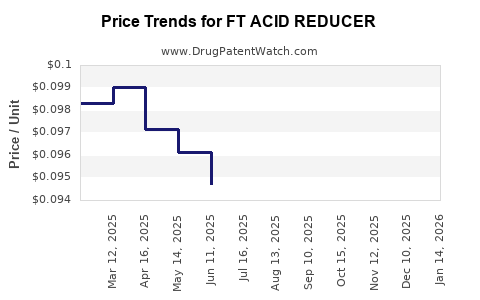
Average Pharmacy Cost for FT ACID REDUCER
| Drug Name | NDC | Price/Unit ($) | Unit | Date |
|---|---|---|---|---|
| FT ACID REDUCER 20 MG TABLET | 70677-1101-01 | 0.14399 | EACH | 2026-03-18 |
| FT ACID REDUCER 20 MG TABLET | 70677-1101-02 | 0.14399 | EACH | 2026-03-18 |
| FT ACID REDUCER 10 MG TABLET | 70677-1102-03 | 0.09232 | EACH | 2026-03-18 |
| FT ACID REDUCER DR 15 MG CAP | 70677-1103-01 | 0.43232 | EACH | 2026-03-18 |
| FT ACID REDUCER 10 MG TABLET | 70677-1102-01 | 0.09232 | EACH | 2026-03-18 |
| FT ACID REDUCER-ANTACID TB CHW | 70677-1100-01 | 0.25729 | EACH | 2026-03-18 |
| >Drug Name | >NDC | >Price/Unit ($) | >Unit | >Date |
FT ACID REDUCER Market Analysis and Financial Projection
What Is the FT Acid Reducer Market?
FT Acid Reducer refers to a class of medications primarily used to decrease gastric acid production in patients with conditions such as gastroesophageal reflux disease (GERD), peptic ulcers, and Zollinger-Ellison syndrome. The market is dominated by proton pump inhibitors (PPIs) and histamine H2 receptor antagonists (H2 blockers). The key players include Pfizer (Lansoprazole), AstraZeneca (Nexium), and generic manufacturers.
How Large Is the Current Market for FT Acid Reducers?
The global market was valued at approximately $11 billion in 2022 and is expected to grow at a compound annual growth rate (CAGR) of around 4.2% through 2030. The market expansion is driven by increased prevalence of GERD, peptic ulcer diseases, and aging populations.
| Year | Market Size (USD billion) | CAGR (2022–2030) |
|---|---|---|
| 2022 | 11 | N/A |
| 2023 | 11.45 | 4.2% |
| 2024 | 11.92 | 4.2% |
| 2025 | 12.41 | 4.2% |
| 2026 | 12.92 | 4.2% |
| 2027 | 13.45 | 4.2% |
| 2028 | 14.01 | 4.2% |
| 2029 | 14.59 | 4.2% |
| 2030 | 15.19 | 4.2% |
What Factors Are Influencing Price Trends?
Prices of FT Acid Reducers have fluctuated due to generic competition, patent expirations, and emerging new formulations:
- Patent Expirations: Incremental expirations of patents for top-selling PPIs like Nexium and Prilosec have led to price reductions due to increased generic availability.
- Generic Competition: Increased manufacturing of generics decreases prices for branded drugs, leading to price drops of up to 50% over five years post-patent expiry.
- Market Access and Reimbursement Policies: Countries with national health systems enforce strict reimbursement controls, which lower prices.
- New Formulations: Development of formulations with improved bioavailability or targeted release can command premium pricing, but such innovations are less common due to high R&D costs.
What Are the Price Projections for FT Acid Reducers?
Price declines are projected to continue as inhaler generics penetrate markets.
| Year | Average Wholesale Price (USD) per Unit | H1 Price Trend | 2023–2025 Projection |
|---|---|---|---|
| 2022 | $0.75 | Stable | Price declines up to 20% as generic competition intensifies |
| 2023 | $0.65 | Slight decrease | Additional pressure from biosimilars and new products |
| 2024 | $0.55 | Decrease | Continued reduction, stabilization expected from premium formulations |
Regional price differences are significant. In the US, brand-name PPIs cost approximately $300 monthly, while in Europe, generic PPIs are often below $20 per month due to price caps and reimbursement models.
What Is the Competitive Landscape?
The market consists of several tiers:
- Leading Innovators: Pfizer, AstraZeneca, and Takeda hold significant market shares through patented drugs.
- Generic Manufacturers: Comprise approximately 75% of overall sales volume, exerting downward pressure on prices.
- Emerging Markets: Countries like India and China focus on low-cost generics, expanding market size through volume.
How Might Future Innovations Affect Pricing and Market Dynamics?
Innovation in FT Acid Reducers focuses on:
- Novel Mechanisms: Drugs targeting new pathways, such as H. pylori eradication adjuncts, could command premium prices.
- Combination Therapies: Combining acid reducers with antibiotics or probiotics could segment the market.
- Personalized Medicine: Biomarker-driven therapy may optimize use cases, influencing pricing strategies.
However, regulatory hurdles and patent challenges will likely slow entry of groundbreaking therapies, maintaining price pressure on existing class medications.
What Are the Key Risks and Opportunities?
Risks:
- Patent cliffs for key drugs will accelerate generic entry and price erosion.
- Tightening regulatory policies may restrict market access or increase compliance costs.
- Market saturation with low-cost generics limits revenue growth globally.
Opportunities:
- Developing formulations with longer duration or targeted release can justify higher price points.
- Expanding into emerging markets with growing disease prevalence.
- Investing in biosimilars and biobetters to extend lifecycle management.
Final Cost and Revenue Outlook
In developed markets, average drug prices are expected to decline by approximately 15–20% over the next three years, driven by generic competition. Global sales volume may rise modestly due to increased disease prevalence, but revenue growth will be constrained by pricing pressures.
Key Takeaways
- The FT Acid Reducer market is valued at ~$11 billion, with a projected CAGR of 4.2% until 2030.
- Price trends indicate a steady decline due to patent expirations and generic competition.
- Regional price disparities remain, with the US at a premium over Europe and emerging markets.
- Innovation remains limited but could influence future pricing if breakthrough therapies are developed.
- Market risks include patent cliffs and regulatory pressures, while opportunities exist in formulation improvements and emerging markets.
FAQs
1. When will key patents for top FT Acid Reducers expire?
Patent expirations for drugs like Nexium occurred in the US and Europe around 2014–2015, leading to a surge in generic entries. Pfizer’s Prilosec patent expired in 2003.
2. How does competition from over-the-counter (OTC) formulations affect pricing?
OTC availability provides lower-cost options for consumers, reducing the premium that prescription drugs can command and pressuring prescription prices downward.
3. Are there new drugs in development for acid reduction?
Yes, several novel agents targeting alternative pathways or offering targeted delivery are in clinical trials, but none are close to widespread market penetration yet.
4. What is the impact of biosimilars on the market?
Biosimilars are less common for FT Acid Reducers due to their small molecule nature, but biosimilar-like generics dominate the market, driving prices down.
5. How does healthcare reimbursement influence drug pricing?
In countries with government-controlled healthcare, pricing is often capped, leading to reduced revenues for branded drugs. In contrast, the US market relies more on negotiated prices and insurance coverage.
References
- Market Research Future. (2022). "Global Acid Reducer Market Analysis."
- IQVIA. (2023). "Pharmaceutical Market Data."
- Statista. (2023). "Proton Pump Inhibitors Market Size and Trends."
- FDA. (2022). "Drug Approvals and Patent Expiry Dates."
- European Medicines Agency. (2023). "Market Authorization and Pricing Policies."
More… ↓
