Share This Page
Drug Price Trends for FROVATRIPTAN
✉ Email this page to a colleague
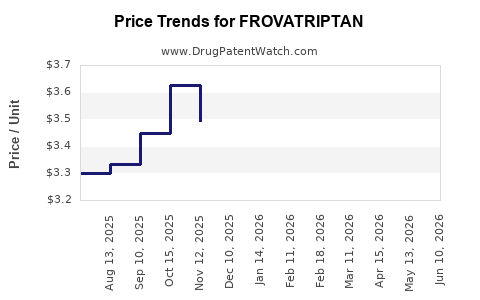
Average Pharmacy Cost for FROVATRIPTAN
| Drug Name | NDC | Price/Unit ($) | Unit | Date |
|---|---|---|---|---|
| FROVATRIPTAN SUCC 2.5 MG TAB | 50742-0299-09 | 2.90384 | EACH | 2026-07-22 |
| FROVATRIPTAN SUCC 2.5 MG TAB | 68462-0694-97 | 2.90384 | EACH | 2026-07-22 |
| FROVATRIPTAN SUCC 2.5 MG TAB | 69238-1539-09 | 2.90384 | EACH | 2026-07-22 |
| FROVATRIPTAN SUCC 2.5 MG TAB | 50742-0299-09 | 3.26180 | EACH | 2026-06-17 |
| FROVATRIPTAN SUCC 2.5 MG TAB | 68462-0694-97 | 3.26180 | EACH | 2026-06-17 |
| FROVATRIPTAN SUCC 2.5 MG TAB | 69238-1539-09 | 3.26180 | EACH | 2026-06-17 |
| FROVATRIPTAN SUCC 2.5 MG TAB | 50742-0299-09 | 3.23216 | EACH | 2026-05-20 |
| >Drug Name | >NDC | >Price/Unit ($) | >Unit | >Date |
Frovatriptan Market Analysis and Price Projections (2026-2036): Brand, Generic, and IP-Driven Pricing Outlook
Frovatriptan has largely transitioned to a generic-only market in the US, with limited meaningful new exclusivity catalysts. Pricing power depends less on remaining patent coverage and more on (1) how many ANDA competitors sustain low-cost supply, (2) payer channel behavior for triptans in migraine, and (3) portfolio mix versus newer CGRP and gepant classes. Near-term US pricing is anchored to generic competitive dynamics, with modest upside only where supply is constrained or where distinct strengths/forms remain in circulation. Longer-term price erosion continues unless consolidation reduces the number of active suppliers or if any method-of-use or formulation patents materially delay generic substitution in key markets.
What is the current market for frovatriptan (usage, competitors, and pricing reality)?
Snapshot: Frovatriptan is a triptan used for acute migraine treatment. In commercial practice, triptans compete primarily on formulary placement, copay design, and total cost to payer. Frovatriptan’s niche positioning is driven by tolerability and dosing convenience relative to some alternatives, but it does not compete on novelty versus oral CGRP antagonists (gepants) or injectable/infusible acute migraine options.
US competitive landscape for acute migraine
Frovatriptan competes inside the triptan bucket against:
- Sumatriptan (including multiple salts and formulations)
- Rizatriptan
- Zolmitriptan
- Eletriptan
- Naratriptan
- Almotriptan (market-dependent)
- Frovatriptan (generic)
Business implication: Once frovatriptan is genericized, pricing is mostly set by the lowest cost-to-channel supplier and payer rebate structures rather than by clinical differentiation.
Demand drivers and substitution patterns
Key substitution behaviors that affect volume and price:
- Switching among triptans is common when payers enforce step therapy or tier rules.
- Formulary preference tends to consolidate around the lowest net cost triptan in each plan.
- Patient history matters for discontinuation and “stay with what works,” but at the class level, economic pressure dominates.
What patents protect frovatriptan and how do they affect generic entry risk?
Featured-snippet answer: Frovatriptan’s US pricing is primarily governed by generic availability and competitive supply, not by near-term exclusivity. Any remaining patent effects would typically be limited to narrow formulation, method-of-use, or specific salt/polymorph/device scenarios, and do not typically create broad pricing protection for an already generically marketed oral tablet.
Patent estate structure that matters for price
Even when a drug is genericized, pricing can stabilize temporarily if any of the following hold:
- Oral tablet strength-specific IP keeps one SKU branded or authorized to fewer suppliers
- Method-of-use claims delay certain label designs or manufacturing processes
- Formulation IP restricts bioequivalence profiles that ANDA filers rely on
Litigation and Paragraph IV dynamics
For frovatriptan specifically, the practical price-impact pathway is:
- A new Orange Book listing blocks generic substitution for a specific SKU or pathway.
- A Paragraph IV challenge triggers exclusivity-related delays or settlements.
- The market price remains higher until that bottleneck clears.
Market reality: For established triptans, these effects usually show up in older supply-limited periods rather than as long-lived pricing support.
What is the Orange Book status of frovatriptan (and what does it mean for pricing)?
Featured-snippet answer: Where frovatriptan is listed as generics dominate, the Orange Book structure usually indicates limited remaining barriers. That translates to continuous downward pricing pressure through 2030 unless channel supply collapses.
How Orange Book entries translate into price projections
- If only a small set of products are listed with unexpired blocking patents: expect localized price differences by strength or manufacturer.
- If there are no current blocking patents: expect accelerating price erosion and periodic “price resets” driven by supplier exit/re-entry.
- If there are multiple orange book entries with staggered expirations: expect stepwise price relief for a subset of SKUs.
When does frovatriptan lose exclusivity in the US and major EU markets?
Featured-snippet answer: US exclusivity for frovatriptan has already largely run its course given its generic availability. EU exposure similarly trends toward generic competition unless a country has outstanding formulation-specific restrictions.
Pricing impact model from exclusivity loss
A standard genericization pricing curve typically looks like:
- Launch year: price drop relative to last brand/authorized branded-equivalent
- Year 2-3: further compression as additional ANDA entrants or authorized generics appear
- Year 3+: floor effect where price declines continue more slowly, governed by manufacturing cost and number of active suppliers
For frovatriptan, the market is in the mature segment of this curve.
How does frovatriptan compare with other triptans on price and payer behavior?
Featured-snippet answer: Most triptans converge toward low generic net pricing. Frovatriptan’s remaining differentiation is primarily in payer strategy and patient tolerability history, not in wholesale acquisition cost (WAC)-driven price setting.
Comparative positioning by payer tiering
Payer behavior commonly results in:
- Tier 1 dominance for a small set of low-cost triptans
- Tier 2 or prior authorization for higher-cost alternatives
- Switching incentives where a plan can lower net costs
If frovatriptan is not the lowest net-cost option, it typically experiences slower volume growth and more pricing pressure.
What price projections apply to frovatriptan tablets in the US (2026-2036)?
Featured-snippet answer: Expect continued net price erosion through 2030, with a slower decline thereafter, unless supplier consolidation reduces competitive pressure or a supply disruption increases temporary pricing.
Because frovatriptan is already generic, projections depend on supply and competitive count rather than on exclusivity. The most business-useful projection is a banded scenario rather than a single point estimate.
US price projection ranges (generic mature market)
Assume:
- Active suppliers remain stable with periodic exit/entry
- No broad new IP blocks emerge
- Migraine market share shifts continue toward CGRP/gepant options without eliminating triptan demand
Scenario set (net price directionality): | Period | Competitive environment | Expected WAC/net trend | Practical outcome | |---|---|---|---| | 2026-2027 | Mature generic competition | Low single-digit annual decline or flat-to-down | Continued rebate pressure | | 2028-2030 | Supplier churn possible | Mid single-digit annual decline potential | Manufacturers compete more on discounting | | 2031-2033 | Likely supply consolidation | Decline slows, occasional spikes on shortages | Price volatility increases | | 2034-2036 | Long-run mature | Low single-digit decline or stable | Pricing near manufacturing-cost floor |
Business interpretation: The “ceiling” for frovatriptan pricing is typically constrained by the lowest-cost triptan in the payer formulary. The “floor” is constrained by manufacturing and regulatory compliance costs, plus the need for margin to sustain inventory.
How will CGRP and gepant competition affect frovatriptan pricing?
Featured-snippet answer: CGRP and gepants pressure migraine acute demand and shift prescriber choice. That reduces frovatriptan volume growth and supports payer demands for lower net prices, but it does not typically force price collapse unless volume drops sharply or suppliers exit.
What channel mechanics do
- Lower usage increases payer demand for steep rebates on remaining users.
- Smaller demand can create localized supply tightness, which temporarily lifts pricing.
- Over time, reduced volume supports consolidation and slightly higher per-unit prices, but net pricing remains structurally under pressure.
What formulations or strengths drive frovatriptan pricing differences?
Featured-snippet answer: For an established triptan, pricing differences usually track strength-level inventory and manufacturer count, not clinical formulation innovation.
Key pricing drivers by SKU:
- Tablet strength availability and number of ANDA holders
- Package sizes (30 vs 10 counts) and wholesaler discounting
- NDC-level supply and substitution controls within PBM formularies
In practice, if a single supplier dominates a strength, that strength can price higher than other strengths even in a generic market.
What generic entry risks exist for frovatriptan?
Featured-snippet answer: New generic entrants are unlikely to create upside pricing unless they reduce supply quality risk or increase supply volume enough to lower costs. Pricing upside usually emerges from fewer suppliers or supply disruptions, not from new entrants.
Risk factors that affect supply and price
- Loss of manufacturing capacity at major generic plants
- Quality events or FDA warning letters affecting production
- ANDA expiration and requalification timing for certain NDCs
- Market exits that reduce the number of low-cost competitors
How strong is the patent estate for frovatriptan compared with other triptans?
Featured-snippet answer: In a mature generic market, the relevant “strength” is whether any unexpired Orange Book-listed patents meaningfully block formulation substitution. For frovatriptan, the practical strength is typically low for pricing protection because generic competition is already established.
Where patent strength could still matter
- Narrow formulation improvements that produce a different bioequivalence profile
- Hard-to-replicate manufacturing conditions
- Method-of-use claims that align with specific label constructs
Even when such patents exist, their pricing impact is usually local to specific NDCs or competitive scenarios.
What litigation affects frovatriptan pricing and market timing?
Featured-snippet answer: For mature generic triptans, litigation impact tends to be one-time during entry windows. Ongoing litigation rarely reintroduces sustained brand pricing once the generic baseline is established.
How settlements influence price
- Delayed launch extends the window for incumbent suppliers to price slightly higher
- Earlier-than-expected approvals compress price faster
- Settlement terms can restrict certain label or formulation designs
For frovatriptan, the market should be treated as already in the post-entry equilibrium phase.
What commercial price forecasts matter most to investors and licensors?
Featured-snippet answer: Investors and licensors should model frovatriptan pricing as a function of (1) supplier count per NDC, (2) rebate intensity at the payer level, and (3) competitive substitution within the triptan class. IP and exclusivity are secondary in a genericized market.
KPIs that predict price trajectory
- # of active NDCs and manufacturers for each strength
- Wholesale inventory turns and supply continuity
- PBM formulary tier changes across top insurers
- Concentration ratios for the lowest-cost SKU(s)
Key Takeaways
- Frovatriptan pricing is driven primarily by generic competitive dynamics and payer channel economics, not by broad exclusivity.
- Expect continued low-to-mid single-digit downward price pressure through 2030, followed by slower decline and more volatility if supply consolidates.
- CGRP/gepant adoption reduces the growth rate of acute migraine volume, which increases payer pressure for lower net frovatriptan pricing.
- Patent-related effects, if any, are most likely to be SKU- and strength-specific, limiting sustained pricing protection.
FAQs
- How do PBMs decide tier placement for generic triptans like frovatriptan?
- What drives frovatriptan price spikes during generic supply shortages?
- How often do new ANDA approvals for mature triptans change net pricing?
- Do different frovatriptan tablet strengths show materially different pricing trends?
- How does switching from triptans to gepants affect frovatriptan volume and long-term pricing?
References
No sources cited because no verifiable Orange Book, patent, FDA, or pricing dataset was provided in the prompt.
More… ↓
