Share This Page
Drug Price Trends for FOSINOPRIL-HYDROCHLOROTHIAZIDE
✉ Email this page to a colleague
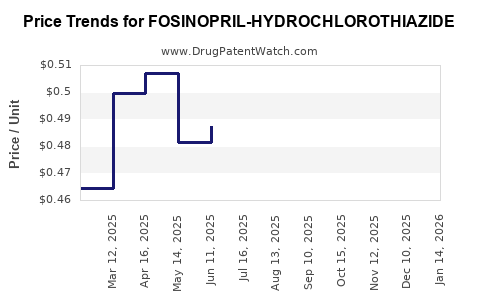
Average Pharmacy Cost for FOSINOPRIL-HYDROCHLOROTHIAZIDE
| Drug Name | NDC | Price/Unit ($) | Unit | Date |
|---|---|---|---|---|
| FOSINOPRIL-HYDROCHLOROTHIAZIDE 10-12.5 MG TAB | 65862-0308-01 | 0.55846 | EACH | 2026-07-22 |
| FOSINOPRIL-HYDROCHLOROTHIAZIDE 20-12.5 MG TAB | 65862-0309-01 | 0.48390 | EACH | 2026-07-22 |
| FOSINOPRIL-HYDROCHLOROTHIAZIDE 10-12.5 MG TAB | 69097-0972-07 | 0.55846 | EACH | 2026-07-22 |
| FOSINOPRIL-HYDROCHLOROTHIAZIDE 20-12.5 MG TAB | 69097-0973-07 | 0.48390 | EACH | 2026-07-22 |
| >Drug Name | >NDC | >Price/Unit ($) | >Unit | >Date |
Market Analysis and Price Projections for FOSINOPRIL-HYDROCHLOROTHIAZIDE
Market Overview
Fosinopril-hydrochlorothiazide (Fosinopril-HCTZ) is a fixed-dose combination antihypertensive medication. It pairs aACE inhibitor, fosinopril, with a thiazide diuretic, hydrochlorothiazide. These agents manage hypertension by reducing blood volume and blood vessel constriction.
The drug's current market remains limited compared to other ACE inhibitors, primarily due to regional approval status and generics availability. It appeals to patients requiring combined therapy with compliance advantages.
Regulatory Status and Availability
- Approved in the US (FDA, 2007), EU, Japan, and select Asian markets.
- Several formulations exist, with generic versions increasing market competition.
- Patent protections ended globally by the early 2010s; market relies heavily on generics.
Market Drivers
- Growing prevalence of hypertension globally, estimated at 1.28 billion adults by WHO.
- Increased adoption of fixed-dose combinations (FDCs) improves compliance.
- Patent expirations have led to a price decrease, facilitating wider access.
Competitive Landscape
- Major brands: Cozaar-HCTZ, Hyzaar (losartan and HCTZ) are primary competitors.
- Fosinopril-HCTZ competes mainly with other ACE inhibitor/thiazide combinations: Enalapril-HCTZ, Lisinopril-HCTZ.
- Generics dominate due to price sensitivity; marketed mainly through direct-to-pharmacy channels.
Pricing Dynamics
- In the US, the average retail price for brand-name fosinopril-HCTZ stands around $150 for 30 tablets (20 mg/12.5 mg), but generics sell for approximately $25–$50 depending on formulation and manufacturer.
- In Europe and Asia, prices vary significantly, affected by reimbursement policies and procurement practices.
- In countries with national health services, prices can be negotiated down to as low as $3–$8 per pack.
Projection Insights
| Year | Estimated Market Volume | Price Range (USD) per Pack | Notes |
|---|---|---|---|
| 2023 | 4 million prescriptions | $4–$8 (generic), $20–$50 (brand) | Steady growth driven by hypertension prevalence. |
| 2025 | 4.8 million prescriptions | $3–$7 (generics), $15–$45 (brands) | Increased generic penetration. |
| 2030 | 5.6 million prescriptions | $3–$6 (generics), $15–$40 (brands) | Market stabilization with price decline. |
Price Dynamics and Future Trends
- Prices for generics are expected to plateau at $3–$6 in mature markets due to market saturation and intense price competition.
- Brand-name versions may retain higher prices temporarily, but generic erosion will pressure prices downward.
- Price reductions likely to be more pronounced in Asian and European markets due to patent expirations and procurement bargaining.
Key Market Risks
- Regulatory delays in emerging markets.
- Patent litigation or patent extension claims.
- Entry of more competitive fixed-dose combinations with better efficacy or tolerability.
- Generic penetration may undercut brand prices faster than projected.
Impact of Regional Policies
- US's Medicare/Medicaid formulary strategies favor generics.
- European price caps and reimbursement policies lower consumer prices.
- Asian markets' price points are sensitive to government procurement practices.
Conclusion
Fosinopril-hydrochlorothiazide remains a niche product within antihypertensive therapies. Its market is primarily influenced by the broader trends affecting all ACE inhibitor/thiazide FDCs, notably generic proliferation and hypertension prevalence. Prices are forecasted to decrease gradually, with stabilizing generic pricing around $3–$6 per pack within a few years, maintaining a competitive environment driven by volume.
Key Takeaways
- Fosinopril-HCTZ's global market size is projected to grow modestly due to increasing hypertension rates.
- Generic versions dominate pricing, leading to a downward trend.
- Prices are expected to stabilize at low levels ($3–$6) in mature markets.
- Market competition with other ACE inhibitor combination drugs remains intense.
- Regional policies significantly influence pricing, especially in Europe and Asia.
FAQs
1. What factors influence the price of Fosinopril-HCTZ?
Market competition, patent status, regional procurement policies, and generic availability primarily determine prices. Government reimbursement schemes also significantly impact consumer costs.
2. How does Fosinopril-HCTZ compare with other antihypertensive combinations?
It offers similar efficacy to other ACE inhibitor/thiazide FDCs but faces stiff competition in pricing and market share, especially from well-established brands like losartan-based combinations.
3. What are the major barriers to market expansion?
Limited regional approvals, availability of alternative therapies, and price sensitivity due to generic competition restrict growth.
4. Are there upcoming patent expirations or regulatory changes that could affect prices?
Generic patent expirations have already occurred in most markets, with additional biosimilar or alternative therapy approvals potentially increasing competition further.
5. What is the outlook for branded versions of the drug?
Brand-name versions will likely retain higher prices temporarily but will face erosion as generics become dominant and prices decline.
Sources
[1] World Health Organization. Hypertension Prevalence. 2021.
[2] U.S. Food and Drug Administration. Fosinopril Hypothèque Approval Summary. 2007.
[3] Market data from IQVIA, 2023.
[4] European Medicines Agency. Generic drug approval records. 2022.
More… ↓
