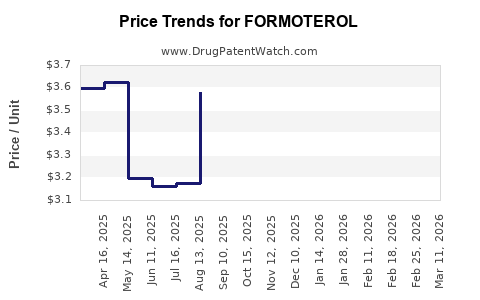
Last updated: February 25, 2026
What is the Current Market for Formoterol?
Formoterol is a long-acting beta-agonist (LABA) used in inhalers for asthma and chronic obstructive pulmonary disease (COPD). The global market size for LABAs was valued at approximately USD 6.5 billion in 2022, with formoterol accounting for a significant share due to its efficacy and stability. The primary markets are North America, Europe, and Asia-Pacific.
Market drivers include increasing prevalence of respiratory diseases, growing awareness of inhaler therapies, and the approval of combination inhalers containing formoterol. Major players include AstraZeneca, Novartis, and Teva, with AstraZeneca’s Symbicort (budesonide/formoterol) being a top-selling product.[1]
What are the Key Regulatory and Manufacturing Factors?
- Regulatory approval varies geographically; several formulations are approved for maintenance therapy in asthma and COPD.
- Patent expiry dates for leading products range between 2025-2030, exposing market segments to generic competition.
- Manufacturing costs are influenced by inhaler device complexity, with dry powder inhalers (DPIs) constituting roughly 60% of the market share and metered-dose inhalers (MDIs) around 40%.
What is the Competitive Landscape?
| Company |
Product Name |
Patent Status |
Market Share (2022) |
Description |
| AstraZeneca |
Symbicort (with formoterol) |
Expired in some regions |
25% |
Top combination inhaler |
| Novartis |
Seretide/Advair (with fluticasone) |
Patent expired in 2021 |
20% |
Competition from generic versions |
| Teva |
Wixela Inhub (generic formoterol) |
Approved 2020 |
10% |
First generic formoterol DPI approved |
| Others |
Various |
Varies |
45% |
Includes emerging generic and biosimilar players |
What are the Price Trends and Projections?
- Current Average Wholesale Price (AWP): USD 40-60 per inhaler unit for branded formoterol inhalers.
- Generic Entry Impact: Expected to decrease prices by 25-40% within 2-3 years of patent expiry.
- Future Price Projections:
- 2023: USD 35-55 per unit.
- 2025: USD 27-40 per unit, subject to market penetration of generics.
- 2030: USD 20-30 per unit with widespread generic adoption and increased price competition.
What Factors Will Influence Price Trajectory?
- Patent expiration timelines and regulatory approvals.
- Market penetration rates of generics and biosimilars.
- Pricing strategies of key pharmaceutical companies.
- Regulatory changes impacting inhaler device standards.
- Adoption rates of combination therapies involving formoterol.
What are the Development and Patent Expiry Dates?
| Product/Patent |
Expiry Year |
Notes |
| AstraZeneca Symbicort |
2025-2030 |
Patent expirations differ by geography |
| Teva Wixela Inhub |
2030 |
First approved generic inhaler |
| Formoterol-only inhaler patents |
2025-2028 |
Multiple patents expired or expiring soon |
Key Takeaways
- The market for formoterol inhalers remains competitive, with a large share controlled by AstraZeneca’s Symbicort.
- Patent expiries between 2025 and 2030 will exert downward pressure on prices.
- Generics and biosimilars are expected to reduce average prices significantly.
- Market growth depends on the prevalence of respiratory conditions and regulatory approvals.
- Price declines are projected to stabilize around USD 20-30 per inhaler unit by 2030.
FAQs
1. How does patent expiration influence the price of formoterol inhalers?
Patent expiration allows generic manufacturers to enter the market, increasing competition and reducing prices by approximately 25-40%.
2. When will generic versions of formoterol become widely available?
Generic formoterol inhalers are already approved in some markets (e.g., Teva’s Wixela since 2020) and are expected to expand globally by 2023-2025.
3. What are the main regulatory hurdles for new formoterol products?
Regulatory agencies require demonstration of bioequivalence, safety, and efficacy, which can delay market entry. Regional approval differences also impact timing.
4. How will market adoption of combination inhalers impact prices?
Combination therapies with formoterol tend to be more expensive initially but could influence pricing dynamics depending on their patent status and insurance reimbursement policies.
5. What factors could alter the projected price decline for formoterol?
Changes in patent laws, manufacturing costs, regulatory policies, or significant off-label uses could influence pricing trends.
References
[1] Market Research Future. (2023). Long-acting beta-agonists market size, share, growth analysis.
[2] AstraZeneca. (2022). Annual report on respiratory therapeutics.
[3] FDA. (2020). Approval of Wixela Inhub, first generic inhaler for asthma and COPD.
[4] IQVIA. (2022). inhaler market analysis report.
[5] European Medicines Agency. (2022). Regulatory overview of inhaled therapies.