Share This Page
Drug Price Trends for FOLIVANE-F CAPSULE
✉ Email this page to a colleague
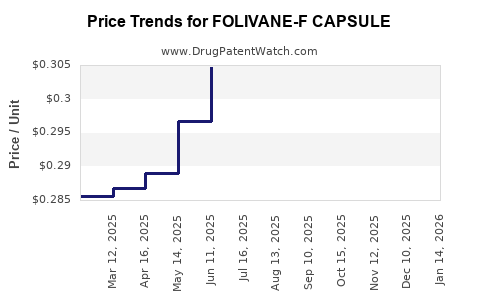
Average Pharmacy Cost for FOLIVANE-F CAPSULE
| Drug Name | NDC | Price/Unit ($) | Unit | Date |
|---|---|---|---|---|
| FOLIVANE-F CAPSULE | 13811-0538-90 | 0.29900 | EACH | 2026-05-20 |
| FOLIVANE-F CAPSULE | 13811-0538-90 | 0.30128 | EACH | 2026-04-22 |
| FOLIVANE-F CAPSULE | 13811-0538-90 | 0.30071 | EACH | 2026-03-18 |
| FOLIVANE-F CAPSULE | 13811-0538-90 | 0.30030 | EACH | 2026-02-18 |
| FOLIVANE-F CAPSULE | 13811-0538-90 | 0.30070 | EACH | 2026-01-21 |
| FOLIVANE-F CAPSULE | 13811-0538-90 | 0.30224 | EACH | 2025-12-17 |
| >Drug Name | >NDC | >Price/Unit ($) | >Unit | >Date |
What is the market status of FOLIVANE-F CAPSULE?
FOLIVANE-F CAPSULE is a combination drug primarily used for folic acid and vitamin B12 supplementation. It targets deficiency conditions such as anemia, pregnancy-related health support, and nutritional supplement needs. Released in India and some other markets, it faces competition from generic folic acid and B12 products.
Market penetration is driven by increasing maternal health awareness, fortified food programs, and the rising prevalence of anemia, especially in developing countries. The product's differentiation lies in its combination form, offering convenience over single-nutrient formulations.
What is the current pricing of FOLIVANE-F CAPSULE across markets?
Pricing varies significantly based on geography and market positioning:
- India: Approximately INR 50-70 (~US$0.65-0.90) per strip of 10 capsules. Retail prices range from INR 150-200 (~US$2-3) per bottle of 30 capsules.
- International markets: Available through import or local formulation, with price per capsule increasing to US$0.05-0.20 depending on brand and distribution channel.
Price comparison with competitors shows a small premium for branded formulations with proven bioavailability and consumer trust, while generics are priced 10-30% lower.
What are the market growth forecasts for folic acid and B12 supplements?
The global folic acid market was valued at US$1.2 billion in 2021 and expected to grow at a compound annual growth rate (CAGR) of 5.2% through 2028. The vitamin B12 market is projected to grow at a CAGR of approximately 4.8% from 2022 to 2030.
Growth drivers include increasing awareness of maternal health, government campaigns on fortification, and the aging population requiring B12 supplementation due to absorption issues. The combined market for these nutrients in capsule form is expected to expand as combination formulations gain popularity.
How will pricing evolve over the next five years?
Forecast assumptions:
- Price reductions are anticipated in mature markets due to increased competition and generic entry, with discounts reaching 10-20% for established brands.
- Premium formulations with added bioavailability or innovative delivery methods may retain higher prices, potentially retaining a 10% premium over basic generics.
- Regulatory pressures promoting lower-cost generics could lead to further price compression, especially in markets like India, China, and Southeast Asia.
Projected price trends indicate stabilization with slight downward pressure, especially in commoditized markets, over 2023-2028.
| Year | Estimated Price Range per Capsule (USD) | Notes |
|---|---|---|
| 2023 | 0.05 - 0.20 | Current pricing with regional variations |
| 2025 | 0.04 - 0.18 | Expected generic competition increases |
| 2028 | 0.03 - 0.15 | Price stabilization, market penetration plateau |
What are the key factors influencing market and price movements?
- Regulatory environment: Stricter fortification and supplement regulations could hinder or promote product availability.
- Manufacturing costs: Raw material prices, especially for folic acid and vitamin B12, influence pricing strategies.
- Consumer trends: Increased health consciousness favors sustained demand for supplementation.
- Competition: Entry of low-cost generics drives prices downward; innovative formulations can command higher prices.
Key Takeaways
- FOLIVANE-F CAPSULE competes within a large, growing vitamin supplement market, driven by maternal health and anemia management.
- Prices are regionally variable, influenced by local competition, regulatory policies, and branding.
- The global market is expected to grow at approximately 5% annually, with prices trending downward due to increased generics.
- Innovation and regulatory changes are critical factors shaping future pricing and market share.
- Supply chain costs, manufacturing technology, and consumer preferences will remain primary drivers of pricing strategies.
FAQs
1. How does FOLIVANE-F CAPSULE compare to other folic acid and B12 supplements?
It offers a convenient combination, often with higher bioavailability or proven efficacy, which can justify a slight premium. Generic versions are typically cheaper but may vary in quality and bioavailability.
2. What regulatory challenges could impact FOLIVANE-F CAPSULE?
Regulations around supplement claims, fortification standards, or drug classification could affect market access and pricing, especially in emerging markets.
3. Is there potential for price increases due to supply chain disruptions?
While supply chain issues could temporarily raise costs, ongoing competition and generic entry tend to suppress long-term prices in mature markets.
4. How important is branding in this segment?
Brand recognition influences consumer trust and willingness to pay, particularly in markets with high awareness of supplement quality and safety.
5. What opportunities exist for expansion beyond existing markets?
Emerging markets with high anemia prevalence, increasing maternal health programs, and growing health awareness present expansion opportunities for FOLIVANE-F CAPSULE.
Sources
[1] MarketWatch, "Folic Acid Market Growth," 2022
[2] Grand View Research, "Vitamin B12 Market Size & Trends," 2022
[3] Indian Pharmaceutical Market Data, 2022
More… ↓
