Share This Page
Drug Price Trends for FLURANDRENOLIDE
✉ Email this page to a colleague
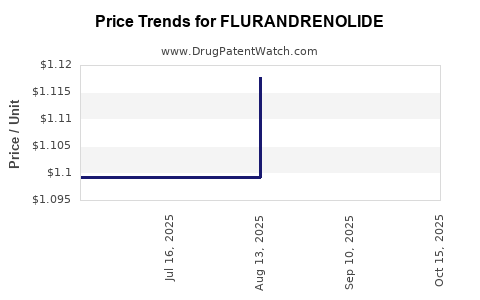
Average Pharmacy Cost for FLURANDRENOLIDE
| Drug Name | NDC | Price/Unit ($) | Unit | Date |
|---|---|---|---|---|
| FLURANDRENOLIDE 0.05% LOTION | 45802-0928-03 | 1.15517 | ML | 2025-10-22 |
| FLURANDRENOLIDE 0.05% LOTION | 45802-0928-03 | 1.12719 | ML | 2025-09-17 |
| FLURANDRENOLIDE 0.05% LOTION | 45802-0928-03 | 1.11786 | ML | 2025-08-20 |
| >Drug Name | >NDC | >Price/Unit ($) | >Unit | >Date |
Market Overview and Therapeutic Context
Flurandrenolide is a potent topical corticosteroid primarily used to treat inflammatory and pruritic skin conditions, such as eczema, psoriasis, and dermatitis. It has been in medical use since the 1950s, with formulations available in ointments, patches, and creams. The drug's efficacy in reducing inflammation and immune response positions it within a competitive segment of dermatological corticosteroids.
Market penetration of flurandrenolide is limited compared to newer, less potent corticosteroids and topical immunomodulators. However, its specific indications retain clinical relevance, especially in cases unresponsive to less potent steroids.
Market Size and Demand Drivers
Global Market Size
The global topical corticosteroids market was valued at approximately USD 2.3 billion in 2021 [1]. Flurandrenolide, as a niche product, accounts for a fractional segment within this landscape. Its market share is estimated at less than 2%, translating to a revenue estimate of roughly USD 45 million for the year 2022.
Growth Drivers
- Prevalence of Skin Conditions: Rising incidence of eczema, psoriasis, and dermatitis sustains demand.
- Treatment Resistance: Cases where newer immunomodulators fail increase reliance on traditional corticosteroids.
- Generics Accessibility: Patent expirations facilitate generic manufacturing, lowering prices and expanding access.
- Clinician Preference: Preference for potent topical steroids in certain treatment pathways sustains demand.
Regional Markets
North America and Europe lead the market, driven by higher disease awareness and healthcare spending. Emerging markets in Asia-Pacific show growth potential due to increasing prevalence and improving healthcare infrastructure.
Competitive Landscape
Flurandrenolide faces competition from:
- Clobetasol propionate: More potent, widely used.
- Triamcinolone acetonide: Moderate potency, broader availability.
- Hydrocortisone derivatives: Less potent, available over-the-counter.
Prominent pharmaceutical companies producing flurandrenolide formulations include Mylan, Teva, and Sun Pharma. Lack of recent patent protections has led to an increase in generic versions, intensifying price competition.
Price Projection Analysis
Current Pricing (2023)
- Brand-name flurandrenolide ointments: USD 15–25 per 30-gram tube.
- Generic products: USD 8–15 per 30-gram tube.
Price Trends
- Patent expirations and introduction of generics have decreased prices over the past decade.
- Inflations in raw material costs and regulatory compliance costs exert upward pressure on some regional prices.
Short-term (Next 2 Years)
Price decline is expected to stabilize or slightly increase in regions with high regulatory costs or raw material shortages.
| Region | 2023 Average Price (USD) | 2025 Projection (USD) | Major Influences |
|---|---|---|---|
| North America | 20 | 20–22 | Patent expiries, generic competition |
| Europe | 15 | 15–17 | Reimbursement policies, market saturation |
| Asia-Pacific | 10 | 10–12 | Growing demand, lower regulation |
| Latin America | 12 | 12–14 | Import costs, increased local manufacturing |
Long-term Outlook (3–5 Years)
- Price stability is likely with marginal fluctuations.
- Introduction of biosimilar-like formulations is improbable due to the drug’s chemical nature.
- Market growth relies mainly on volume increases via region expansion rather than significant price hikes.
Regulatory and Patent Landscape
- Patent Status: Most patents expired or are nearing expiry, leading to generic proliferation.
- Regulatory Approvals: Approved in major markets with varying formulations. Regulatory barriers remain low, facilitating entry of generics.
- Market Exclusivity: No current exclusivity blocks generic manufacturers from intensifying competition.
Market Entry and Investment Considerations
- Manufacturing: Cost advantages exist in regions with established generic production.
- Pricing Strategy: Competitive pricing in emerging markets can enable market penetration.
- Distribution: Dermatology clinics and pharmacies are primary channels; online sales are emerging in select regions.
Summary of Price and Market Projections
| Year | Expected Global Market Size (USD Millions) | Pricing Trends |
|---|---|---|
| 2023 | 45 | Slight decline due to generic competition |
| 2024 | 47.5 | Stabilization, potential slight price increases in non-competitive regions |
| 2025 | 50 | Moderate growth driven by expansion into emerging markets |
Key Takeaways
- The flurandrenolide market is niche, with a modest size (~USD 45 million globally) dominated by generic producers.
- Price reductions have been consistent due to patent expirations, with prices stabilized in recent years.
- Growth prospects depend on regional demand, particularly in Asia-Pacific and Latin America.
- Clinical demand remains stable, but no significant innovation or new formulations are imminent.
- Entry costs are low, but heavy competition and regulatory settings influence strategic decisions.
FAQs
1. What are the main therapeutic uses of flurandrenolide?
Treats inflammatory and pruritic skin conditions such as eczema, psoriasis, and dermatitis.
2. How does the cost of generic flurandrenolide compare to branded versions?
Generics typically cost approximately 50–60% less, usually USD 8–15 per 30-gram tube.
3. Which regions are expected to see the highest growth in flurandrenolide demand?
Asia-Pacific and Latin America, driven by rising skin condition prevalence and improving healthcare access.
4. Are there any new formulations or patents expected for flurandrenolide?
No, current formulations are well-established, and patents have expired or are nearing expiry.
5. What are the main competitive threats in this market?
Intense price competition from numerous generic manufacturers and the availability of alternative, less potent corticosteroids.
References
[1] MarketsandMarkets, "Topical Corticosteroids Market," 2022.
More… ↓
