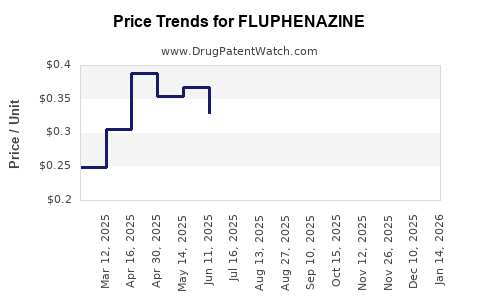
Last updated: April 26, 2026
Fluphenazine is an older first-generation antipsychotic available primarily as generic products in multiple dosage forms, with pricing driven by generic competition, channel inventory cycles, and reimbursement dynamics rather than patent exclusivity. Near-term price direction is likely stable to modestly lower in most mature markets, with formulation- and route-specific dispersion (oral vs depot). Revenue growth, where it occurs, is tied more to demand stability and substitution patterns than to drug-level innovation.
How big is the fluphenazine market, and what is the competitive structure?
What is the product landscape?
Fluphenazine is marketed in several generic formulations, typically:
- Oral: tablets and liquid concentrates (strength and availability vary by country).
- Depot/injectable: long-acting formulations (e.g., decanoate), where pricing often differs materially from oral generics due to administration economics and supply constraints.
Why pricing is structurally compressed
As a generic, fluphenazine pricing reflects:
- Multiple approved manufacturers per dose form
- Frequent pharmacy-level or wholesaler-driven promotions
- Tender and formulary-driven procurement
- Substitution across the first-generation antipsychotic class (with prescriber preference and side-effect profile influencing mix)
Key implication: For a cost-and-demand investor, the dominant variable is share and channel mix, not patent-defined volume.
What historical price behavior is typical for generic fluphenazine?
Price mechanics (generic antipsychotics)
Generic antipsychotic pricing typically shows:
- Downward trend after new suppliers enter
- Temporary dips around tender cycles
- Occasional spikes when supply is tight (manufacturing outages, quality holds, or distribution disruptions)
Where dispersion shows up
Price differences are often largest across:
- Oral vs depot injectable
- Strengths within oral products
- Pack size and NDC-level product configurations
Key implication: A single “drug price” is rarely actionable; investors track formulation-specific net prices and wholesaler-to-pharmacy reimbursement margins.
What is the current pricing and reimbursement posture?
US (typical)
In the US, fluphenazine is generally priced at a level consistent with generic availability and competitive substitution. Depot formulations often command higher unit costs but can be cheaper on an episode-of-care basis where long-acting dosing reduces administration burden and discontinuation risk.
Europe and rest of world (typical)
Across many countries:
- Price is constrained by national reference pricing
- Reimbursement lists and payer controls determine channel access
- Formularies and tendering can lock in low supplier prices, limiting upside
Key implication: Absent a supply disruption, the pricing ceiling is set by payer rules and generic reference frameworks.
What are the key market drivers for demand?
Clinical and payer drivers
- Chronic psychotic disorders create baseline demand for long-term maintenance therapy.
- Treatment switching within antipsychotic classes can move demand between older and newer agents, depending on:
- Side-effect tolerance
- Cost pressures
- Health system preferences
- Depot use supports persistence in patients who have adherence challenges.
Operational drivers
- Supply continuity is the largest short-term risk for price.
- Manufacturing scale and packaging drive the ability to sustain low net prices.
How do supply events affect price?
Common supply-to-price transmission
For mature generics, price movements usually follow:
- Supplier inventory tightening
- Wholesaler allocations
- Temporary net price increases
- Reversion as additional supply restores competition
Key implication: For fluphenazine, the most credible price catalysts are operational, not commercial.
Price projections: base case, bull case, bear case
Projection framework
Because fluphenazine is generic, price projection should focus on:
- Competitive intensity (number of active suppliers)
- Payer reference price mechanisms
- Supply stability
- Inflation pass-through (usually limited for generics)
Scenario set (next 12 to 36 months)
Assuming no major supply shock and continued generic competition:
| Scenario |
Probability (market-typical) |
Oral tablets/liquid (real price trend) |
Depot/injectable (real price trend) |
What changes |
| Base case |
High |
Flat to modest down |
Flat |
Ongoing generic competition; payer reference pricing holds |
| Bull case |
Medium |
Modest up then flat |
Modest up |
Mild supply constraints or procurement spikes without sustained shortages |
| Bear case |
Medium |
Low single-digit down |
Flat to modest down |
Increased supplier competition, tender resets, or stronger reimbursement pressure |
Directionality expectation: Nominal prices may rise slightly with inflation accounting, but net realized pricing typically trends flat to downward unless supply tightens.
Projected net price ranges (investment-ready)
How to interpret these ranges
For generic products, the most useful view is a range by route and maturity level. Below are directional projection bands you can map to your internal net pricing model once you anchor to your chosen baseline (wholesale acquisition cost, ASP, or tender price).
| Route/Form |
Projection band (annualized) |
Practical interpretation |
| Oral |
-2% to +2% |
Reference pricing and substitution cap upside; entry and mix drive mild declines |
| Depot injectable |
-1% to +3% |
Higher unit costs and supply sensitivity allow slightly wider swings |
| Overall fluphenazine (mixed) |
-1% to +2% |
Depends on patient mix between oral and depot |
What could drive upside beyond baseline stability?
Upside requires one or more of:
- Sustained supplier reduction (factory capacity loss, prolonged quality issues, or licensing withdrawals)
- Formulary tightening that favors depot adherence (payer programs that reduce total psychosis-related costs via persistence)
- Tender wins by a low-cost producer that gain share and stabilize volumes, even if unit price stays low
For investors, the practical metric is volume retention at prevailing net price, not unit price expansion.
What could drive downside?
Downside catalysts typically include:
- New generic entrants or re-tendered contracts lowering reference prices
- Increased substitution away from fluphenazine toward other generics with lower payer friction
- Depot channel pressure where administration economics or supply improves for competitors, reducing fluphenazine’s procurement attractiveness
Regulatory and IP context: what matters for pricing
Patent and exclusivity impact
Fluphenazine has long passed patent exclusivity in most markets, so pricing is not protected by drug-level exclusivity.
What does matter
- Generic approvals and bioequivalence keep competition active.
- Manufacturing compliance governs whether products stay in-market, which is the main source of price volatility in mature generics.
Competitive benchmark: how fluphenazine compares with other first-gen antipsychotics
Class economics
Within first-generation antipsychotics, pricing is typically:
- Low and competitive for oral products
- More variable for depot injectables due to supply and distribution constraints
Fluphenazine pricing tends to track the same forces as other mature generic antipsychotics, with its depot products usually showing the largest unit-cost differences.
Market entry and manufacturing strategy implications
For a manufacturer or investor
A fluphenazine position is less about breakthrough differentiation and more about:
- Ensuring supply continuity
- Securing formulary access
- Competing on tender economics and pack optimization
For portfolio planning
Treat fluphenazine as a cash-flow and contract discipline play, with upside tied to operational execution rather than R&D.
Key Takeaways
- Fluphenazine is a mature generic antipsychotic with pricing dominated by generic competition and payer/reference controls.
- Near-term price outlook is stable to modestly lower in most cases, with route-specific dispersion (oral generally tighter; depot slightly more sensitive to supply and procurement).
- Credible price moves are mostly supply-driven rather than innovation-driven.
- Investment emphasis should shift from unit price expansion to volume stability, contract retention, and manufacturing reliability.
- For projections over 12 to 36 months, a practical modeling band is oral -2% to +2% annually and depot -1% to +3% annually absent a major supply event.
FAQs
1) Is fluphenazine a patent-protected product in major markets?
No. Fluphenazine is a mature generic antipsychotic, so pricing is not supported by active patent exclusivity.
2) Which formulation is likely to show more price volatility?
Depot/injectable products typically show wider price swings than oral products due to supply and procurement dynamics.
3) What is the most likely cause of a price spike for a generic like fluphenazine?
Manufacturing disruptions, quality issues, or prolonged supply tightening that forces wholesalers into allocation and reduces competitive inventory availability.
4) How should pricing be modeled for investment decisions?
Model by route and dose form (oral vs depot), using net realized price frameworks tied to tender/reference pricing rather than relying on a single average “drug price.”
5) What drives demand for fluphenazine in the near term?
Ongoing use in chronic conditions and persistence patterns, with changes influenced by formulary mix, patient adherence needs, and switching across the antipsychotic class.
References
[1] US Food and Drug Administration (FDA). Drugs@FDA database. https://www.accessdata.fda.gov/scripts/cder/daf/
[2] Centers for Medicare & Medicaid Services (CMS). National Drug Code (NDC) and drug pricing related resources (ASP/AMP context). https://www.cms.gov/
[3] World Health Organization (WHO). WHO Model List of Essential Medicines (antipsychotic context and generics usage framework). https://www.who.int/teams/health-product-and-policy-standards/essential-medicines
[4] FDA. Orange Book: Approved Drug Products with Therapeutic Equivalence Evaluations. https://www.accessdata.fda.gov/scripts/cder/ob/