You're using a free limited version of DrugPatentWatch: Upgrade for Complete Access

Last Updated: December 6, 2025

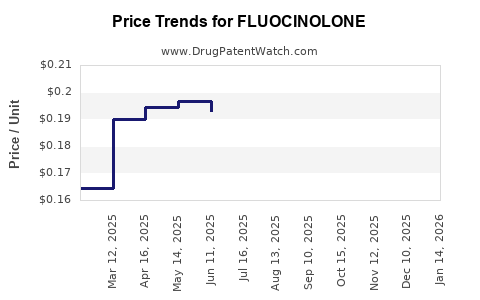
Drug Price Trends for FLUOCINOLONE


✉ Email this page to a colleague

« Back to Dashboard


Drug Price Trends for FLUOCINOLONE

Average Pharmacy Cost for FLUOCINOLONE

These are average pharmacy acquisition costs (net of discounts) from a US national survey
Drug Name NDC Price/Unit ($) Unit Date
FLUOCINOLONE 0.01% BODY OIL 70752-0156-06 0.17300 ML 2025-11-19
FLUOCINOLONE 0.01% CREAM 00713-0223-15 1.72662 GM 2025-11-19
FLUOCINOLONE 0.01% BODY OIL 64980-0331-04 0.17300 ML 2025-11-19
FLUOCINOLONE 0.01% CREAM 00713-0223-60 1.38979 GM 2025-11-19
FLUOCINOLONE 0.01% BODY OIL 45802-0887-26 0.17300 ML 2025-11-19
FLUOCINOLONE OIL 0.01% EAR DRP 70752-0159-20 1.04555 ML 2025-11-19
>Drug Name >NDC >Price/Unit ($) >Unit >Date

Best Wholesale Price for FLUOCINOLONE

These are wholesale prices available to the US Federal Government which, by law, must be the best prices available to any customer under comparable terms and conditions
Drug Name Vendor NDC Count Price ($) Price/Unit ($) Unit Dates Price Type
FLUOCINOLONE ACETONIDE 0.025% OINT,TOP Sandoz, Inc. 00168-0064-60 60GM 46.19 0.76983 GM 2023-08-15 - 2028-08-14 FSS
FLUOCINOLONE ACETONIDE 0.01% SOLN,TOP Sandoz, Inc. 00168-0059-60 60ML 15.78 0.26300 ML 2023-08-15 - 2028-08-14 FSS
FLUOCINOLONE ACETONIDE 0.025% OINT,TOP Sandoz, Inc. 00168-0064-15 15GM 16.41 1.09400 GM 2023-08-15 - 2028-08-14 FSS
FLUOCINOLONE ACETONIDE 0.01% OIL,TOP Golden State Medical Supply, Inc. 51672-1356-08 118ML 25.99 0.22025 ML 2023-06-15 - 2028-06-14 FSS
FLUOCINOLONE ACETONIDE 0.01% OIL,TOP Golden State Medical Supply, Inc. 51672-1356-08 118ML 28.08 0.23797 ML 2023-06-23 - 2028-06-14 FSS
FLUOCINOLONE ACETONIDE 0.01% OIL,TOP (SCALP) Golden State Medical Supply, Inc. 51672-1357-08 118ML 24.72 0.20949 ML 2023-12-15 - 2028-06-14 FSS
>Drug Name >Vendor >NDC >Count >Price ($) >Price/Unit ($) >Unit >Dates >Price Type
Price type key: Federal Supply Schedule (FSS): generally available to all Federal Govt agencies / 'BIG4' prices: VA, DoD, Public Health & Coast Guard only / National Contracts (NC): Available to specific agencies

Market Analysis and Price Projections for Fluocinolone

Last updated: July 27, 2025

Introduction

Fluocinolone, a potent synthetic corticosteroid, is primarily used for managing allergic, dermatologic, and inflammatory conditions. Widely recognized under its topical formulations, it also has applications in intra-articular injections and implantable devices for chronic inflammatory diseases. As a mid- to high-tier corticosteroid, its market dynamics are influenced by factors such as patent status, regulatory landscapes, clinical positioning, and competitive alternative therapies. This report analyzes current market conditions and projects future pricing trajectories for Fluocinolone, equipping stakeholders with data-driven insights for strategic planning.

Market Overview

Therapeutic Areas and Market Penetration

Fluocinolone's therapeutic utility spans dermatology, ophthalmology, rheumatology, and certain autoimmune conditions. Prominent formulations include topical creams, intra-articular injections, and intravitreal implants such as the Iluvien (fluocinolone acetonide implant for diabetic macular edema).

According to GlobalData, the corticosteroid market, including Fluocinolone, was valued at approximately USD 2.3 billion in 2022, with a compound annual growth rate (CAGR) of 3.5% projected through 2030[1]. The ophthalmic segment exhibits significant growth driven by the expanding diabetic population and advances in sustained-release implant technology.

Key Players and Product Portfolio

Major pharmaceutical companies involved as patent holders or developers of Fluocinolone formulations include Bausch + Lomb, Alimera Sciences, and Santen Pharmaceutical. Bausch + Lomb’s Iluvien, launched in 2012, remains a flagship product in the ophthalmology segment. Generic manufacturers have entered the space, especially post-patent expiry, intensifying price competition.

Regulatory and Market Access Landscape

Regulatory agencies such as the FDA, EMA, and Japan’s PMDA have approved various Fluocinolone-based products, often with combination or extended-release formulations. Patent expirations, which for some formulations occurred between 2018 and 2022, have catalyzed generic entry, impacting market share and pricing.

Market Drivers and Barriers

Market Drivers

  • Rising prevalence of dermatologic and ocular inflammatory diseases.
  • Aging populations with increased susceptibility to chronic inflammatory conditions.
  • Development of sustained-release implantable devices, improving adherence and patient outcomes.
  • Competitive pricing of generics increasing accessibility.

Market Barriers

  • Stringent regulatory requirements delaying market entry.
  • Patent expiries reducing exclusivity periods.
  • Potential safety concerns and side-effect profiles limiting broader utilization.
  • Competition from other corticosteroids and non-steroidal alternatives.

Pricing Landscape

Current Pricing Analysis

Topical Formulations:
Brand-name Fluocinolone creams and ointments command premium prices, typically ranging from USD 40–80 per tube (15-30g). Generic versions, available since mid-2010s, have reduced prices by approximately 20–30%, with prices dropping to USD 20–50 per item.

Intra-articular and Ophthalmic Implants:
The Iluvien implant currently retails at approximately USD 2,500–3,000 per implant (lasting about three years). The high cost reflects manufacturing complexity, patent protections, and the convenience of sustained-release delivery.

Impact of Patent Expiry

Patent expiry has precipitated a sharp decline in branded product prices, with bid-offer competition driving down costs. For instance, generics of topical Fluocinolone are often priced 40–50% below branded counterparts, boosting adoption in price-sensitive markets.

Projected Price Trends (2023–2030)

Short-Term (2023–2025):
Prices for branded topical formulations are expected to stabilize amid moderate generic competition. Ophthalmic implant costs will likely see marginal declines (~5–10%) as manufacturing efficiencies improve and generic alternatives gain regulatory approval.

Medium to Long-Term (2025–2030):
Expected growth in generic entries and biosimilars (if applicable) will continue pressuring prices downward. Specifically:

  • Topical Fluocinolone could see a price decrease of 15–25%, aligning with overall corticosteroid market trends.
  • Implantable formulations, faced with increasing competition from newer delivery platforms, may experience a 10–15% price reduction, though high development costs may temper significant declines.

Influencing Factors on Price Projection

  • Regulatory Approvals: Approval of biosimilars or generics in key markets (US, EU, China) will accelerate price erosion.
  • Market Penetration and Adoption: Increased use in emerging markets as patent protections lapse and prices drop.
  • Technological Developments: Innovations in drug delivery could influence pricing structures, either through cost reductions or premium offerings.

Strategic Implications for Stakeholders

Manufacturers should closely monitor patent expirations and regulatory approvals to optimize revenue streams. Developing cost-efficient manufacturing processes and exploring combination therapies may maintain profitability amidst declining prices. Investors and healthcare payers should anticipate continued price reductions, emphasizing value-based assessments and formulary management.

Key Trends and Future Outlook

  • Generic Competition Intensifies: The disappearance of exclusivity will drive prices downward across all formulations.
  • Growth in Sustained-Release Technologies: These may command premium prices initially but will face future commoditization as competition increases.
  • Market Expansion in Emerging Economies: Price reductions will facilitate broader access, expanding market size.
  • Innovative Delivery Systems: Necessar to sustain higher price points, such as biodegradable implants or personalized dosing platforms.

Key Takeaways

  • Price Decline Post-Patent Expiry: Robust generic competition has led to a consistent downward trend in Fluocinolone prices, especially for topical formulations.
  • Segment-Specific Trends: Ophthalmic implants sustain higher prices due to technological complexity, but even these face future price pressures.
  • Market Expansion Opportunities: Lower prices expand access in emerging markets, likely increasing cumulative sales volumes.
  • Regulatory Dynamics: Continued patent cliff risks and regulatory approvals will shape long-term pricing strategies.
  • Innovation as a Differentiator: Advanced delivery systems and combination therapies will be critical to maintaining premium pricing.

Conclusion

The Fluocinolone market exhibits clear signs of maturation with declining prices driven by patent expiries and generics. While this trend challenges profitability for existing manufacturers, opportunities abound for innovating delivery systems and expanding into emerging markets. Stakeholders should adopt agile strategies that balance cost-efficiency, regulatory navigation, and technological innovation to thrive in this evolving landscape.


FAQs

1. When did key patents for Fluocinolone expire, prompting generic market entry?
Most patents for Fluocinolone topical formulations expired between 2018 and 2022, leading to increased generic competition and significant price declines.

2. How does the price of Fluocinolone implants compare to topical formulations?
Implants like Iluvien carry a substantially higher price point (~USD 2,500–3,000 per device) due to their advanced delivery technology, whereas topical formulations generally cost between USD 20–80 per unit.

3. What are the main factors affecting future Fluocinolone prices?
Patent expiries, regulatory approvals of generics/biosimilars, technological advancements in drug delivery, and market penetration in emerging regions primarily influence future prices.

4. Are there regional variations in Fluocinolone pricing?
Yes, prices tend to be higher in North America and Europe due to higher regulatory and reimbursement standards. Emerging markets often experience lower prices owing to increased competition and different healthcare dynamics.

5. What opportunities exist for pharmaceutical companies in this market?
Investing in innovative delivery systems, securing regulatory approvals in untapped markets, and developing combination therapies are strategic avenues to sustain revenue amid declining prices.


References

[1] GlobalData, "Corticosteroids Market Analysis," 2022.

More… ↓

⤷  Get Started Free

Make Better Decisions: Try a trial or see plans & pricing

Drugs may be covered by multiple patents or regulatory protections. All trademarks and applicant names are the property of their respective owners or licensors. Although great care is taken in the proper and correct provision of this service, thinkBiotech LLC does not accept any responsibility for possible consequences of errors or omissions in the provided data. The data presented herein is for information purposes only. There is no warranty that the data contained herein is error free. We do not provide individual investment advice. This service is not registered with any financial regulatory agency. The information we publish is educational only and based on our opinions plus our models. By using DrugPatentWatch you acknowledge that we do not provide personalized recommendations or advice. thinkBiotech performs no independent verification of facts as provided by public sources nor are attempts made to provide legal or investing advice. Any reliance on data provided herein is done solely at the discretion of the user. Users of this service are advised to seek professional advice and independent confirmation before considering acting on any of the provided information. thinkBiotech LLC reserves the right to amend, extend or withdraw any part or all of the offered service without notice.