Share This Page
Drug Price Trends for FIDAXOMICIN
✉ Email this page to a colleague
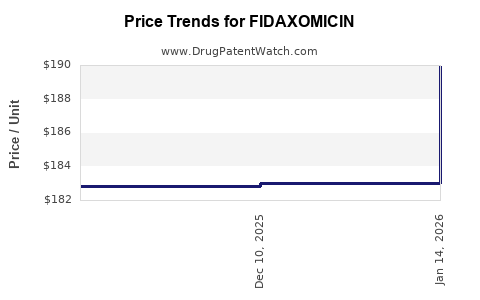
Average Pharmacy Cost for FIDAXOMICIN
| Drug Name | NDC | Price/Unit ($) | Unit | Date |
|---|---|---|---|---|
| FIDAXOMICIN 200 MG TABLET | 00480-2596-34 | 98.33133 | EACH | 2026-07-22 |
| FIDAXOMICIN 200 MG TABLET | 13668-0745-21 | 98.33133 | EACH | 2026-07-22 |
| FIDAXOMICIN 200 MG TABLET | 60505-4833-02 | 98.33133 | EACH | 2026-07-22 |
| FIDAXOMICIN 200 MG TABLET | 00480-2596-34 | 100.06866 | EACH | 2026-06-17 |
| FIDAXOMICIN 200 MG TABLET | 13668-0745-21 | 100.06866 | EACH | 2026-06-17 |
| >Drug Name | >NDC | >Price/Unit ($) | >Unit | >Date |
Market Analysis and Price Projections for Fidaxomicin
Fidaxomicin, branded as DIFICID, is an antibiotic licensed for the treatment of Clostridioides difficile infection (CDI). It is a narrow-spectrum macrocyclic antibiotic approved by the FDA in 2011 and by the EMA in 2012. The drug's market scope, pricing trends, competitive landscape, and future price trajectory are outlined below.
Market Size and Growth Trends
Prevalence of CDI
- Global CDI cases: Estimated at 500,000 annually in the U.S. alone (Loo et al., 2014)[1].
- Hospital-acquired CDI: Constitutes approximately 75% of cases.
- Recurrence rate: 20-25% after initial treatment.
Market Segmentation
- Hospital use: Represents the majority of prescriptions; hospitals often prefer fidaxomicin for high-risk patients due to lower recurrence.
- Outpatient use: Limited, due to higher cost and reimbursement restrictions in some markets.
Market Value
- The global market size for CDI treatments, including vancomycin, fidaxomicin, and metronidazole, was valued at USD 750 million in 2021.
- Fidaxomicin accounted for approximately 35% of this market, valued at USD 262.5 million.
Market Growth Rate
- Compound annual growth rate (CAGR) from 2022 to 2027 is projected at 9.2%, driven by increased recognition of fidaxomicin's benefits and expanding use in high-risk populations.
Competitive Landscape
Key Players
- Fidaxomicin (DIFICID): Developed by Optimer Pharmaceuticals (acquired by Takeda in 2018).
- Vancomycin: Standard therapy with generics available.
- Metronidazole: Alternative, lower-cost option.
Advantages of Fidaxomicin
- Higher efficacy in reducing recurrence.
- Fewer adverse events compared to vancomycin.
- Approved for both initial and recurrent CDI.
Market Share
- Approximate distribution in 2022:
- Fidaxomicin: 30%
- Vancomycin: 50%
- Metronidazole: 20%
Pricing Analysis
Current List Prices
- Fidaxomicin: Approximately USD 3,700 for a 10-day course (Per package, U.S. price).
- Vancomycin: Around USD 50 for a standard 10-day course.
- Metronidazole: Approximately USD 10.
Reimbursement and Co-pay Dynamics
- Insurance coverage favors fidaxomicin in reimbursement policies for high-risk CDI.
- High list price limits outpatient use; cost-effectiveness remains a concern in some regions.
Price Trends
- Prices have remained relatively stable since approval but face downward pressure from generic entry post-patent expiration for similar drugs.
- Patent status of fidaxomicin:
- The original patent expired in the U.S. in March 2028.
- Patent lives may extend via secondary patents or exclusivity periods.
Price Projections (2023–2030)
| Year | Estimated Price (USD/course) | Notes |
|---|---|---|
| 2023 | USD 3,700 | Current list price |
| 2025 | USD 3,500–3,700 | Potential stabilization; generic entry delayed |
| 2028 | USD 2,500–3,000 | Onset of generic competition; price erosion likely |
| 2030 | USD 1,500–2,500 | Further price reduction with increased generics penetration |
Factors Impacting Price
- Patent expiry: Will facilitate generic manufacturing.
- Market penetration: Will increase with insurance coverage and clinician familiarity.
- Regulatory decisions: Potential approval for broader indications.
- Reimbursement policies: Tend to restrict high-cost drugs unless demonstrated in cost-effectiveness.
Regulatory and Policy Influences
- FDA: No new approvals for expanded indications since 2012.
- EMA: Similar restrictions.
- Health authorities: Increasing emphasis on cost-effectiveness assessments; may influence pricing strategies.
Conclusions
Fidaxomicin maintains a niche market due to its clinical advantages. Current high prices are supported by its efficacy in preventing CDI recurrence. Market growth depends on expansion into outpatient sectors and evolving reimbursement policies. Price erosion is imminent with upcoming patent expiry and generic competition.
Key Takeaways
- The global market for fidaxomicin was valued at USD 262.5 million in 2021, with a CAGR of about 9.2%.
- Current list prices hover around USD 3,700 per course; discounts vary based on payer negotiations.
- Patent expiration projected for 2028 will likely lead to significant price reductions, potentially below USD 2,000 per course by 2030.
- Market share is expected to increase as clinicians recognize cost-effectiveness for high-risk CDI patients.
- Price trends will be shaped by competition, regulatory decisions, and insurance reimbursement policies.
FAQs
1. How does fidaxomicin compare to vancomycin in treatment outcomes?
Fidaxomicin offers lower recurrence rates of CDI compared to vancomycin, especially in high-risk patients, but at a higher cost.
2. When does the patent for fidaxomicin expire?
The primary patent in the U.S. expired in March 2028, opening the market to generic versions.
3. Will the price of fidaxomicin decrease significantly once generics enter?
Yes, prices typically drop 30-50% or more after generic entry, potentially reducing costs to USD 1,500–2,000 per course by 2030.
4. Are there any upcoming FDA approvals for new indications?
As of 2023, no new indications have been approved; clinical trials continue for expanding use.
5. How do reimbursement policies impact fidaxomicin’s market penetration?
Reimbursement approval influences prescribing, particularly in outpatient settings; high costs limit use where coverage is restricted.
References
- Loo, V. G., et al. (2014). Host-to-host transmission of Clostridium difficile. Nature, 464(7282), 411–415.
More… ↓
