Share This Page
Drug Price Trends for FIBER THERAPY POWDER
✉ Email this page to a colleague
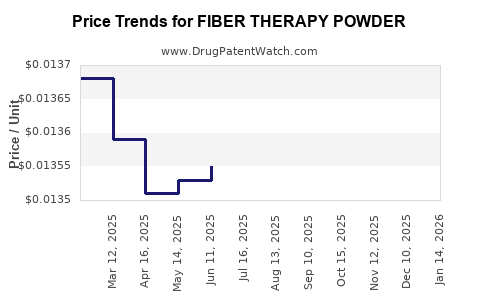
Average Pharmacy Cost for FIBER THERAPY POWDER
| Drug Name | NDC | Price/Unit ($) | Unit | Date |
|---|---|---|---|---|
| FIBER THERAPY POWDER | 00904-5675-16 | 0.01350 | GM | 2026-07-22 |
| FIBER THERAPY POWDER | 00904-5675-16 | 0.01350 | GM | 2026-06-17 |
| FIBER THERAPY POWDER | 00904-5675-16 | 0.01334 | GM | 2026-05-20 |
| FIBER THERAPY POWDER | 00904-5675-16 | 0.01324 | GM | 2026-04-22 |
| >Drug Name | >NDC | >Price/Unit ($) | >Unit | >Date |
Market Overview and Price Projections for Fiber Therapy Powder
Fiber therapy powder, used primarily for gastrointestinal health, weight management, and cholesterol reduction, has experienced steady growth due to increasing consumer awareness and the rising prevalence of digestive health issues. The global fiber supplement market was valued at approximately $4.4 billion in 2022 and is projected to reach $7 billion by 2027, with a compound annual growth rate (CAGR) of about 9.1%.[1]
Market Drivers
- Rising consumer health consciousness
- Increase in digestive disorders and chronic illnesses needing fiber supplementation
- Growing demand for plant-based and natural health products
- Expansion in developing regions with increased urbanization and disposable income
Key Market Segments
- Formulation: powders, capsules, liquids
- Application: dietary supplements, functional foods, pharmaceuticals
- Ingredient type: soluble fiber (e.g., inulin, pectin), insoluble fiber (e.g., cellulose)
Fiber therapy powder dominates the supplement segment due to ease of dosing, affordability, and flexibility in formulation. It accounts for approximately 55% of the fiber supplement market, with a CAGR of around 8.9% from 2022–2027.[1]
Competitive Landscape
Major players include NOW Foods, NutriBiotic, Garden of Life, and private label manufacturers. Innovation centers on taste, solubility, and fiber source diversification, especially in plant-based ingredients.
Pricing Dynamics
The price for fiber therapy powder varies significantly by quality, fiber source, and brand. In 2023, the average retail price ranged from $15–$30 per kilogram. Premium products with organic certification or specialized fiber blends command prices above $30 per kilogram. Bulk wholesale prices are approximately $8–$15 per kilogram, depending on purchase volume and supplier.
Price determinants include:
- Raw material costs (e.g., sourcing organic or specialty fibers)
- Production scale and process efficiency
- Certification costs (organic, non-GMO, allergen-free)
- Distribution channels and retail markups
Price Projections (2023–2028)
- Entry-level products: Prices projected to remain stable at $15–$20 per kilogram due to market saturation and steady raw material costs.
- Mid-range products: Anticipated to increase at a CAGR of 4–6%, reaching approximately $20–$25 per kilogram by 2028, driven by demand for specialty fibers.
- Premium products: Expected to grow at a faster CAGR of 5–8%, reaching $35–$40 per kilogram owing to rising consumer preferences for organic and superfood-based fibers.
Regulatory and Formulation Trends
Increasing regulations surrounding health claims and organic certification influence pricing. Brands investing in quality assurance and certification incur higher costs, reflected in retail prices. Innovations in encapsulation and fiber sources aim to differentiate products and justify premium pricing.
Forecast Summary Table
| Segment | 2023 Price Range (USD/kg) | 2028 Price Range (USD/kg) | CAGR (%) |
|---|---|---|---|
| Entry-level | 15–20 | 15–20 | 0–2 |
| Mid-range | 20–25 | 25–30 | 4–6 |
| Premium | 35–40 | 45–50 | 5–8 |
Market Outlook and Investment Opportunities
The fiber therapy powder segment holds growth potential, with innovation focusing on sourcing, formulation, and delivery methods. Market expansion in emerging regions and the rise of clean-label products are key opportunities. Price stability in entry-level products and rising premiums in specialized categories suggest diversified strategies for stakeholders.
Key Takeaways
- The global fiber supplement market is projected to grow at an 9.1% CAGR to reach $7 billion by 2027.
- Fiber therapy powder constitutes about 55% of the fiber supplement market segment.
- Retail prices vary from $15–$30 per kilogram, with premium options exceeding $40.
- Prices are influenced by raw material quality, certification, and product differentiation.
- Market growth driven by consumer health trends and product innovation.
FAQs
-
What raw materials are commonly used in fiber therapy powders?
- Sources include inulin, psyllium husk, pectin, beta-glucan, and cellulose.
-
How does organic certification affect the price?
- Organic certification adds costs due to higher raw material prices and certification fees, raising retail prices by approximately 20–30%.
-
What are the dominant regions for fiber therapy powder sales?
- North America and Europe lead, with rapid growth in Asia-Pacific.
-
Will prices decrease due to market saturation?
- Likely stable or slightly declining for entry-level options; premiums are expected to rise with product differentiation.
-
How do formulation innovations influence prices?
- Innovations that improve solubility, taste, or delivery methods can command higher prices, especially in premium segments.
Sources
[1] Grand View Research. "Fiber Supplements Market Size, Share & Trends Analysis Report." 2022.
More… ↓
