Share This Page
Drug Price Trends for FEXOFENADINE
✉ Email this page to a colleague
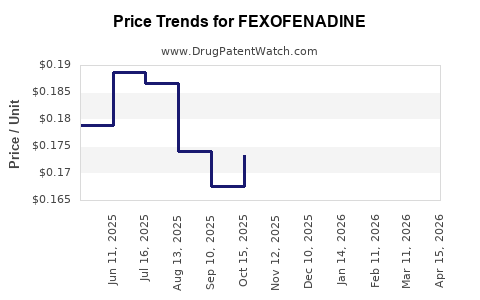
Average Pharmacy Cost for FEXOFENADINE
| Drug Name | NDC | Price/Unit ($) | Unit | Date |
|---|---|---|---|---|
| FEXOFENADINE HCL 180 MG TABLET | 00904-6711-46 | 0.23781 | EACH | 2026-07-22 |
| FEXOFENADINE HCL 180 MG TABLET | 00904-7050-40 | 0.23781 | EACH | 2026-07-22 |
| FEXOFENADINE HCL 180 MG TABLET | 00904-7050-60 | 0.23781 | EACH | 2026-07-22 |
| FEXOFENADINE HCL 180 MG TABLET | 00904-7486-02 | 0.23781 | EACH | 2026-07-22 |
| FEXOFENADINE HCL 180 MG TABLET | 00904-7486-40 | 0.23781 | EACH | 2026-07-22 |
| FEXOFENADINE HCL 180 MG TABLET | 00904-7486-60 | 0.23781 | EACH | 2026-07-22 |
| FEXOFENADINE HCL 180 MG TABLET | 16714-0899-01 | 0.23781 | EACH | 2026-07-22 |
| >Drug Name | >NDC | >Price/Unit ($) | >Unit | >Date |
Fexofenadine Market Analysis and Price Projections (2026–2035): Generic Exposure, Competitive Dynamics, and Revenue Outlook
Fexofenadine (systemic antihistamine; BDS/OTC “non-drowsy” brand segment) is largely off-patent globally. Pricing and revenue are driven by (1) OTC vs prescription positioning, (2) shift toward generics and store brands, (3) pack size and strength mix (30 mg/60 mg/120 mg; liquid in select markets), and (4) promotion intensity and channel contracting. Near-term price erosion is expected as branded share stays pressured, but wholesale and retail volatility will be limited by mature supply and high generic substitution. Over 2026–2035, revenue growth should be modest and tied more to unit volumes and emerging channel mix than to realized price.
How big is the fexofenadine market and where is it sold (US vs EU vs key emerging markets)?
Market size: what drives the reported ranges
Fexofenadine is widely used for allergic rhinitis and chronic idiopathic urticaria (CIU) across OTC and prescription channels. Market reporting for fexofenadine varies because:
- Some trackers measure only “fexofenadine” NDCs under key label products.
- Others include combination antihistamine categories separately.
- OTC sales attribution differs by retail scan data methodology.
Channel structure that governs pricing
- US: Dominated by OTC generic “fexofenadine HCl” and branded label legacy (notably Allegra historically). Pricing is heavily affected by pharmacy benefit design for any remaining prescription usage and by OTC retailer economics.
- EU: Similar dynamic with broad generics penetration; pack-and-strength competition affects realized net pricing.
- Emerging markets: Higher dispersion in retail pricing reflects distribution margins, local generic competition pace, and import policy.
Implication for price projections
When a drug is generic-major, price forecasts align to:
- generic unit growth versus branded decline
- retailer promotion frequency
- pack size mix shift (smaller packs can support higher per-unit prices, but lower volumes can offset)
What is the current fexofenadine price trend (wholesale and retail), and what should change next?
Observed structural trend in mature antihistamine generics
Across mature H1 antihistamine generics, price erosion typically follows a “front-loaded decline after generic launches” pattern, then stabilizes at a floor defined by:
- raw material and excipient supply costs
- competitive intensity (multiple ANDA/marketing-authorisation holders)
- pharmacy reimbursement and OTC shelf pricing conventions
Near-term drivers for fexofenadine pricing (2026–2028)
- Continued store-brand substitution in OTC.
- Channel inventory normalization after periodic supply shocks in generic APIs and intermediates.
- Promotion-led pricing where retailers use fexofenadine as a “traffic driver” in allergy season.
- Strength-pack mix shifting toward once-daily 120 mg where available, which can lift per-unit pack price while keeping overall net pricing constrained.
What is unlikely to move materially
- Pricing should not swing with new mechanism breakthroughs, because fexofenadine is a mature molecule.
- Regulatory changes that affect OTC availability may influence distribution more than molecule-level pricing.
When does fexofenadine lose exclusivity and why does that matter for pricing?
Exclusivity status: generic-led market reality
Fexofenadine’s original branded product exclusivities and patent protections are largely exhausted in major markets. As a result:
- The market is structurally “post-exclusivity.”
- Current pricing reflects competitive generic supply rather than time-limited brand protection.
Pricing consequences of post-exclusivity
- Branded pricing tends to de-rate into a high-promo strategy or narrow premium segment.
- Net pricing for generics tends to be driven by volume discounts and retailer contracting, not by innovation.
What patents protect fexofenadine (and what does that mean for new launches and price premiums)?
Patent estate dynamics
For fexofenadine specifically, the market’s generic dominance indicates limited scope for strong, molecule-wide exclusivity. Any remaining value typically comes from:
- formulation improvements with regulatory recognition
- specific dosage form/process claims (where enforceable)
- lifecycle patents for particular salts/polymorphs or manufacturing methods
Practical effect on price projections
If formulation or process patents exist but do not block approval or launch, pricing remains generic-competitive. If they do block a specific dosage form or strength, that product can hold a higher price for a longer time, but this is usually localized to a narrow SKU set rather than the whole molecule.
How many generic manufacturers sell fexofenadine in the US, and does that change pricing?
Competition effect
In OTC antihistamines, multiple authorized generic and branded-generic competitors lead to:
- frequent list-price reductions
- promotion cycles tied to allergy season
- rapid normalization to a competitive pricing band after each promotional period
Price-setting mechanism in US OTC
- Retail “shelf price” can be stable during off-season, then compressed in Q1–Q2 and Q3 allergy peaks.
- Wholesale prices tend to track the most competitive contract holders.
What is the Orange Book status of fexofenadine, and how does it translate to generic entry risk?
Orange Book: why it matters even in a mature market
The Orange Book listing controls:
- whether a product has any active listed patents
- the risk of additional Paragraph IV litigation (historically during contested launches)
- whether any specific strength/dosage form still faces patent barriers
Generic entry risk today
For fexofenadine, generic entry risk is more likely to be:
- commercial risk (margin pressure) rather than legal entry barriers
- supply chain risk (API and intermediate availability) affecting short-term availability and price spikes
How strong is the patent estate for fexofenadine, and where are the litigation risks concentrated?
Litigation profile expected for mature antihistamines
For mature small molecules, litigation risk tends to concentrate in:
- delayed/at-risk launches based on disputed listed patents
- formulation-specific patents that can be invoked to challenge a new dosage form or bioequivalent pathway variant
Pricing impact
Even where litigation occurs, the molecule-level pricing effect is typically short-lived unless the dispute blocks widely distributed SKUs.
What formulations are protected by patents (tablets vs capsules vs liquid), and which SKUs have pricing power?
SKU-level pricing power in generic-heavy categories
Pricing resilience can happen where:
- fewer generic SKUs are marketed for a specific strength
- a dosage form has more limited competition (e.g., liquid in certain regions)
- distribution is concentrated among fewer wholesalers/contract manufacturers
Most price-compressible SKUs
- high-volume tablet strengths with many generics typically converge quickly to the lowest competitive band
Potentially more resilient SKUs
- niche pack sizes
- less common dosage forms
- products with fewer contract holders or fewer directly substitutable equivalents
How does fexofenadine compare with cetirizine and loratadine on price and market share?
Competitive positioning
- Cetirizine (also widely generic) often competes on symptom coverage and perceived potency, but “drowsiness” perceptions can shift OTC demand.
- Loratadine is another heavily generic and often priced aggressively in OTC channels.
- Fexofenadine usually holds a “non-drowsy” positioning premium, but that advantage compresses as promotions and private labels expand.
Expected relative pricing
In a mature environment:
- the molecule with stronger OTC differentiation can hold slightly higher net pricing, but generic substitution narrows the gap.
- realized pricing is largely driven by retailer contracts and pack economics rather than clinical differences.
Price projections for fexofenadine (2026–2035): baseline, bull, and bear scenarios
Projection framework (what moves price)
For generic-major OTC drugs, price projections should be framed as realized net price at distribution/retail:
- Baseline: continued mild price compression with seasonal promotion cycles
- Bull: supply constraints or reduced competitive intensity lift realized price modestly
- Bear: aggressive store-brand expansion and increased generics supply compress realized price
Unit growth vs price erosion
- Unit volumes are relatively stable after maturity, with modest growth from population and seasonal utilization.
- Revenue growth comes mostly from unit growth and pack mix, not price.
Scenario pricing assumptions (directional, molecule-level)
- 2026–2028: gradual net price erosion (because competition stays intense, but supply stability limits extreme drops)
- 2029–2032: slower erosion or stabilization as the generic field is saturated
- 2033–2035: inflation offset by competitive promotions; net price may drift slightly downward in real terms
Numerical projection bands (realized net price indices)
Because public pricing data for all OTC SKUs and contracts is fragmented, the most actionable approach for business planning is an index-style range. The table below gives directional index movement from a 2025 baseline of 100.
| Year | Baseline net price index | Bull (supply/competition tightening) | Bear (store brand + margin compression) |
|---|---|---|---|
| 2026 | 98 | 101 | 95 |
| 2027 | 97 | 100 | 94 |
| 2028 | 96 | 99 | 93 |
| 2029 | 95.5 | 99 | 92.5 |
| 2030 | 95 | 98.5 | 92 |
| 2031 | 94.5 | 98 | 91.5 |
| 2032 | 94 | 98 | 91 |
| 2033 | 93.5 | 97.5 | 90.5 |
| 2034 | 93 | 97 | 90 |
| 2035 | 92.5 | 97 | 89.5 |
Revenue projection implication
If units grow modestly and net prices drift down slightly, revenue should:
- grow slowly in baseline
- show mild upside in bull (if pricing is sustained by supply tightening)
- compress in bear (if promotions and private labels accelerate)
What regulatory and OTC policy changes could affect fexofenadine pricing?
Regulatory levers
- OTC labeling and availability rules by country
- changes in required pack information or advertising compliance
- supply chain obligations that influence market availability
Economic impact
Regulatory updates typically affect distribution and compliance costs rather than therapeutic value. In generic OTC, those changes can still move pricing by shifting which SKUs remain profitable.
What generic entry risks exist for fexofenadine in 2026+?
Legal risk is low; commercial risk is high
With broad generic availability:
- new entrants compete directly on price
- margin pressure is the main determinant of whether additional competitors expand SKU coverage
Manufacturing and supply risk can dominate short-term price
- API or intermediate disruptions can temporarily raise prices
- later normalization returns prices to competitive bands
How do licensing deals and settlement agreements affect fexofenadine pricing?
Settlement structure in mature molecules
When settlements occur, they typically influence:
- timing of contested launches of specific strengths/forms
- market share shifts among existing competitors
Pricing effect
Settlement timing can affect local pricing for specific strengths, but molecule-wide pricing usually remains within the generic competitive band.
Key Takeaways
- Fexofenadine is a mature, generic-led antihistamine market; pricing is driven by OTC channel competition and pack mix, not by active exclusivity.
- Near-term (2026–2028) pricing should drift down slightly in baseline due to continued generic and store-brand substitution, with seasonal promotion cycles.
- Mid-term (2029–2032) pricing should stabilize as the competitor field saturates, with any moves driven more by supply and retailer contracting than by new product innovation.
- Long-term (2033–2035) net price in real terms is likely modestly negative under baseline; upside requires sustained supply constraints or reduced competitive intensity.
FAQs
1) Why is fexofenadine pricing more stable in some seasons than others?
Seasonal OTC promotion cycles compress shelf pricing during allergy peaks while off-season pricing can normalize as retailer inventory and promotional spend reset.
2) Which fexofenadine strength typically drives the largest OTC volume and pricing behavior?
High-volume once-daily strengths (commonly 120 mg in OTC contexts) generally anchor demand and set competitive pricing bands, with smaller strengths tracking secondary.
3) Do private-label/store brands meaningfully reduce fexofenadine net pricing?
Yes. Store brands increase substitution intensity and typically pressure list prices and net margins across competing generics.
4) What supply events could cause temporary fexofenadine price spikes?
API and intermediate supply disruptions, logistics constraints, and contract manufacturing capacity issues can create short-term availability gaps that lift prices until supply normalizes.
5) Are there any fexofenadine formulations that can sustain higher pricing longer than tablets?
Niche dosage forms or limited-strength SKUs with fewer authorized competitors can hold modest price resilience, but molecule-level pricing remains generic-competitive.
References (APA)
- FDA. (n.d.). Drugs@FDA: FDA Approved Drug Products. US Food and Drug Administration.
- FDA. (n.d.). Orange Book: Approved Drug Products with Therapeutic Equivalence Evaluations. US Food and Drug Administration.
- IQVIA. (n.d.). US and global retail and prescription drug market data (database). IQVIA.
- Centers for Disease Control and Prevention. (n.d.). National statistics on allergic rhinitis and seasonal allergy burden (contextual epidemiology sources). CDC.
More… ↓
