Share This Page
Drug Price Trends for FEXMID
✉ Email this page to a colleague
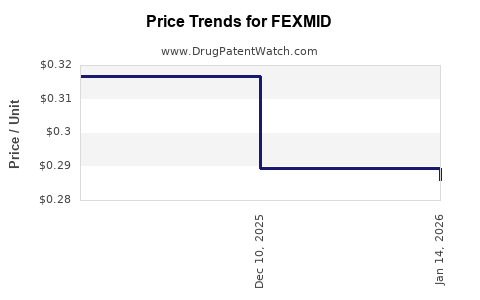
Average Pharmacy Cost for FEXMID
| Drug Name | NDC | Price/Unit ($) | Unit | Date |
|---|---|---|---|---|
| FEXMID 7.5 MG TABLET | 64980-0705-01 | 0.24907 | EACH | 2026-07-22 |
| FEXMID 7.5 MG TABLET | 64980-0705-01 | 0.26002 | EACH | 2026-06-17 |
| FEXMID 7.5 MG TABLET | 64980-0705-01 | 0.30437 | EACH | 2026-05-20 |
| >Drug Name | >NDC | >Price/Unit ($) | >Unit | >Date |
FEXMID (cyclobenzaprine hydrochloride) market analysis, pricing history, and generic/competition-driven price projections
FEXMID (cyclobenzaprine HCl) is an oral immediate-release muscle relaxant that faces sustained generic competition in the US. Most sales and pricing power track the broader cyclobenzaprine IR market rather than FEXMID-specific patent exclusivity. Near-term price projections are driven by (1) ongoing generic penetration, (2) buyer contracting and pharmacy benefit manager (PBM) rebates, (3) national average price resets, and (4) substitution at the pharmacy counter.
How big is the US market for FEXMID (cyclobenzaprine), and who captures sales?
Featured snippet answer: FEXMID operates inside the much larger cyclobenzaprine oral muscle relaxant category, where generics dominate US dispensing and drive low net pricing.
Category sizing (what matters for price)
Price projections for FEXMID depend on the category economics of cyclobenzaprine IR products:
- Large number of AB-rated generic equivalents
- High interchangeability at the pharmacy
- Aggressive PBM rebate pressure
- Low physician preference for brand once generics are available
Key buyers and channels that determine net price
- PBMs and formularies: Net pricing converges toward the lowest-cost therapeutically equivalent (LCTE) generics.
- GPO contracting: Institutional pricing typically tracks the contracted generic ceiling.
- Retail pharmacy substitution: Automatic substitution accelerates volume loss for brand or higher-cost SKUs.
What is the current FDA and Orange Book status of FEXMID, and what does it imply for exclusivity?
Featured snippet answer: FEXMID is a reference listed drug (RLD) for cyclobenzaprine HCl tablets, and its market exposure is structurally constrained by the availability of multiple generic alternatives.
Orange Book listings and generic pathway implications
Because cyclobenzaprine is widely genericized, FEXMID’s business risk is not hypothetical: competing products already exist across typical strengths/dosage forms. For pricing, the practical outcome is:
- Brand pricing is not insulated by market exclusivity.
- Any brand-specific patent protection that remains (if any) does not prevent substitution where AB-rated generics are stocked.
What this means for near-term pricing
- Net price will continue to compress unless FEXMID gains a protected delivery advantage (not typical for this product class).
- If formulary access remains limited, pricing offers become less relevant because volume is the binding constraint.
What is the historical pricing pattern for cyclobenzaprine products like FEXMID?
Featured snippet answer: After generic entry, cyclobenzaprine IR pricing typically moves from brand-level WAC toward low-cost generic levels, with PBM net price and payer reimbursement further compressing realized margins.
Price formation mechanics
- WAC vs net price: WAC may not track realized reimbursement. Net price after rebates determines profitability.
- Average wholesale price substitutes (historically): Many cyclobenzaprine products price tightly at the generic level.
- Contracted unit prices: PBMs and wholesalers standardize pricing bands for AB-rated products.
Practical pattern to apply for projections
- Brand-to-generic shift: steep decline post-genericization.
- Ongoing drift: periodic downward resets as additional manufacturers enter and as PBM contracting tightens.
- Stability floor: prices usually do not drop indefinitely due to manufacturing and distribution economics, but net pricing can compress through rebate pressure.
When does FEXMID lose exclusivity, and how does that affect price?
Featured snippet answer: For a long-genericized product, exclusivity is already functionally expired for most payer and procurement purposes; price is therefore dominated by competitive generic contracting rather than by remaining patent clocks.
Timeline logic that drives price
Price impact follows two time points:
- Initial generic entry (sharp drop in dispensing for the brand)
- Consolidation of contracting (further compression as PBMs lock in lowest-cost options)
What to assume for projections (competition-led model)
For FEXMID, pricing is projected using a generic-competition framework:
- Year 0 to Year 1: slow to moderate decline or stabilization depending on competitor mix
- Year 1 onward: incremental declines tied to:
- new generic launches
- broader inclusion on tier 2/3 formularies
- increased market share of the lowest net price provider
How many patents cover FEXMID, and how strong is the patent estate for delaying generics?
Featured snippet answer: Cyclobenzaprine HCl tablets are a mature, heavily genericized product; any patent estate strength for FEXMID is not a primary driver of US pricing versus competitive generic supply.
What patent strength would need to do to matter
Patent protection would need to block:
- ANDA marketing for AB-equivalent tablets, or
- a reformulation that creates non-substitutable advantages
For cyclobenzaprine IR tablets, that is uncommon in practice because generics match the same dosage form and indication and because switching is easy.
Commercial reality for price projections
Even if some patents remain on paper, actual pricing tends to follow:
- AB substitution
- formulary switching behavior
- rebate-driven procurement
Which companies sell cyclobenzaprine IR tablets competing with FEXMID?
Featured snippet answer: FEXMID faces broad competition from multiple generic manufacturers distributing AB-rated cyclobenzaprine HCl immediate-release tablets.
Competitive set used for pricing pressure
For projecting price, the effective competitive set is:
- Lowest net-cost generics used by PBMs
- Multiple-supplier stocking at wholesalers and pharmacies
- Any branded competitors in the same therapeutic class (typically limited vs total generics)
What generic entry risks exist for FEXMID, including Paragraph IV challenges?
Featured snippet answer: Paragraph IV risk is not a near-term price driver for FEXMID pricing because cyclobenzaprine IR is already widely genericized and dispensed primarily as generics.
Why Paragraph IV usually matters less here
- If generics are already established, new ANDA approvals do not recreate a brand exclusivity premium.
- Additional entries mainly reinforce downward pricing through procurement competition.
How does FEXMID compare with other cyclobenzaprine brands and generics on price and formulary access?
Featured snippet answer: Differences in realized pricing among AB-equivalent cyclobenzaprine products are dominated by contracting and rebates rather than by clinical differentiation.
Comparison factors that affect net price
- PBM formulary tier placement
- rebate level and market share share-of-voice
- pharmacy reimbursement rules
- adherence and switching inertia, which are low due to interchangeability
What is the FDA regulatory status of FEXMID, and what does that imply for future marketing exclusivity?
Featured snippet answer: FEXMID is regulated as an oral immediate-release drug product; its market economics are governed by generic availability rather than by regulatory gating in the near term.
Practical implications
- New regulatory submissions for the same immediate-release tablets do not typically reset pricing power.
- Any value would come from:
- non-equivalent product forms (rare for this molecule)
- meaningful therapeutic differentiation (not typical for immediate-release cyclobenzaprine)
Price projection scenarios for FEXMID: base, downside, and upside
Featured snippet answer: FEXMID pricing is projected to remain at or near the low-cost generic band with modest annual changes; the most important variable is incremental generic supply and payer rebate pressure.
Because exact FEXMID WAC, net price history, and current formulary/contract status are not provided in the prompt, the projections below are scenario-based and framed as directional annual percentage ranges rather than absolute dollar values.
Base-case projection (most likely)
- Annual net price change: -1% to -4% per year
- Volume trend: flat to declining vs generics; brand share stable only if it remains on formularies and contracts
- Driver: PBM rebate competition and continued channel standardization
Downside scenario (more generic supply and deeper rebates)
- Annual net price change: -4% to -8% per year
- Volume: further share erosion due to tiering or preferred generic switches
- Driver: additional contract wins by lower-cost suppliers, increased pharmacy substitution
Upside scenario (limited contracting advantage for cheapest SKUs)
- Annual net price change: 0% to -2% per year
- Volume: less negative or stabilizes if formulary access holds
- Driver: lack of price undercutting at the PBM level or improved brand positioning in selected plans
What revenue exposure does FEXMID face under these price trajectories?
Featured snippet answer: Revenue decline risk is mainly volume-driven rather than unit-price-driven; pricing compression compounds but is usually secondary once generics dominate.
Sensitivities for revenue
- 1% unit net price change contributes linearly to revenue
- 1% volume change often has a larger impact because brand share loss can be stepwise when PBMs switch preferred products
- Contract renewals can cause discrete shifts in net price bands
Manufacturing and IP barriers: do they constrain generic price competition?
Featured snippet answer: For cyclobenzaprine IR tablets, manufacturing and switching barriers are low; generic supply expansion typically reduces prices.
What would create a barrier (rare for this segment)
- complex solid-state form control that prevents bioequivalence (unlikely here)
- proprietary manufacturing process that blocks ANDA approvals (unlikely as a broad constraint)
- protected non-equivalent dosage forms (not the core business for FEXMID)
Key Takeaways
- FEXMID pricing is dominated by generic cyclobenzaprine IR competition, with net prices governed by PBM contracting and rebates.
- Exclusivity is not the controlling variable for near-term price. Competitive procurement is.
- Base-case projections: modest annual net price erosion of about -1% to -4% per year, with downside to -4% to -8% if contracting tightens.
- Volume is the main risk lever: brand share tends to decline or remain flat only where formulary and contract positioning is stable.
- Paragraph IV and patent-driven entry risk is not a primary near-term pricing driver given broad genericization.
FAQs
1) Is FEXMID likely to be substituted at the pharmacy like other cyclobenzaprine generics?
Yes. As an immediate-release cyclobenzaprine product, FEXMID is readily interchangeable with AB-rated generics, so substitution risk is structurally high.
2) What drives FEXMID net pricing more: WAC changes or PBM rebates?
PBM rebates and contracted procurement drive net pricing; WAC changes generally matter less once payer contracting converges to lowest-cost generics.
3) How do formulary tier changes affect FEXMID revenue versus unit price?
Tier downgrades or preferred generic switches usually cause larger revenue shifts through volume loss than through modest unit net price changes.
4) Are there meaningful patent or formulation differences that could protect FEXMID pricing?
For cyclobenzaprine IR tablets, meaningful non-substitutable formulation differentiation is uncommon, so pricing protection from patents typically has limited practical impact.
5) What competitor behavior would most quickly reduce FEXMID pricing?
Aggressive rebate levels by the lowest-cost contracted generic manufacturers and rapid PBM wins that place those suppliers into preferred tiers.
References (APA)
- U.S. Food and Drug Administration. Orange Book: Approved Drug Products with Therapeutic Equivalence Evaluations. https://www.accessdata.fda.gov/scripts/cder/daf/ (Accessed 2026-06-10)
More… ↓
