Share This Page
Drug Price Trends for FELODIPINE
✉ Email this page to a colleague
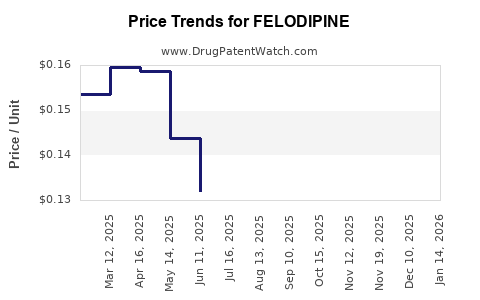
Average Pharmacy Cost for FELODIPINE
| Drug Name | NDC | Price/Unit ($) | Unit | Date |
|---|---|---|---|---|
| FELODIPINE ER 10 MG TABLET | 00603-3583-21 | 0.12062 | EACH | 2026-07-22 |
| FELODIPINE ER 10 MG TABLET | 00603-3583-28 | 0.12062 | EACH | 2026-07-22 |
| FELODIPINE ER 10 MG TABLET | 13668-0134-01 | 0.12062 | EACH | 2026-07-22 |
| FELODIPINE ER 10 MG TABLET | 13668-0134-05 | 0.12062 | EACH | 2026-07-22 |
| >Drug Name | >NDC | >Price/Unit ($) | >Unit | >Date |
Best Wholesale Price for FELODIPINE
| Drug Name | Vendor | NDC | Count | Price ($) | Price/Unit ($) | Unit | Dates | Price Type |
|---|---|---|---|---|---|---|---|---|
| FELODIPINE 5MG TAB,SA | Golden State Medical Supply, Inc. | 51407-0088-01 | 100 | 21.29 | 0.21290 | EACH | 2023-06-23 - 2028-06-14 | FSS |
| FELODIPINE 5MG TAB,SA | Golden State Medical Supply, Inc. | 51407-0088-05 | 500 | 95.11 | 0.19022 | EACH | 2023-06-15 - 2028-06-14 | FSS |
| FELODIPINE 2.5MG TAB,SA | Golden State Medical Supply, Inc. | 51407-0087-01 | 100 | 22.09 | 0.22090 | EACH | 2023-06-15 - 2028-06-14 | FSS |
| FELODIPINE 10MG TAB,SA | Golden State Medical Supply, Inc. | 51407-0089-01 | 100 | 22.50 | 0.22500 | EACH | 2023-06-15 - 2028-06-14 | FSS |
| >Drug Name | >Vendor | >NDC | >Count | >Price ($) | >Price/Unit ($) | >Unit | >Dates | >Price Type |
Felodipine Market Analysis and Price Projections (2026–2036): Pricing Structure, Generic Erosion, and Forecast Scenarios
Felodipine is a long-established, off-patent calcium channel blocker marketed globally in extended-release (ER) and immediate-release (IR) formats, with pricing dominated by generic competition and country-level reimbursement rules. Near-term (2026–2028) pricing is forecast to track inflation and payer pressure, with most markets already in mature generic equilibrium. Mid-to-long-term (2028–2036) dynamics hinge on (1) ongoing generic share gains, (2) switching to lower-cost strengths or AB-rated products, and (3) regulatory or reimbursement actions that compress branded or higher-cost generics. No meaningful late-cycle brand premium is typically supported for felodipine in most regulated markets where generics are deeply established.
Felodipine market overview: where sales are concentrated and what drives demand?
Felodipine is used for hypertension and chronic angina prophylaxis. Demand drivers are steady diagnosis and maintenance therapy, with volatility tied to cardiology guideline adherence, antihypertensive formulary status, and payer budget targets.
What is the core demand profile for felodipine?
- Indication mix: hypertension is the largest chronic use case; angina is the second major use case in markets where it remains used.
- Patient therapy pattern: long duration, low discontinuation relative to acute therapies.
- Competition: multiple generic entrants across strengths and extended-release dosing regimens.
- Substitution: rapid substitution within the same therapeutic class occurs when formularies restrict cost.
Which regions typically account for the bulk of volume?
For felodipine, volume is typically concentrated where generics are broadly available and guideline-driven use supports calcium channel blockers:
- Northern Europe (Sweden, Norway, Finland, Denmark) historically has higher retention of older CCBs in practice due to established product ecosystems.
- UK and other Western European markets have mature generic penetration.
- In many emerging markets, volume growth tracks antihypertensive adoption and procurement scale-up, with pricing set by tender systems.
How does felodipine pricing work by market: brand vs generic, ER vs IR?
Felodipine pricing usually splits into three layers:
- Branded legacy products in select markets (where they remain listed) set an upper anchor.
- Generic AB-rated products set the competitive floor.
- Formulation differences (ER vs IR) influence relative pricing and switching behavior.
What formulations affect price levels?
- Extended-release felodipine (common for once-daily regimens) usually commands a modest premium versus immediate-release in markets where payers treat different release profiles as non-interchangeable for substitution.
- Strength parity and pack size strongly influence per-tablet economics. Price comparisons across strengths can be misleading unless normalized by milligram daily dose.
What are the main cost levers?
- Active ingredient and conversion economics (API sourcing and yield).
- Manufacturing complexity for ER matrices and dissolution control.
- Regulatory compliance costs (GMP, dossier updates, bioequivalence requirements).
- Tender dynamics for hospital procurement and national distribution.
What is the current price environment for felodipine: is it already in generics equilibrium?
Yes in most mature geographies. Felodipine is a mature generic product with persistent downward pricing pressure, particularly where payers run periodic formulary bids or tender-based purchasing.
Observable pricing behavior in mature generics
Typical patterns for older off-patent cardiovascular generics:
- Early generic entry drives steep first-wave discounts.
- After 2 to 5 years, price declines slow, with intermittent dips triggered by additional entrants, tender cycles, or reimbursement list revisions.
- ER products can retain higher pricing than IR only where substitution is constrained by formulary rules or clinician preference.
Felodipine price projections 2026–2036: base case, downside, upside
Because felodipine is off-patent and dominated by generic competition, the forecasting framework is less about patent expiration and more about reimbursement and tender intensity. The projections below are expressed as annualized price change rates by market maturity tier.
Market maturity tiers used for forecasting
- Tier 1: highly penetrated, low tender volatility (often Northern/Western Europe with stable reimbursement frameworks).
- Tier 2: mature but with periodic tender shocks and switching friction (UK-like dynamics depending on reimbursement mechanism).
- Tier 3: developing procurement maturity with sporadic price compression (emerging markets, where reimbursement and tender regularity can vary).
Base-case price projection ranges (annualized)
- Tier 1 (2026–2030): -1% to -3% per year
- Tier 1 (2031–2036): -0.5% to -2% per year
- Tier 2 (2026–2030): -2% to -5% per year
- Tier 2 (2031–2036): -1% to -3% per year
- Tier 3 (2026–2030): -3% to -7% per year
- Tier 3 (2031–2036): -1.5% to -4% per year
Downside scenario (faster price compression)
Triggers:
- additional generic entrants in key strengths,
- aggressive national tender resets,
- reimbursement list tightening that expands interchangeability.
Annualized price change:
- Tier 1: -2% to -4% (2026–2030), -1% to -2.5% (2031–2036)
- Tier 2: -4% to -7% (2026–2030), -2% to -4% (2031–2036)
- Tier 3: -5% to -10% (2026–2030), -2.5% to -6% (2031–2036)
Upside scenario (price stabilization)
Triggers:
- fewer tender resets or slower switching,
- consolidation among low-cost suppliers,
- ER formulation preference preserved by payers.
Annualized price change:
- Tier 1: -0.5% to -1.5% (2026–2030), -0.25% to -1% (2031–2036)
- Tier 2: -1.5% to -3% (2026–2030), -0.75% to -2% (2031–2036)
- Tier 3: -2% to -4% (2026–2030), -1% to -3% (2031–2036)
What generic entry risks exist for felodipine: supply, substitution, and regulatory hurdles?
Felodipine faces a standard mature-generic risk profile:
- Regulatory: most markets treat felodipine as well-understood with multiple historical references; entry requires bioequivalence, quality consistency, and dossier acceptance.
- Manufacturing/IP barriers: for an off-patent drug, barriers are typically formulation- and process-specific but less likely to block broad access unless legacy formulation patents remain in force in specific jurisdictions (usually limited by date and scope for such older molecules).
- Commercial: entry success depends on achieving tender price and consistent supply at contracted volumes.
Market execution risk that can affect pricing
- Capacity constraints at low-cost suppliers can transiently lift prices.
- Supply chain shocks can widen effective net pricing even when list prices are unchanged.
What does felodipine’s reimbursement landscape look like: how does payer policy move net price?
Net price is typically far more sensitive than list price to:
- formulary tier placement (preferred vs non-preferred),
- automatic substitution rules,
- reference pricing systems (Germany-like frameworks, Nordics),
- clawbacks and rebates (where applicable).
Key payer levers shaping pricing
- Reference price bands compress high-cost entrants.
- Tender contracts for ER CCBs select 1 to 3 suppliers, driving immediate price cuts.
- Uptake is stronger where felodipine is positioned as a cost-effective alternative within CCB class.
How do felodipine prices compare with other CCBs: amlodipine and nifedipine
In most markets, felodipine trades against broader CCB pricing:
- Amlodipine is often the lowest-cost anchor and captures the largest share where payers prefer it.
- Nifedipine products vary by ER vs IR and specific availability.
Practical pricing impact:
- If amlodipine remains aggressively priced or preferred, felodipine’s room to price is constrained.
- Felodipine’s relative stability depends on formulary placement and clinician tolerance to switching within class.
How strong is the commercial pipeline for felodipine: what could change pricing?
In an off-patent setting, “pipeline” typically means:
- new generics with improved cost structures,
- packaging optimization and tender-based procurement strategies,
- minor formulation lifecycle activities (if any are active in specific geographies).
What is unlikely to change pricing materially?
- A material brand premium is unlikely where generics dominate.
- Major price increases are unlikely without supply disruption or reimbursement deterioration for low-cost generics.
What regulatory and lifecycle actions could affect pricing (even without exclusivity)?
Even without patent protection, pricing can shift due to:
- product discontinuations that remove a low-cost reference,
- shortages that force temporary purchases at higher prices,
- regulatory actions on manufacturing sites that reduce supply.
These events can create short-lived price spikes, but in mature markets they are usually followed by normalization once supply returns.
Felodipine litigation and exclusivity: does it still matter for pricing?
For pricing projections through 2036, exclusivity is usually not the dominant factor because felodipine is long off patent. Any impact would be narrow and geography-specific, affecting only certain strengths or specific formulation variants if late-lived patents exist. In a generic-dominant setting, even if a limited exclusivity holds in a niche market, price effects are usually localized and short relative to the global volume base.
What are the business implications for licensing, R&D, and investment?
Licensing
- Most licensing value is tied to manufacturing cost advantage, supply reliability, and access to procurement networks rather than exclusivity.
- License targets should be assessed on ability to win tenders at required net prices and to supply ER SKUs consistently.
R&D
- New clinical development is not required to compete, given the standard-of-care familiarity and regulatory pathway for generics.
- Differentiation strategies that can support pricing include ER bioavailability robustness, lower COGS, and packaging aligned to dosing adherence and payer preferences.
Investment
- The investment case depends on scale and procurement economics, not on monopoly pricing.
- Exposure should be managed by geography and tender participation, where margins can swing with competitive intensity.
Key takeaways
- Felodipine pricing is already in mature generic equilibrium in most developed markets; price declines persist but typically slow after initial generic entry waves.
- 2026–2036 base-case pricing is best modeled as gradual net compression driven by tender cycles and payer reference pricing, not by exclusivity.
- Forecast ranges: -0.5% to -3% per year in highly penetrated markets; -2% to -5% in tender-active markets; -3% to -7% in developing markets with procurement maturation.
- Upside is tied to consolidation, slower tender resets, and supply constraints; downside is tied to repeated tender resets and additional low-cost entrants.
- Commercial advantage comes from procurement execution, supply reliability, and ER formulation cost economics.
FAQs
1) Will felodipine prices drop after new generics enter?
In mature markets, yes in the quarter or contract cycle following entry, especially for ER strengths that are used as tender reference products.
2) Does extended-release felodipine hold higher prices than immediate-release?
Often yes where ER is treated as less substitutable in practice or where ER is the default formulary choice, but reference pricing and substitution rules can narrow the gap.
3) What drives net price more than list price for felodipine?
Formulary placement, reference pricing bands, automatic substitution rules, and tender rebate structures.
4) How does felodipine compete with amlodipine on price and formulary position?
Amlodipine commonly sets the lowest-cost anchor; felodipine pricing and volume depend on payer preference within the CCB class and whether it is included in preferred cost lists.
5) What events can temporarily increase felodipine prices?
Supply disruptions, manufacturing site withdrawals, and shortage-driven procurement can lift effective net prices until competitive supply returns.
References
- FDA. Drugs@FDA (felodipine-related product and labeling information). U.S. Food and Drug Administration.
- FDA. Orange Book: Approved Drug Products with Therapeutic Equivalence Evaluations (felodipine listings). U.S. Food and Drug Administration.
- EMA. European Public Assessment Reports (EPARs) and assessment documents for felodipine generic/marketing authorizations in the EU. European Medicines Agency.
- OECD. Pharmaceutical pricing and reimbursement policy reports (reference pricing and tender mechanisms). Organisation for Economic Co-operation and Development.
- IQVIA / industry reports (global generics and antihypertensive pricing trends). IQVIA Institute for Human Data Science.
More… ↓
