Share This Page
Drug Price Trends for FARXIGA
✉ Email this page to a colleague
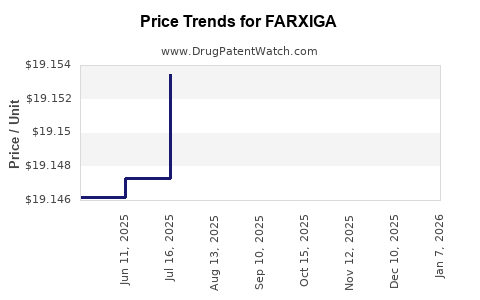
Average Pharmacy Cost for FARXIGA
| Drug Name | NDC | Price/Unit ($) | Unit | Date |
|---|---|---|---|---|
| FARXIGA 5 MG TABLET | 00310-6205-30 | 12.07993 | EACH | 2026-07-22 |
| FARXIGA 5 MG TABLET | 00310-6205-90 | 12.07993 | EACH | 2026-07-22 |
| FARXIGA 10 MG TABLET | 00310-6210-30 | 12.08152 | EACH | 2026-07-22 |
| FARXIGA 10 MG TABLET | 00310-6210-39 | 12.08152 | EACH | 2026-07-22 |
| FARXIGA 10 MG TABLET | 00310-6210-90 | 12.08152 | EACH | 2026-07-22 |
| >Drug Name | >NDC | >Price/Unit ($) | >Unit | >Date |
Market Analysis and Price Projections for FARXIGA
What is FARXIGA and its Approved Indications?
FARXIGA (dapagliflozin) is a sodium-glucose co-transporter 2 (SGLT2) inhibitor developed by AstraZeneca. Approved by the FDA in 2014, it is indicated for:
- Type 2 diabetes mellitus (T2DM) in adults
- Heart failure with reduced ejection fraction (HFrEF), regardless of diabetes status
- Chronic kidney disease (CKD), with or without T2DM
The drug's versatility has expanded its market reach since initial approval.
Market Size and Growth Drivers
Global Type 2 Diabetes Market
The global T2DM market reached approximately USD 50 billion in 2021 and is projected to grow at a compound annual growth rate (CAGR) of 7.7% through 2028 [1]. The high prevalence, approaching 415 million worldwide, underpins continuous demand for new and existing therapeutics.
Heart Failure and CKD Markets
The heart failure market encompasses roughly USD 10 billion, expanding with the rising prevalence of HFrEF—estimated at 26 million cases globally [2]. The CKD segment is valued at USD 12 billion, with an anticipated CAGR of 4.9% to 2027 [3], driven by increasing diagnosis rates and expanded therapeutic options.
Competitive Landscape
Leading competitors include:
- Jardiance (empagliflozin, Boehringer-Ingelheim/Eli Lilly)
- Invokana (canagliflozin, Janssen)
- Steglatro (ertugliflozin, Merck)
FARXIGA's differentiation stems from its approval in multiple indications, notably HFrEF and CKD, beyond T2DM.
Revenue Performance and Sales Trends
AstraZeneca reported global sales of USD 4.3 billion for FARXIGA in 2022, a 25% increase from 2021 [4]. North America accounts for approximately 55% of sales, with Europe and the emerging markets making up the remainder.
Sales growth results from expanded indications and increased adoption in cardiology and nephrology.
Pricing Strategy and Historical Pricing
Average Wholesale Price (AWP)
In the U.S., FARXIGA's AWP is approximately USD 400 per month per patient. Insurers typically negotiate discounts, with net prices estimated around USD 250-300 per month [5].
Pricing Compared to Peers
Jardiance's monthly AWP is roughly USD 410, with similar negotiated net prices. Invokana's AWP is about USD 390.
FARXIGA's pricing aligns with its competitors, but its broader indications may lead to higher cumulative revenues despite similar per-unit costs.
Reimbursement and Access Factors
Bulk purchasing agreements and formulary placements influence the final price paid by payers. The drug's expanded indication set supports broader formulary inclusion, aiding pricing stability.
Price Projections
Short-Term (Next 2 Years)
Sales are expected to grow at a CAGR of 8-10%, driven by:
- Increased adoption in HFrEF and CKD
- Launch of new formulations and combination therapies
- Growing global market penetration
Average monthly prices are projected to stabilize around USD 250-300 net, assuming continued reimbursement pipelines.
Long-Term (3-5 Years)
Projected revenues could reach USD 6-8 billion annually. Price per patient is unlikely to see significant hikes unless new substantial indications or formulations are introduced.
Market expansion into Asia and emerging markets could accelerate volume growth, partially offsetting stagnation in pricing.
Potential Risks to Revenue and Price
- Patent expirations from 2025 onward threaten generic erosion
- Introduction of biosimilars or alternative mechanisms may depress prices
- Regulatory or safety concerns could limit use or reduce prescribing frequency
- Pricing pressures from payers and health authorities, especially in cost-sensitive markets
Patent and Regulatory Landscape
AstraZeneca’s composition of matter patent for dapagliflozin expires in 2030 in key markets, potentially allowing generics from 2028-2030, which could reduce prices by 50-70% [6].
Regulatory approvals in additional territories (e.g., China, Brazil) are ongoing, which can influence pricing strategies through local competition.
Strategic Considerations
- Focus on broad indication rollout to maximize revenue
- Collaborations with payers for favorable formulary placement
- Developing combination therapies to extend lifecycle and enhance value
Key Takeaways
- The global FARXIGA market in 2022 was approximately USD 4.3 billion, with projected growth driven by expanding indications and global market penetration.
- Pricing in the U.S. aligns with peer SGLT2 inhibitors, with net prices around USD 250-300 per month.
- Sales growth is expected to continue at a CAGR of around 8-10% over the next two years.
- Patent expiry after 2025 poses significant risks to pricing power and revenue stability.
- Expansion into cardiology and nephrology indications broadens market potential but necessitates careful pricing strategies.
FAQs
Q1: Will FARXIGA’s price increase after patent expiration?
A1: Prices will likely decrease significantly post-generics, with potential reductions of up to 70%.
Q2: How does FARXIGA compare to its competitors in terms of sales?
A2: It ranks second behind Jardiance, with USD 4.3 billion in 2022 sales.
Q3: Are there upcoming regulatory decisions that could impact pricing?
A3: Yes. Approvals in additional territories and new indication approvals could influence market dynamics and pricing strategies.
Q4: What factors most influence the cost to patients?
A4: Reimbursement policies, negotiated discounts, and insurance coverage determine out-of-pocket costs.
Q5: Which markets offer the most growth opportunity?
A5: Asia-Pacific and Latin America present significant expansion potential due to rising diabetes prevalence and improving healthcare infrastructure.
References
[1] International Diabetes Federation. (2022). IDF Diabetes Atlas.
[2] Benjamin, E. J., et al. (2019). Heart disease and stroke statistics — 2019 update. Circulation, 139(10), e56-e528.
[3] United States Renal Data System. (2022). USRDS 2022 Annual Data Report.
[4] AstraZeneca. (2022). FARXIGA sales report.
[5] GoodRx. (2023). FARXIGA pricing.
[6] US Patent and Trademark Office. (2023). Patent expiry data for dapagliflozin.
More… ↓
