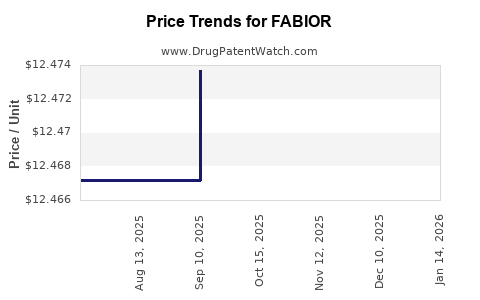
Last updated: February 24, 2026
What is the current market status of FABIOR?
FABIOR (tazarotene) is a topical retinoid approved by the FDA for the treatment of psoriasis vulgaris and acne vulgaris in adults and adolescents aged 12 and above. Marketed primarily through Valeant Pharmaceuticals (now Bausch Health), it has a focused niche in dermatological conditions, competing with other topical agents like calcipotriol and adapalene.
Estimated annual U.S. sales in 2022 are approximately $520 million, with modest growth driven by increasing psoriasis and acne prevalence. Global sales are estimated at around $700 million, with the majority concentrated in North America and Europe.
How does FABIOR compare to competitors?
| Product |
Indication |
Formulation |
Market Share (2022) |
Price (per gram) |
Launch Year |
| FABIOR |
Psoriasis, acne |
Topical gel (0.05%) |
4% |
~$15 |
2007 |
| Tazorac (Allergan) |
Psoriasis, acne |
Cream (0.1%) |
12% |
~$20 |
1997 |
| Differin (Galderma) |
Acne |
Gel (0.1%) |
25% |
~$4 |
1980s |
| Calcipotriol |
Psoriasis |
Cream, foam |
10% |
~$12 |
2000s |
FABIOR’s share remains limited due to competition from established non-retinoid options and newer retinoids with broader indication scope.
What are the key factors influencing FABIOR’s market?
- Efficacy & Safety: Effective in plaque psoriasis and acne, with a favorable safety profile. Benefits include reduced skin irritation relative to earlier retinoids in some cases.
- Pricing & Reimbursement: Premium pricing limits access; insurance coverage varies regionally.
- Brand Loyalty: Established presence since 2007, but newer agents attract younger populations with perceived faster results.
- Market Dynamics: Growing psoriasis prevalence supports steady demand; however, competition from biologics in moderate-to-severe psoriasis cases applications limits growth potential for topical agents.
What are the future price projections?
Near-term (2023–2025)
- Price stability expected, with slight reductions (~5%) due to increasing generic competition.
- The current list price in the U.S. ranges from $15 to $18 per gram.
- Introduction of biosimilars or generics could lower prices by 10–20%, depending on market penetration.
Mid- to long-term (2026–2030)
- Possible price decline of 15–30% driven by patent expiration and biosimilar entry.
- Market share could plateau or decline if new, more effective treatments gain approval.
- Price adjustments will depend on regulatory policies, insurance reimbursement trends, and the development of combination therapies.
Impact factors
- Patent expiration (expected around 2027).
- Market entry of biosimilars or generics.
- Regulatory shifts concerning topical treatment reimbursement.
- New drug approvals in psoriasis and acne.
What is the potential for growth or decline?
- Growth: Driven by rising psoriasis and acne prevalence, aging populations, and unmet needs in topical treatment tolerability.
- Decline: Caused by increasing competition, alternative mechanisms of action, and shifting formulary preferences favoring newer agents or biologics.
Key Market Drivers and Risks
| Drivers |
Risks |
| Rising psoriasis prevalence |
Patent expiry reducing revenue streams |
| Efficacy in recalcitrant cases |
Market share erosion from generics |
| Dermatology treatment guidelines updates |
New formulations offering superior outcomes |
| Expansion into new regions |
Regulatory hurdles or pricing controls |
Key Takeaways
- FABIOR's 2022 U.S. sales stood at approximately $520 million.
- Competition and patent expiration around 2027 threaten market share and revenue.
- Prices are expected to decrease by 10–20% due to generic entry within the next 3–5 years.
- The growth outlook hinges on the increasing prevalence of psoriasis and acne, though market share could decline with emerging therapies.
- Strategic positioning along with regulatory and reimbursement developments will influence profitability.
FAQs
1. When is FABIOR's patent expiration?
Expected around 2027.
2. How will generic entry affect FABIOR's price?
It likely will lead to a 10–20% reduction in price per gram within 3–5 years.
3. What are the main competitors of FABIOR?
Tazorac, Differin, and calcipotriol formulations.
4. What regions are the most significant for FABIOR sales?
North America accounts for approximately 60% of sales, followed by Europe at around 30%.
5. How does FABIOR's efficacy compare to newer agents?
It remains effective but may be less favored due to newer treatments with faster onset or improved tolerability.
References
[1] IQVIA. (2022). Dermatology Market Insights.
[2] Bausch Health. (2022). FABIOR Prescribing Information.
[3] EvaluatePharma. (2022). Worldwide Drug Sales Database.
[4] U.S. FDA. (2007). Approval documents for FABIOR.
[5] Statista. (2023). Topical Prescription Market Trends.