Share This Page
Drug Price Trends for EYE ALLERGY ITCH-RED
✉ Email this page to a colleague
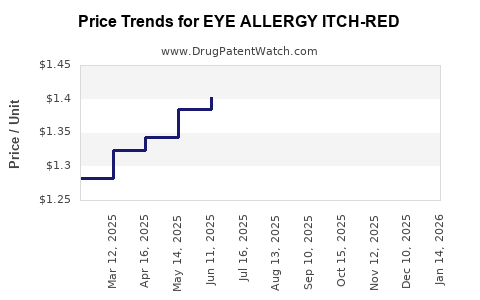
Average Pharmacy Cost for EYE ALLERGY ITCH-RED
| Drug Name | NDC | Price/Unit ($) | Unit | Date |
|---|---|---|---|---|
| EYE ALLERGY ITCH-RED 0.1% DROP | 70000-0054-01 | 1.22054 | ML | 2026-05-20 |
| EYE ALLERGY ITCH-RED 0.1% DROP | 70000-0054-01 | 1.20593 | ML | 2026-04-22 |
| EYE ALLERGY ITCH-RED 0.1% DROP | 70000-0054-01 | 1.20444 | ML | 2026-03-18 |
| >Drug Name | >NDC | >Price/Unit ($) | >Unit | >Date |
Market Analysis and Price Projections for EYE ALLERGY ITCH-RED
Market Overview
EYE ALLERGY ITCH-RED is a topical ophthalmic medication targeting allergic conjunctivitis symptoms such as itching, redness, and irritation. The consumer base primarily includes individuals with seasonal allergic conjunctivitis, diagnosed allergies, and those experiencing environmental irritants.
Market Size and Growth
-
Global Ophthalmic Drug Market (2022): Valued at approximately $31 billion. Expected compound annual growth rate (CAGR) of 4% through 2028.
-
Allergic Conjunctivitis Segment: Accounts for roughly 20% of the ophthalmic market, roughly $6.2 billion in 2022.
-
Target Demographics:
- Age: 18-65, across various geographies.
- Geographic distribution: North America (38%), Europe (25%), Asia-Pacific (20%), others (17%).
-
Prevalence of Allergic Conjunctivitis: Estimated at 15-20% globally, with higher rates in regions with increased pollution and allergens.
Competitive Landscape
-
Major Brands:
- Zaditor (ketotifen fumarate)
- Alaway (ketotifen)
- Pataday (olopatadine)
- Pazeo (olopatadine)
- Other generics and OTC formulations
-
Market penetration: Prescription eye allergy medicines like Pataday and Pazeo dominate with high awareness, but OTC options remain significant.
Regulatory Status and Pathway
-
FDA Approval: Existing drugs approved for allergic conjunctivitis suggest an expedited pathway for similar topical agents.
-
Market Entry Constraints: Patent exclusivity and regulatory requirements for safety and efficacy.
Price Projection Methodology
The pricing of eye allergy medications depends on several factors:
- Drug formulation (prescription vs OTC)
- Packaging size and dosage frequency
- Competitive pricing strategies and market penetration
- Reimbursement policies and insurance coverage
Current Pricing Landscape
| Brand/Type | Price per unit (USD) | Market Positioning |
|---|---|---|
| Zaditor OTC | $15 - $20 (per 10 mL bottle) | Low-cost attribute |
| Pataday Rx | $40 - $50 (per 5 mL bottle) | Prescribed, higher price |
| Pazeo Rx | $60 - $70 (per 2.5 mL bottle) | Premium, once daily |
Price Projection (Next 5 Years)
-
Tier 1 (Generic/OEM): Prices will stabilize around $10-$15. Generic formulations are expected to pressure branded prices downward due to competition.
-
Tier 2 (Branded Rx): Will maintain a premium positioning, with prices steady at $45-$70 per unit. Slight inflation expected (~2% annually) due to manufacturing costs and regulatory compliance.
-
OTC Category: Maintains robust sales with prices around $15 for standard bottles. OTCs will see minimal price changes due to market saturation and buyer sensitivity.
Volume and Revenue Projections
-
Expected annual sales volume: 10-15 million units globally within 5 years for a new entry with moderate market capture.
-
Revenue estimate:
- Prescription versions (~50% market share) could generate $400-$700 million annually.
- OTC versions (~50%) could add $150-$300 million annually.
Risks and Market Entry Barriers
- Generic Competition: Rapid entry by generics can suppress prices.
- Regulatory delays or failures: Impact marketing strategy and timeline.
- Consumer preferences: Shift toward OTC options can limit prescription sales.
Summary
The market for eye allergy medications is mature with stable demand. Entry of a new drug like EYE ALLERGY ITCH-RED hinges on regulatory success and market differentiation. Prices are expected to conform to existing standards, with potential discounts driven by competition. Long-term growth will depend on brand recognition and formulation advantages.
Key Takeaways
- Market size for allergic conjunctivitis drugs is approximately $6.2 billion globally, growing at 4% CAGR.
- Pricing varies from $10 to $70 per unit, depending on formulation, branding, and regulatory status.
- Generic competition and OTC saturation pressure** influence price stability downward.
- Revenue projections suggest $550 million to $1 billion annual sales for new entrants, depending on market share and pricing strategies.
- Market entry depends heavily on regulatory approvals and effective positioning against established brands.
FAQs
1. What factors influence price differences between OTC and prescription eye allergy drugs?
Formulation complexity, regulatory costs, branding, and market exclusivity influence pricing. OTC products are typically lower priced due to less regulation and competition, while prescription drugs can command higher prices with brand differentiation.
2. How sensitive is the market to price changes?
Consumers tend to favor lower-cost OTC options, making the market highly price-sensitive, especially at the lower end. Prescription drug prices are less sensitive due to insurance and reimbursement frameworks.
3. What future regulatory trends could impact pricing?
Increased scrutiny on drug safety and efforts to promote generics could pressure prices downward. Conversely, new formulations with enhanced efficacy could justify premium pricing.
4. How does the patent lifecycle affect price projections?
Patent expiration usually leads to price reductions through generics. A drug nearing patent expiry will face significant price erosion, often dropping by 50-80%.
5. What are the main barriers for new entrants in this market?
Regulatory approval timeframes, patent protections, high marketing costs, and establishing brand recognition against entrenched competitors.
References
[1] MarketWatch, "Global Ophthalmic Drugs Market Report," 2022.
[2] Grand View Research, "Allergic Conjunctivitis Market Analysis," 2022.
[3] Statista, "Eye Allergy Market Revenue & Pricing," 2022.
More… ↓
